Spiking fuel costs may sound death knell for budget airlines. Would a federal bailout help?
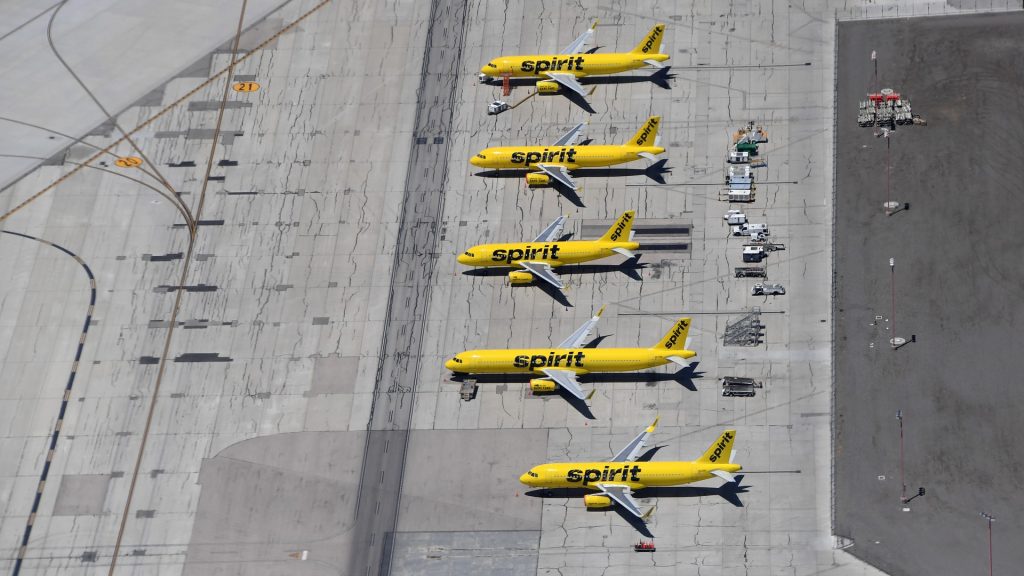
Travelers flying to or from Arnold Palmer Regional Airport in Latrobe, Pennsylvania, have just one option: Spirit Airlines. But the budget carrier, operating in bankruptcy, is likely to shut down unless it receives a government bailout — leaving places like Latrobe with no commercial air service.
“Losing them would be devastating,” Gabe Monzo, who runs Arnold Palmer Regional, told Straight Arrow.
Nevertheless, Monzo said, “if a federal subsidy just prolongs the inevitable, it’s time to move on.”
Monzo’s ambivalence reflects a larger debate as low-cost airlines like Spirit seek federal relief as surging jet fuel prices squeeze carriers already struggling with higher labor, aircraft and maintenance costs.
The airlines warn that without help, smaller cities like Latrobe could lose air service, and fares could rise for all travelers.
Meanwhile, American taxpayers facing higher costs of their own would not be eager to rescue private airlines yet again. Would another airline bailout protect competition and service, or become a losing investment for the public?
Budget airlines ask for billions in federal relief
A group of U.S. budget airlines, including Frontier and Avelo, is asking for $2.5 billion in government assistance in exchange for warrants that could give the government equity in the companies, The Wall Street Journal reported this week. That $2.5 billion figure reportedly represents how much their jet fuel costs exceed what the airlines had previously forecast and assumes the spike in oil prices caused by the war in Iran will continue.
“The White House is aware of outreach that was made by a group of budget airlines to the Department of Transportation,” White House spokesperson Kush Desai wrote to Straight Arrow. “The Administration continues to monitor the health of the U.S. aviation industry for passengers and airline employees.”
Desai added: “Unless an announcement is officially made by the Administration, however, any discussion about federal policymaking should be regarded as baseless speculation.”
The requests followed reports that the administration is considering giving Spirit a lifeline of up to $500 million in government-backed financing. Neither Spirit nor the administration commented to Straight Arrow about the possibility of a rescue package.
However, President Donald Trump has publicly floated the idea of helping the struggling carrier.
“I’d love to be able to save those jobs,” Trump told reporters last week. “I’d love to be able to save an airline.”
Trump himself bought a bankrupt airline in 1989 — which he relaunched and renamed the Trump Shuttle — in a venture that failed after about three years largely due to high debt and weak demand.
U.S. Transportation Secretary Sean Duffy delivered a different message than the president about Spirit Airlines.
“What we don’t want to do,” he told Reuters earlier this month, “is put good money after bad.”
Can budget airlines survive without a bailout?
Budget airlines are under mounting strain as fuel prices surge and other operating costs continue to rise. Experts said these carriers are struggling to compete with major airlines that offer more routes and fare options while possessing greater market power.
“In traditional times, when jet fuel prices have soared like this, we’ve seen a wave of mergers and acquisitions and bankruptcies in the airline industry,” said Clint Henderson, principal spokesperson for The Points Guy, a travel rewards website.
Henderson told Straight Arrow that the industry may now be at the beginning of that process, with “Spirit the first domino to fall, but probably not the last.”
Meanwhile, airfares are spiking. Nationwide, fares were up about 15% in March from a year earlier, according to Bureau of Labor Statistics data, with prices on some routes climbing even more sharply.
Higher prices could further dampen travel demand. Bureau of Transportation Statistics figures show Americans were already flying less in January, before the Iran war added new cost pressures.
Henderson said the latest oil shock could be the “nail in the coffin” for some carriers.
What happens when budget airlines disappear?
Experts said if low-cost airlines like Spirit, Frontier and Avelo disappear, airfares could climb higher and smaller cities will lose flight access.
“Everybody loves to hate on the low-cost carriers until they go out of business, and then fares go up across the board,” said Henderson.
For example, when Spirit stopped serving the Minneapolis-St. Paul International Airport in December 2025, Delta hiked prices for flights leaving from that airport by about 50% “almost overnight,” said Henderson.
Delta did not immediately respond to Straight Arrow’s request for comment.
Henderson said airfares also shot up in Butte, Montana, after Allegiant Air, another small low-cost carrier, stopped serving that city’s airport.
According to data from The Points Guy, it is now cheaper to fly from New York to many European cities than from Las Vegas to Washington, D.C., or from parts of Montana to New York.
Courtney Goff, a spokesperson for Avelo Airlines, declined to comment on reports Avelo has asked for federal relief.
However, “we emphatically agree that a healthy airline industry with strong competition is important to the U.S. economy, especially during this period of high fuel prices,” Goff said.
As the country’s smallest and newest airline, Goff said, Avelo’s “focus on underserved airports gives millions of U.S. consumers low-fare nonstop air service options they otherwise would not have.”
Avelo drew criticism last year for operating deportation flights for the U.S. Immigration and Customs Enforcement out of Mesa, Arizona, beginning in May 2025.
Avelo declined to comment about these flights to Straight Arrow. But, according to Reuters, the carrier ended its participation in the ICE program in January because the “short-term benefits” of operating these flights did not provide enough predictable revenue to offset their “operational complexity and costs.”
Are airline bailouts a good use of taxpayer dollars?
While budget airlines can open the skies for some travelers, it is far from clear that a taxpayer investment would pay off.
American taxpayers already provided roughly $59 billion in relief to the domestic airline industry during the COVID-19 pandemic in 2020 and 2021 through the U.S. Treasury Department’s Payroll Support Program. While the program was primarily designed to keep airline workers employed, the Treasury said it recouped only $556 million from the sale of airline warrants — just a fraction of what taxpayers doled out.
Another attempt to bail out these airlines might be futile and wasteful, said Henderson, from The Points Guy.
“The low-cost carrier model appears to be completely busted right now,” he said.
Spirit lost billions of dollars even before the Iran war sent fuel prices soaring. “If Spirit can’t run its own airline profitably,” Henderson said, “how is the U.S. government supposed to do it?”
Propping up struggling airlines with federal dollars, he added, “might just put a Band-Aid on an open wound.”
Round out your reading
- Scientists unearth new evidence on how the Grand Canyon was shaped.
- Why the Army is adding a second fitness test for combat.
- Illegal midwives, growing demand: The fight over home birth in America.
- 40 years after Chernobyl, the U.S. pushes nuclear power once again.
- We’re building a new Straight Arrow. Help us shape our future by taking our survey.
Ella Rae Greene, Editor In Chief