Should renters in the South be guaranteed air conditioning?
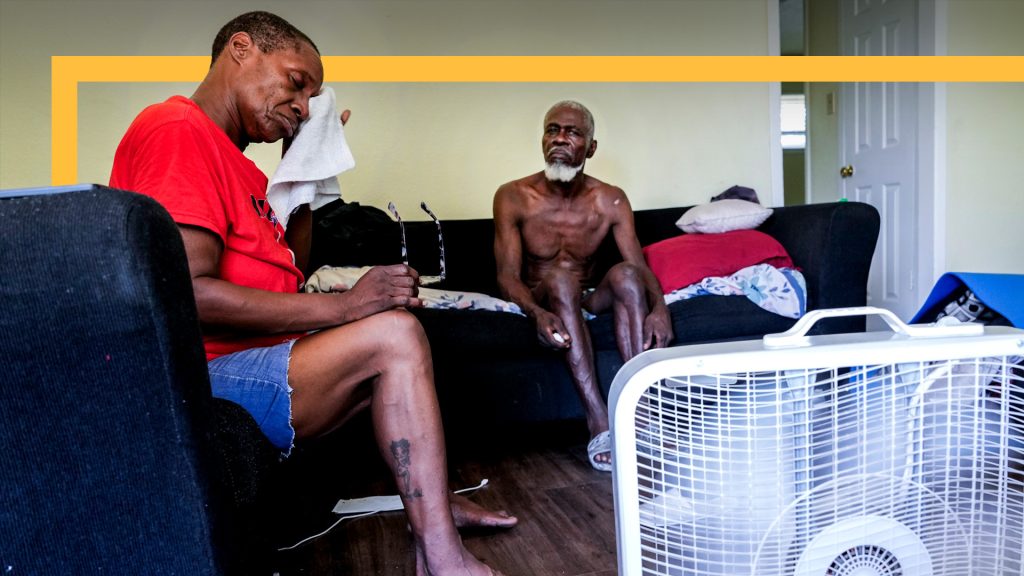
HOUSTON — The first thing Alejandra Salinas noticed was the heat, permeating all corners of the house. It was late June, and nearing triple digits — typical for the Texas summer. But inside?
“They have to prop the door open all day long to [allow] some airflow in,” said Salinas, a Houston city councilmember. “I was shocked to learn that this was an issue in the city of Houston.”
It very much is. Across the city, an estimated 20,400 households — including the one Salinas visited in late June in the city’s historic Fifth Ward — lack air conditioning.
Despite being one of the nation’s hottest states, Texas laws do not require air conditioning for rental housing. Other Texas cities like Austin, Dallas and El Paso, Salinas said, already adopted similar ordinances years ago with little pushback. After weeks of research, Salinas rallied her team and proposed a cooling ordinance at city council. The first of its kind for Houston, the ordinance would require landlords to provide air conditioning for rentals.
If passed, she said, the ordinance would allow Houston to catch up with other southern cities.

How dangerous can extreme heat be in people’s homes?
Each year, meteorologists announce new record-setting highs and longer heatwaves. When heat strikes, citizens are left to shoulder the burden, investing in expensive air conditioning units and climbing energy costs. For those without the means, living without air conditioning has been a struggle, with many relying on fans, open windows and cooling centers to survive.
Public health experts have witnessed the devastating impacts of heat-related deaths, but gaps in access, education, and government policies persist. Nationwide, scorching southern cities have already implemented cooling ordinances, while parts of New England and the Pacific Northwest put similar policies on their dockets. Historically, several states have recognized the importance of adequate heating during harsh winters, setting a precedent for climate-related housing policies.
When meteorologist and longtime Houstonian Matt Lanza first heard about Salinas’s proposed ordinance, his first thought was: How is this not already a thing?
In his years running the popular meteorology blog Space City Weather, Lanza has seen firsthand how deadly heat can be.
“Nobody is ever completely immune from suffering the effects of heat stroke or heat illness,” Lanza told Straight Arrow. Across the nation and his industry, Lanza said, he is witnessing growing questions about heat.
“There’s competition within weather meteorology, in terms of, which hazard is the most dangerous?” he said. “Is it heat, or is it cold?”
For Zoe Middleton, associate policy director for the Union of Concerned Scientists, the answer is clear.
“Extreme heat is the deadliest climate impact,” Middleton told Straight Arrow. “More people in the States are increasingly dying from extreme heat.”
In 2024, the National Weather Service (NWS) found that extreme heat was the leading cause for weather-related fatalities, including floods, hurricanes, tornadoes and winter freezes. The following year, when more than 100 people died from the Texas Hill Country floods, extreme heat was listed as the No. 2 deadliest disaster, behind flooding.
But high temperatures are only part of the equation. The biggest danger for overheating, according to Middleton, is wet-bulb temperature, which measures both heat and humidity. Wet-bulb temperature is critical because it quantifies how heat feels: When wet-bulb temperature reaches 95°F, the human body hits its own cooling limit.
“[It’s] heat that’s incredibly hard for people to cool down from on their own,” Middleton said. In these cases, external sources, like air conditioning, are key to reducing illness.

What happens to the human body during extreme heat exposure?
Research into wet-bulb temperature and heat-related illness has expanded in the last decade, shedding light on the dangers of overheating. Studies on the Texas prison system, which lacks air conditioning, have been a major driver for understanding the impacts of extreme heat, said Sylvia Dee, associate professor for the Earth, Environmental and Planetary Science Department at Rice University.
“We have plenty of evidence suggesting that heat-related illness and heat-related deaths will increase if people don’t have access to safe cooling,” Dee told Straight Arrow.
Long-term exposure to extreme heat, Dee said, can lead to kidney failure, cardiac arrest and exacerbate respiratory illnesses, largely affecting vulnerable communities like young children, the elderly or those with underlying health concerns.
“From a health perspective, there are direct consequences of extreme heat that will kill you,” Dee said.
With extreme heat a growing danger, public health organizations are pushing to educate politicians and citizens. In 2024, the Centers for Disease Control and Prevention (CDC) found that around 1,220 individuals die each year from overheating. In response, the CDC launched Heat Risk, an interactive forecasting tool to help Americans safely navigate high temperatures. Still, progress can be made, said Shweta Arya, a senior project manager at the American Public Health Association’s (APHA) Center for Climate, Health & Equity.
Recognition for heat-related illnesses as a public health concern peaked under the Biden administration, according to Arya. Now, though, federally, heat-related protections have largely stalled, despite deeply reported, comprehensive research.
In 2025, the Trump administration halted efforts to expand the Occupational Safety and Health Administration’s (OSHA) plan to establish national heat safety protections. The move, Arya and Dee told Straight Arrow, was a major roadblock in the lengthy fight to protect against extreme heat, putting millions of outdoor workers at risk.
“There’s increasingly some kind of political resistance to common sense laws that will save lives, in my opinion, from heat-related illness,” Dee said. Yet, the need for formal protections and heat-related policies is critical.
“Right now, only a handful of states have policies in place to protect [these] orders,” Arya says. “We need those kinds of strong examples coming from the national level.”
Because there are few national heat protection policies, the policies that do exist are largely at the local level. Hubs in Arizona, Florida, North Carolina, and Louisiana have passed cooling ordinances, arguing that climbing temperatures increased the risk of heat-related illnesses.
Outside of the South, cities in California, Nevada, Maryland and Washington have enacted similar policies, while legislators in Oregon passed Senate Bill 1536 in 2022, guaranteeing tenants the right to install ACs. Earlier this year, New York City passed a similar ordinance, citing hundreds of heat-related deaths annually.

Can the human body naturally adapt to extreme heat without AC?
While America shifts the responsibility of air conditioning onto state and local officials, some eschew air conditioning altogether. In a 2016 article for The Guardian, New York City-based writer Franklin Schneider argued that air conditioning is largely a luxury. The average, healthy American, Schneider said, can go without because, barring health concerns or extreme conditions, the human body naturally acclimatizes. After a few weeks of heat exposure, the body naturally adapts and cools more efficiently. In other, hotter regions of the world, people rarely have air conditioning, and they tend to adapt quickly, he argued. So, he asked: Why can’t Americans?
To prove his point, Schneider has spent 20 years without air conditioning and plans to keep going. At this point, he doesn’t see the need to invest.
“I’m basically just too lazy to get air conditioning,” Schneider told Straight Arrow. Just a few weeks ago, he braved New York’s weeklong heat wave with nothing but a ceiling fan on its lowest setting.
“[AC] will make your nights more pleasant, but being hot is just an inconvenience,“ he said.
Not everyone buys this.
“People think I’m insane,” he told Straight Arrow, chuckling. “Because people really [talk] about air conditioning like it’s like an absolute necessity. It’s like having water, or electricity.”
Despite his own lifestyle, Schneider knows that he too has limits. The East Coast’s climate is relatively forgiving when it comes to heat, and heatwaves are short and endurable, he said. Had temperatures exceeded 100°F for more than a week, Schneider too might very well turn to air conditioning as a last resort.
Round out your reading
- From Obama to Trump to Biden: When networks said ‘no’ to presidential speeches.
- ‘The end of American science as we know it.’ White House funding plan sparks alarm.
- AI data centers are popping up everywhere. What exactly do they do?
- The Trump administration is accused of breaking a law built to target the KKK.
- One Republican senator is dead, another is still alive. Both are the center of conspiracy theories.
Ella Rae Greene, Editor In Chief