‘Scorched earth’ deed restrictions can keep grocers out of food deserts. States are fighting back
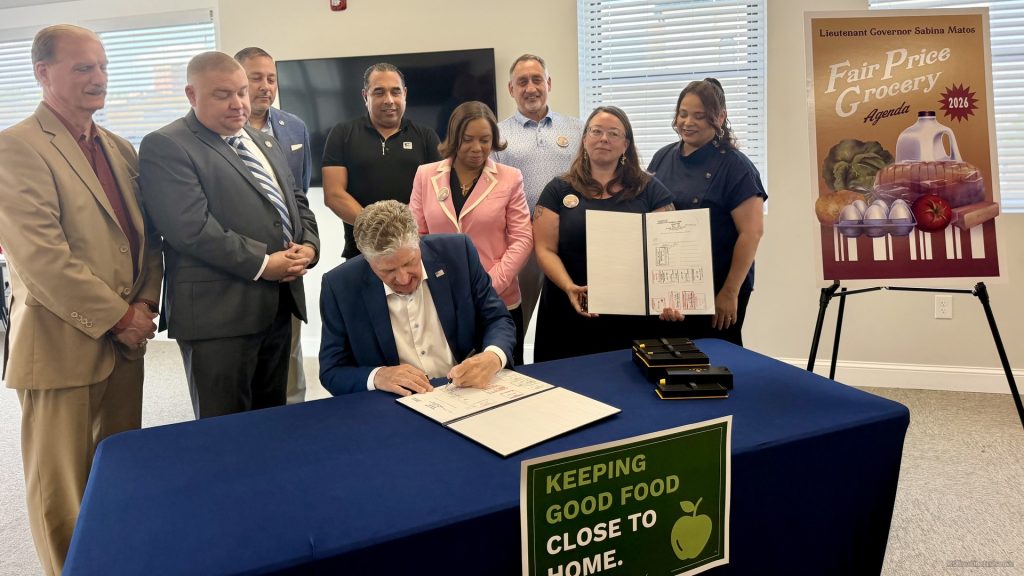
Woonsocket, Rhode Island, a city of roughly 45,000 people near the Massachusetts border, has just one full-scale grocery store: a PriceRite located three miles from the city center.
Getting there can be difficult for residents in one of the state’s poorest cities. With more than 40% of Woonsocket households earning less than $35,000 a year, and with 18% of residents having no access to a car, many families are stranded in what officials call a food desert.
Now, under a new Rhode Island law targeting restrictive grocery store covenants, communities like Woonsocket could get some relief from a corporate practice that critics blame for helping create food access crises in Rhode Island and across the country.
“We can make sure that when a grocery store closes and sells its real estate, another store is not barred from moving into that same space,” Rhode Island Gov. Dan McKee, a Democrat, said at a bill-signing ceremony on Wednesday.
Washington state passed a similar law in March. Now, with grocery affordability still a political flashpoint, lawmakers in other states are scrutinizing a corporate practice that critics say can make the problem worse.
A corporate practice under fire
When selling or leasing property, large retailers may include deed restrictions in their contracts that bar competitors from moving into the spaces they leave vacant. These restrictions may remain in force for years, or even decades.
Retailers say the restrictions prevent similar businesses from competing with their nearby locations by using the stores, parking lots and infrastructure they built.
But opponents say these so-called “scorched earth” covenants are anticompetitive and leave communities with empty storefronts and blight. The practice, they say, also shuts out small businesses and can leave shoppers with fewer choices and higher prices.
Restrictive covenants are especially common in the supermarket industry, where suitable sites can be scarce because grocers often need large buildings, loading areas and parking. In low-income communities, critics say, the effects can be especially damaging.
“This practice is so insidious because it harms everyone: the consumer, the community, and the competition,” said Rhode Island Lt. Gov. Sabina Matos.
Matos, also a Democrat, told Straight Arrow that in Woonsocket alone, her office discovered three properties with restrictive covenants and two more with anticompetitive leases that could have housed grocery stores.
She started this work, she said, when she tried to help a supermarket owner who saw opportunity in Woonsocket but could not find a suitable property to buy or lease that was free of restrictions.
Stop & Shop, the dominant supermarket chain in the state, has been shrinking its presence but leaving behind restrictive covenants that Matos said could keep rivals from taking over their sites for up to 30 years.
One of those sites, Matos said, is pictured here on Diamond Hill Road in Woonsocket.

Stop & Shop did not immediately respond to Straight Arrow’s request for comment.
For residents, living in a food desert can be detrimental to their wallets and their health.
An investigation by ecoRI News found that many residents in Woonsocket buy groceries from convenience stores, where prices tend to be higher and the food less healthy, when they cannot access the supermarket. The outlet also found more fast-food restaurants than fresh-food stores.
A Woonsocket health equity study from 2016 linked food access to health challenges. It found that 37% of children in the city were obese, far higher than the national average.
A national movement
Rhode Island’s new law bars new restrictive covenants that prevent property from being used to sell fresh food for off-premises consumption. It includes a narrow exception for grocers that relocate nearby, and it does not apply to covenants already in place.
In March, Washington Gov. Bob Ferguson signed similar legislation, the first statewide ban on restrictive covenants that prevent or limit a property from being used by a grocery store or pharmacy.
A California bill banning these types of restrictions recently cleared a state Senate committee.
The issue has also drawn attention in Congress. In May, Democratic Sens. Kirsten Gillibrand of New York, Maria Cantwell of Washington, Ron Wyden of Oregon and Cory Booker of New Jersey asked Federal Trade Commission Chair Andrew Ferguson to examine whether restrictive covenants used by grocery stores violate federal competition law.
“I am proud to see that what we have uncovered in Rhode Island has reached the attention of the U.S. Senate,” Matos said. “I hope they’re able to take on this fight at the national level.”
While celebrating his state’s legislation, McKee said these covenants are “designed to benefit big business and not the consumer.”
He said it’s the equivalent of saying: “I’m taking my ball and going home, so no one can play.”
Round out your reading
- America at 250: Straight Arrow’s week-long look at the pressures testing modern America.
- Ketamine is booming in America. The reasons go beyond drugs.
- Cluster of AI news sites suddenly goes dark after human reporter starts asking questions.
- A 79-year-old, obese, well-connected man gained exclusive access to a new weight loss drug. Is it Trump?
- Newsom pushes national wealth tax after opposing California billionaire tax.
Ella Rae Greene, Editor In Chief