Scandals force a closer look at secret state job funds
In April, Indiana State Representative Ed Delaney called for accountability from the Indiana Economic Development Corporation, a quasi-public nonprofit that distributes grants and tax breaks.
Governor Mike Braun had recently signed an executive order calling for more transparency from nonprofits such as IEDC, but DeLaney wanted more.
Audits and news reports suggested employees of the development group, which receives some taxpayer money, had undisclosed conflicts of interest, and the state lawmaker wanted new systems in place to prevent self-dealing.
“You would assume the staff would fill out forms and paperwork if they had a conflict and bring it to the proper authorities, but I don’t know that [Braun] has created anything to make sure that’s done,” DeLaney said at the time.
A spokesperson for Braun did not respond to Straight Arrow’s request for comment.

Why are public-private economic development organizations facing scrutiny?
Calls for greater transparency from public/private development organizations such as the IEDC is something of a trend this year; lawmakers in several states are pushing for audits or seeking to change state laws. Those calls were turbocharged in part by a scandal involving the resignation of an elite public university’s president.
These part-public, part-private groups are not identical, but share some traits, including their connections to state and local governments. Ohio’s governor, for example, appoints board members to JobsOhio, the state’s public/private development group.
Another similarity: They are generally not responsive to public records requests. JobsOhio was founded as a private nonprofit in 2011 and is not subject to the Buckeye State’s sunshine laws.
“They could deny [a records request] or cherry pick what they release,” Ohio State Senator Sandra O’Brien told Straight Arrow. “When you allow an agency to cherry pick the information they can give you, they’re only going to give you what they want to give you, which is why we have open records laws.”
The IEDC was founded in 2005 to spur job growth and is funded through a mix of public and private money. In its most recent annual report, the group claimed its actions helped create more than 137,000 jobs in Indiana through 2024.
Critics like Delaney, however, argue the organization’s inner workings remain a mystery because its records aren’t public.
Proponents of development organizations say they tip the scales in favor of a state or city when companies look to expand or relocate and bring jobs with them.
“When we talk to businesses investing large amounts of capital, there are a couple of things they want and one is predictability,” said West Virginia State Delegate JB Akers, who cosponsored a bill to create a public/private development group in his state.
Building a factory can take years, and dealing with a development group unconnected to elected leaders helps ensure consistency, he said.
Groups like JobsOhio frequently post press releases announcing new factories or white-collar office openings and hold splashy press conferences featuring corporate executives and politicians standing side-by-side — often garnering positive coverage. When JobsOhio unveiled a $300 million investment fund earlier this month, the news coverage was largely uncritical.
JobsOhio spokesperson Matt Engelhart did not comment for this story, but said in a statement to the Ohio Capital Journal that the organization “appreciates our strong working relationship with state legislative leaders.”
“We are committed to maintaining our best-in-class transparency while ensuring Ohio remains competitive for economic development opportunities,” the statement said.
The organizations tout job numbers sometimes measured in the thousands, but research shows that large grants and tax breaks for manufacturing projects only result in job and wage growth about half the time, Alexandra Tsvetkova, a researcher for West Virginia University’s Regional Research Institute, told Straight Arrow.
“It’s not a smart investment,” she said.

What happened at JobsOhio?
Calls for these groups to release more information about their inner workings are not new, but the latest round was inspired by a series of audits and the forced resignation of Ohio State University’s top official.
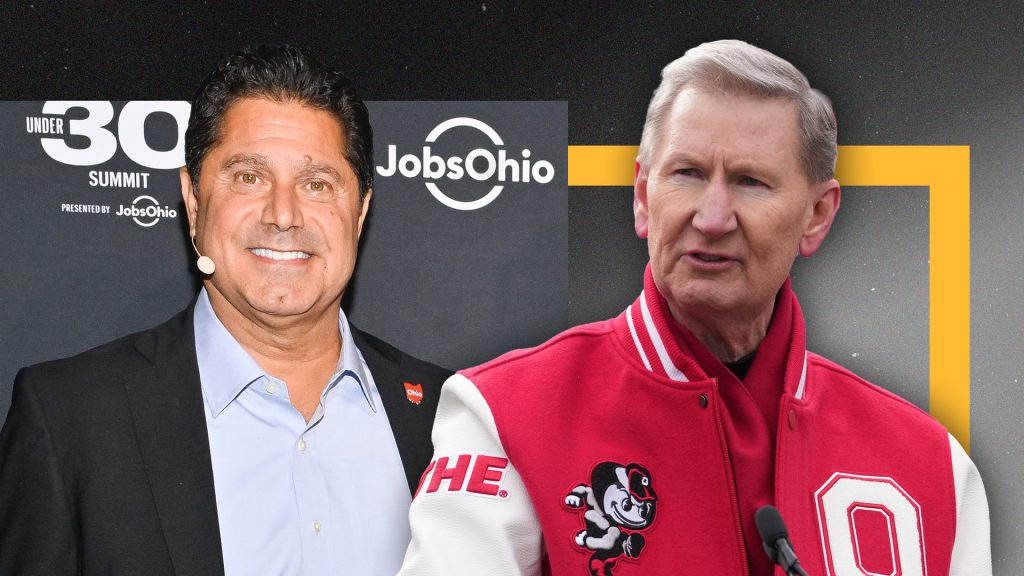
OSU President Ted Carter resigned in March following the disclosure of an inappropriate relationship with podcaster Krisanthe Vlachos, who sought his help in securing public resources.
Various news outlets reported Carter allegedly pulled strings to facilitate a $60,000 grant from JobsOhio to support the Vlachos’ podcast, which featured an appearance from the organization’s president and CEO, J.P. Nauseef. Episodes of the podcast, a veteran-focused program entitled “The Callout,” have since been removed from YouTube.
In the scandal’s wake, four Ohio lawmakers sponsored a pair of bipartisan bills requiring regular audits of JobsOhio and stipulating that the organization must honor public records requests.
One of the bills, introduced in Ohio’s House of Representatives, received its first hearing earlier this month, although it is unclear whether either bill will come up for a vote.
Ohio distributes all the liquor sold in the state. Before the profits were redirected to JobsOhio in 2013, they used to go into the general fund.
“If taxpayer-supported programs are creating opportunities in our communities, Ohioans should be able to see where the money is going and how it’s being used,” State Representative Christine Cockley, who co-sponsored one of the JobsOhio bills, said in a statement.
The lawmakers calling for changes to JobsOhio say the funding structure is no different than using tax money.
“I would argue that it’s taxpayer money,” O’Brien told Straight Arrow. “They’re giving it to JobsOhio, but it still belongs to the taxpayer. It’s public dollars.”
Criticism of JobsOhio spans the ideological spectrum.
“We don’t love giving specific tax breaks or specific grants to one business over another,” Greg Lawson, senior research fellow at the Conservative Buckeye Institute, told Straight Arrow, referring to the institute. “We do believe in low taxes, but we don’t want to be picking winners and losers through government policy.”
Which states are auditing their public-private development groups?
North of Ohio’s state line, the Michigan Economic Development Corporation made headlines last month when a member of its executive committee was charged with improperly spending $20 million in state grants.
The organization is considered a part of the state’s government and has provided records requested by media outlets, making it an outlier among public/private development organizations.

Elsewhere in the country, audits and investigations into similar groups unearthed details that unnerved state lawmakers. Delaney’s call for accountability came after an audit last year revealed that IEDC staff had at least 30 undisclosed conflicts of interest.
“Whatever they did in the past, they got away with it,” he said. “The rules just can’t be ignored. There has to be enforcement and consequences.”
In Hawaii, a January audit of a similar organization, the Office of Economic Revitalization, met only about a third of its goals since its creation in 2020 using money from the American Rescue Plan.
The office “spent almost $324 million between 2021 and 2025, and a big chunk of that —, $284 million — was directed for a rental and utility relief program,” Troy Shimasaki, Honolulu’s acting city auditor, told Straight Arrow. “It was a missed opportunity that it didn’t provide the most comprehensive economic revitalization that was envisioned.”
Florida lawmakers dismantled Enterprise Florida, the state’s own public/private development organization, two years ago following corruption accusations.
Spokespeople for IEDC, the Michigan Economic Development Corporation and the Office of Economic Revitalization did not respond to requests for comment.
Do economic development incentives actually create jobs?
In spite of tens of millions in grants and tax breaks spent by public/private development groups, the odds of success are no better than a coin flip, Tsvetkova told Straight Arrow.
“States are spending so much money, you want a guaranteed return,” she said.
At least one of JobsOhio’s major investments stands on shaky ground.
In 2022, the organization said it gave chipmaker Intel $125 million to help bring a pair of microchip factories and roughly 3,000 tech jobs to a Columbus suburb. The factories were originally slated to open by 2025, but are now scheduled to open between 2030 and 2032, the Columbus Dispatch reported.
Akers understood the criticism of public/private development groups when he proposed creating one in West Virginia.
A provision of his bill — which has passed one chamber of the state legislature — would clarify that the organization, Team WV, is subject to public records laws, although it has a trade secrets exemption.
“We included that because we considered it a best practice,” Akers said.
But he acknowledged that West Virginia lawmakers were “somewhat sensitive” to critiques of JobsOhio and IEDC.
While the organization would be funded by profits on liquor sales, Akers said Team WV would not have the sole authority to distribute grants and tax breaks and would instead make recommendations to the state’s Division of Economic Development.
Round out your reading
- Could a common dietary supplement accelerate Alzheimer’s?
- NY AG Letitia James gets hundreds of taunts, racial slurs in ICE public reporting portal.
- As Musk becomes the first trillionaire, historian sees warning signs.
- An experimental weight loss drug is so effective, many Americans don’t care it’s not FDA approved.
- How search engine optimization reduced Simone Biles to an ‘NFL wife’.
Ella Rae Greene, Editor In Chief