One Republican senator is dead, another is still alive. Both are the center of conspiracy theories
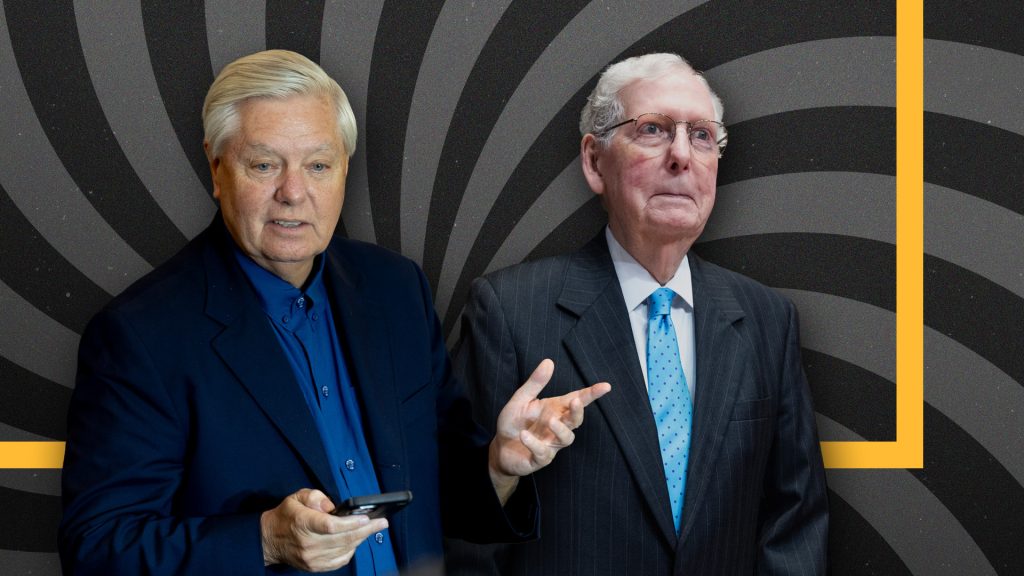
A powerful, longtime Republican senator was declared dead, and, frankly, people weren’t that shocked. At least not at first glance.
After all, online conspiracy theories had been swirling around for weeks about 84-year-old Sen. Mitch McConnell, R-Ky. He was hospitalized more than a month ago, and his lack of public appearances had led to questions about whether he still had a pulse.
But McConnell is very much still kicking, he confirmed with a proof-of-life photograph his office released Sunday. It showed the frail-looking lawmaker in a hospital bed, smiling and clutching an up-to-date copy of The Washington Post.
The man whose death was announced Sunday was that of the younger — but still elderly — Sen. Lindsey Graham, R-S.C., who, his office initially stated, succumbed to a “brief and sudden illness” at the age of 71.
Cue the conspiracy theories — once again. Graham’s unexpected death prompted wild speculation to go viral online that the senator was killed by an adversarial foreign government. Perhaps Russia, perhaps Iran or Ukraine, depending on who one asked. His office later said Graham died of cardiovascular disease, and the medical examiner’s preliminary findings don’t point to foul play.
The news about McConnell and Graham highlights how information voids about the wellbeing and deaths of high-profile figures are routinely — and quickly — filled by baseless conspiracy theories. Conspiracy theories are all around us, but are only given power when people pay attention to them, said Joseph Uscinski, a University of Miami professor who studies misinformation.

Given the media attention on McConnell’s health, and then on Graham’s sudden death, it’s no surprise that “people with conspiratorial worldviews will conspiracy theorize about it,” Uscinski told Straight Arrow. He said that people believe wild stories, at least in part, because they reinforce a belief that their political enemies are up to no good.
“There’s conspiracy theories about deaths, conspiracy theories about births, conspiracy theories about people not dying,” he said. “So it’s much more about a predisposition than it is about the event itself or our communication technologies or anything that’s going on at the moment.”
Graham’s sudden death prompts wild theories
Quickly after officials announced Graham’s death, pro-Kremlin social media accounts began to spread a conspiracy that he was killed in a Russian drone strike while visiting a Ukrainian drone facility a day earlier, according to an analysis by media literacy company NewsGuard. Other social media users have pinned the blame on Israel, the COVID-19 vaccine and the Clintons.
Republican lawmakers and pundits, including those in President Donald Trump’s inner circle, have stoked the conspiracies.
Just an hour after Graham’s office announced the death, and requested “privacy during this incredibly difficult period,” far-right influencer Laura Loomer, who calls herself an investigative reporter, promoted a conspiracy theory that the senator was the victim of a Russian or Iranian hit. Perhaps he was poisoned, Loomer claimed in a 3:05 a.m. post on the social media platform X.
“There should be an investigation into his death,” Loomer wrote. “Especially after Iran called for his death less than one week ago.”

In a text message to Straight Arrow, billionaire Trump ally John Catsimatidis shared several tweets that seemed to suggest Graham’s death was part of a broader conspiracy. Among them was a post — since deleted — from Bill Ackman, the billionaire hedge fund manager. Ackman shared a video of Graham in Ukraine a day before his death with the caption, “This doesn’t look like a guy who would die hours later.”
FBI Kash Patel further fueled the fire. In a post on X, Patel honored Graham as “a devoted public servant, a fierce defender of our nation and a true patriot,” before suggesting that federal law enforcement was investigating his death. “The FBI is assisting local authorities and has made every necessary resource available,” Patel wrote.
On Monday, some 20 federal agents, including from the FBI, were spotted at Graham’s home near the Capitol. Trump said Tuesday he is aware of conspiracy theories swirling around about Graham’s death but that the “FBI is wasting their time” investigating the matter.
When reached for comment, an FBI spokesperson referred Straight Arrow to the Washington police department.
“We have nothing to add to the FBI Director’s social media post over the weekend,” the spokesperson said.
A proof-of-life photo — called into question
On the same day the internet was flooded with conspiracy theories about the cause of Graham’s death, McConnell released a proof-of-life photo that seemed designed to silence conspiracy theories claiming that he was dead.
In a statement, McConnell said he was hospitalized after a fall and that he had contracted pneumonia. But he said his doctors “confirmed that I didn’t break any bones or suffer a concussion.”
It only added fuel to the fire.
Loomer, again, jumped to offer a theory: The proof-of-life photo was generated by artificial intelligence, she posted on X.
“This is such bulls—,” she tweeted. “His staff are liars.”
Social media sites were flooded with posts claiming the photo was AI-generated, pointing to blurry text and other elements as proof. Meanwhile on right-wing Real America’s Voice, Sen. Ron Johnson, R-Wis., questioned whether the photo showed what it claimed.
“I just heard from a source that was an older photo,” Johnson said.
Two news outlets, The Washington Post and WHAS-TV in Louisville, highlighted forensic analyses that determined the photo was authentic. The memes that followed, like an AI-generated video of McConnell breakdancing, are a different story.

How misinformation festers
Deaths of celebrities have long been fodder for conspiracies. Take, for example, Elvis Presley, who died on the toilet in 1977 but who, according to conspiracy theorists, is still very much alive.
Researchers have long documented the drivers of the phenomenon, including “proportionality bias,” a psychological belief that a big event was caused by something equally grand. The reward structures of social media, including a lust for virality, also contribute to the spread of sensational, wild, eye-catching — and, let’s face it, often funny — misinformation.
Conspiracy theories often provide explanations to confusing news, offer closure to tragic events and provide people a sense of control over the world around them. They’re also embraced by people with a desire to “understand and feel safe in their environment,” and by people who “need to feel like the community they identify with is superior to others,” according to 2023 research by the American Psychological Association.
Mistrust in public institutions, including the media, can also play a role. People with high levels of paranoia, and those with a strong “sense of antagonism toward others,” are particularly likely to buy into conspiracy theories, researchers concluded.
Even though high-profile conspiracy theories can make it seem like people have collectively lost their minds, they’ve been around for as long as people have, Uscinski told Straight Arrow.
“It’s not the events themselves that drive these conspiracy theories — it’s people,” Uscinski said. Major news events routinely prompt conspiracy theories that, in turn, attract attention. But conspiracy theories, he said, are all around us.
“I will guarantee you that, in some little town somewhere in the middle of nowhere, the town council might be debating a bicycle-sharing policy,” Uscinski said. “And there’ll be someone in the room saying ‘This is part of Agenda 21. It’s a conspiracy by the UN to instill communism on us.’”
Conspiracy theories aren’t the problem. Believing them is
Uscinski acknowledged that the current political moment is ripe for the spread of conspiracies. Theories are circulating online, for example, that McConnell is already dead and that his passing is being covered up by Republicans to retain power.
“Because the Senate is so evenly divided, the death of a senator and the health condition of Mitch McConnell is quite meaningful to the balance of power,” Uscinski said. “So, of course, people would be like, ‘Oh, well, somebody must have a motive to either cover something up or assassinate someone or who knows what.”
Loomer and other conspiratorially minded pundits will continue to spread questionable ideas “every day about all sorts of events,” Uscinski said. But conspiracy theories should be treated as people “engaging in ideas.” Even if they lack hard evidence, he said, how to “stop people from engaging in ideas becomes a very dark question, and potentially a very scary one.” Loomer didn’t respond to a direct message on X seeking comment from Straight Arrow.
Conspiracy theories can serve to provide “a good check on those who are wielding power,” he said.
And sometimes, they turn out to be true.
“We have to be able to question the actions of the powerful, and we should be able to question what they’re doing in secret,” Uscinski said. “So, in that sense, I don’t have a problem with conspiracy theories. What I do have a problem with is people doggedly believing them before there’s an appropriate amount of evidence to support them.”
Round out your reading
- With more prison space than prisoners, correctional facilities are shutting down.
- ‘Game changer’: New cancer treatment turns major surgery into an outpatient procedure.
- Viewers overwhelmingly support ‘The View’s’ fight against the FCC. Will that matter?
- Why an ICE shooting in Houston isn’t leading to mass protests.
- Milwaukee detective is the latest officer charged with misusing Flock cameras.
Ella Rae Greene, Editor In Chief