Massie loses Kentucky primary; Cassidy flips on Trump in Iran vote
President Donald Trump gets the result he wanted in Kentucky after longtime critic Rep. Thomas Massie loses his primary fight.
Plus, critics are calling Trump’s new IRS settlement and anti-weaponization fund a political slush fund. Now the fight over who could eventually qualify for payments.
And the U.S. is preparing criminal charges against Raúl Castro over a case from 30 years ago.
These stories and more highlight your Unbiased Updates for Wednesday, May 20, 2026.
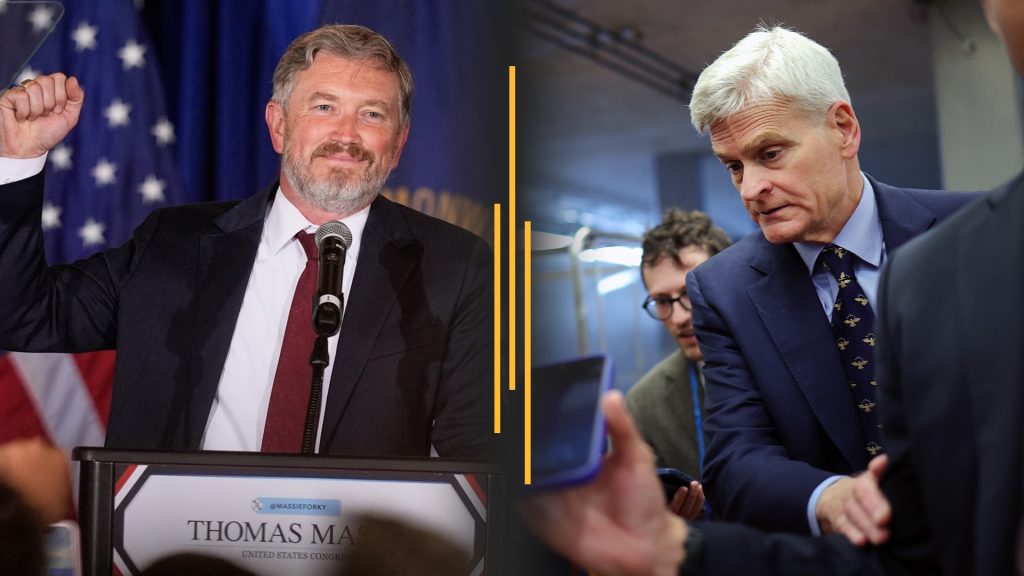
Massie loses seat to Trump-backed candidate in costly primary battle
Another win for President Donald Trump Tuesday night as one of his most persistent Republican critics on Capitol Hill lost his seat.
Rep. Thomas Massie, R-Ky., lost Tuesday’s primary to Trump-backed challenger and former Navy SEAL Ed Gallrein in what has been described as the most expensive U.S. House primary ever.

Gallrein’s campaign got a boost not only from Trump’s endorsement, but from heavy outside spending, including major support from pro-Israel groups, which AdImpact says accounted for about half of the money spent to help his candidacy.
Massie has been one of the GOP’s most consistent critics of U.S. involvement in the war with Iran.
“I would, I would have come out sooner, but I had to call my opponent and concede and it took a while to find Ed Gallrein in Tel Aviv,” Massie said. “Look, they used, they used a lot of dirty tricks, but we stayed the course. We did not. We didn’t bend the knee. We didn’t throw a foul ball. We didn’t do any of those things. We didn’t kneecap anybody. There were — we had lots of opportunities to try a lot of stuff like that, and we never did it. We ran a clean race.”
In his concession speech, Massie went on to add, “We weren’t really running against Ed Gallrein. We weren’t running against Donald Trump. We were running for what we believe in.”
Massie’s term doesn’t end until January, giving him several more months on Capitol Hill and more opportunities to clash with the Trump administration.
Also in Kentucky, another Trump-backed candidate picked up a win.
Rep. Andy Barr won the Republican primary for Mitch McConnell’s open Senate seat and will face Democrat Charles Booker in November.
And Kentucky wasn’t the only state with major races on the ballot Tuesday.
In Georgia, voters pushed both the Republican governor’s race and the GOP Senate primary into runoffs.
Former college football coach Derek Dooley and Congressman Mike Collins advanced in the Senate race after Congressman Buddy Carter fell short.
Whoever emerges will face Democratic incumbent Jon Ossoff in one of the most-watched Senate races of the midterms.
Meanwhile, Lt. Gov. Burt Jones and healthcare billionaire Rick Jackson will meet in a runoff for the governor’s nomination.
And in Alabama, voters set up a familiar matchup: Republican Tommy Tuberville and former Democratic Sen. Doug Jones will face off in the race for governor, six years after Tuberville defeated Jones for his U.S. Senate seat.
Senate advances war powers measure as four Republicans cross party lines
The Senate took a step Tuesday toward reining in Trump’s war powers in Iran, moving forward a measure that had failed seven times before.
The 50-47 vote advances a resolution that would require the president to pull U.S. forces from the conflict unless Congress formally authorizes the war.
Four Republicans broke with their party to help push it forward, including Sen. Bill Cassidy, R-La.
Cassidy flipped his vote just days after losing his primary to a Trump-backed challenger. It’s timing that is already turning heads on Capitol Hill.
The U.S. military campaign is now nearly three months old, and the deadline for congressional authorization has already passed.
Democrats argue the president cannot continue military operations without clear approval from Congress. Some Republicans say active hostilities have largely ended.
The resolution still has a long way to go.
It must survive at least two more Senate votes and pass the House, which rejected a similar measure last week.
And even if it clears Congress, Trump is expected to veto it.
New deal adds tax protections for Trump, barring claims involving Trump, his family or his businesses
New details are emerging about Trump’s settlement with the IRS, and they’re raising new questions about a deal that already created a nearly $1.8 billion anti-weaponization fund.
Newly released language would also bar the IRS from pursuing claims or examinations involving Trump, his family or related businesses.
Investigators discovered the new terms Tuesday in an addendum linked to the Justice Department’s settlement announcement.
Acting Attorney General Todd Blanche wrote that the federal government is “Forever barred and precluded from prosecuting or pursuing, any and all claims” asserted by the IRS against Trump, his family or his business.
The language covers tax matters involving Trump, family members, trusts, companies and other related entities.
The addendum expands on Monday’s agreement that created the roughly $1.8 billion fund for people who claim they were targeted by government “Weaponization” during the Biden administration.
The administration is pushing back against criticism that the fund or the agreement benefits the president personally.
“The question is, is a dollar of this money going to the Trump administration? No. Is a dollar of this money going to Donald Trump personally? No. Is a dollar of this money going to Donald Trump’s family? No,” said Vice President JD Vance on Tuesday. “The people that would get the money are people, some of whom have been prosecuted completely disproportionate to any crime they’ve ever committed.”

Acting Attorney General Todd Blanche defended the agreement during congressional testimony.
“It is true that this is unusual, that is true, but it is not unprecedented, and it was done to address something that had never happened again either,” Blanche said. “So there is an impressive nature of what we did yesterday in response to years and years of weaponization.
Associate Attorney General Stanley Woodward said it’s too soon to pass judgment on the new fund.
“I think that it’s way, way, way too early for us to rush to judgment on whether this was a good or a bad idea to describe it as a slush fund, or really even to criticize it,” Woodward said. “You know why? Because there’s not been a single claim filed. There’s not been a single payment made.”
Critics see it very differently.
Sen. Chris Murphy, D-Conn., told reporters the judge in the case even called it corrupt because Trump was essentially “suing himself.”
“We’ve never ever seen anything like this before. I get it that people, you know, don’t know what a big number is anymore, but $1.7 billion, that’s a lot of money,” Murphy said. “That’s your taxpayer money. You worked hard for that money. And that money is now going into a political slush fund for the president to give to January 6th rioters? To hand out to his political allies around the country. That’s outrageous.”
Massachusetts Democrat Richard Neal accused Trump of turning the federal government into “his personal protection racket,” writing on X, “This corruption marks a dark day for democracy.”
FBI traces mosque shooting suspects’ path to attack, says teens self-radicalized online
More information has become available about the two teenagers accused of carrying out Monday’s deadly attack at a San Diego mosque, which left three people dead.
Investigators said the two — identified as 17-year-old Cain Clark and 18-year-old Caleb Vazquez — met online, where authorities said they self-radicalized. The FBI said it found evidence the pair drew inspiration from previous mass shooters, including the gunman who carried out the 2019 Christchurch mosque attack in New Zealand.

Investigators said Clark and Vazquez filmed Monday’s attack and posted it online. Authorities also said they left behind what the FBI described as a manifesto before taking their own lives.
“The vehicle they used, we also identified writings and various ideologies outlining religious and racial beliefs of how the world they envision should look. These subjects did not discriminate on who they hated,” Mark Remily, the lead FBI agent in charge, said.
Investigators said the writings included anti-semitic rhetoric and hate directed at Muslims, the LGBTQ+ community, Black people, women and people across the political spectrum. Authorities said both expressed beliefs about white people being replaced or eliminated.

As the investigation moves forward, the community continues to mourn the three men killed.
One, mosque security guard Amin Abdullah, is being hailed as a hero after investigators said he triggered a lockdown alert at the mosque’s school and confronted the attackers, actions police say may have saved countless lives.
US prepares charges against Raúl Castro over 1996 civilian plane shootdown
The U.S. prepares to take a major step against one of Cuba’s most powerful figures Wednesday morning.
The Justice Department and the FBI are expected to announce criminal charges against former Cuban President Raúl Castro, the brother of longtime Cuban leader Fidel Castro.
Reports said U.S. officials plan to accuse Cuba’s leadership of ordering the shoot-down of civilian planes in 1996.

The two “Brothers to the Rescue” aircraft had departed from Florida and were part of a group conducting missions to support Cubans trying to leave the island. The Cuban Air Force shot down both planes over international waters, killing four Cuban Americans.
NBC News reported a grand jury has already returned an indictment, though the specific charges have not been disclosed.
Acting Attorney General Todd Blanche is expected to attend Wednesday’s announcement in Miami, which is home to one of the country’s largest Cuban-American communities.

The case surfaces as the U.S. continues to increase pressure on Cuba’s government. The island has faced deep economic struggles, including fuel shortages, repeated blackouts and growing poverty.
Just last week, CIA Director John Ratcliffe traveled to Cuba and met with officials from the country’s interior ministry, where he said the U.S. was prepared to engage on security and economic issues.
Albino buffalo draws Trump comparisons
In Bangladesh, a rare buffalo has gained fame because of its unusual resemblance to Trump.
The nearly 1,500-pound albino buffalo has drawn crowds, with people stopping by just to see it in person after photos and videos took off online. Visitors said it’s the blonde hair, the face and even the hairstyle that draws comparison.
One man said he thought the comparison was exaggerated until he saw the buffalo for himself. Another woman said the resemblance is “exactly like Trump,” though she was quick to add one important difference.
She described the buffalo as “very calm and polite.”
More from Straight Arrow:

Why the immune system turns on women more often than men
As many as 50 million Americans live with an autoimmune disease, a broad category of disorders in which the immune system mistakenly attacks the body’s own tissues. Many of these conditions are chronic, debilitating and cannot be cured.
Roughly 80% of people living with an autoimmune disease are women. Women are roughly nine times more likely than men to develop lupus, where the immune system attacks organs throughout the body. Sjögren’s syndrome — which damages moisture-producing glands such as those that make tears and saliva — may be nearly 19 times more common in women. Women are also about three times more likely to develop Multiple Sclerosis, a disease in which the immune system attacks the protective covering surrounding nerve fibers in the brain and spinal cord.
Ella Rae Greene, Editor In Chief