Judge weighs press freedom vs. student privacy in contentious legal battle
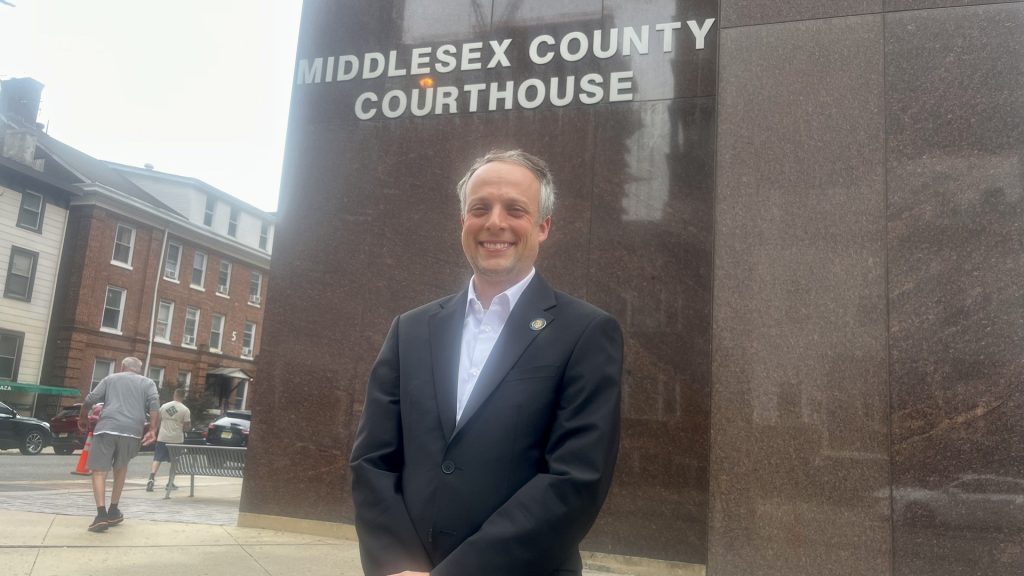
NEW BRUNSWICK, N.J. — Newspaper editor Charlie Kratovil will have to wait at least a little longer before he learns whether he can fully report on a school gun incident after a judge declined on Tuesday to lift a court order censoring him.
Judge Thomas Daniel McCloskey of Middlesex County, New Jersey, said he will issue a ruling “within a day or two” after a tense, hourslong hearing Tuesday over an emergency order that forced local news outlet New Brunswick Today to remove school surveillance footage from its YouTube page. The surveillance footage depicted a high schooler getting busted for bringing a BB gun to school — and called into question educators’ public statements about the incident.
McCloskey said Tuesday the case pits student privacy and school security concerns against press freedom and the public’s right to know.
“I haven’t lost sight of the public’s interest here,” McCloskey said in court. “It is somewhat of a struggle to ensure the right decision is reached.”
The school district maintains it has an obligation under state and federal law to protect the student’s identity from the public. Kratovil, however, maintains the public has the right to know about the incident — and how the district responded after the fact.
Kratovil says his decision to publish the video is in line with the First Amendment and that school officials sought to silence him to protect their public reputations.
It’s been more than a month since that May 29 court order was first put in place. First Amendment advocates say the case is about more than a feud between a local news outlet and a school district. It’s part of a growing trend in which local judges use emergency orders to impose prior restraints, prohibiting journalists from publishing certain information.
“We have a problem in our school system with bullying and unfortunately it starts at the top,” Kratovil said in an interview with Straight Arrow after Tuesday’s hearing. “The board of education is continuing to bully New Brunswick Today and trying to force us to participate in their cover-up.”
Why did a NJ school district sue a news editor?
Tuesday’s hearing is the latest development in a case that began in early May, when a New Brunswick High School student attempted to bring a BB gun onto campus. A metal detector alerted the school’s security staff, who searched the 16-year-old student and took him into custody.
The school was placed into lockdown, which led Kratovil to question the severity of the threat and to accuse school leaders of misleading the public about potential harms to students. School officials described the incident as a “security drill” in an alert to parents, which didn’t mention that a student had been arrested for bringing a weapon to school.
The student, whose name has not been made public because he is a minor, was arrested on allegations of possessing a weapon and causing a false public alarm.
A day after New Brunswick Today uploaded the video to the internet, the school board took Kratovil to court, claiming he had violated state and federal laws protecting the teenager’s privacy rights. Neither of the laws applies to journalists.
Still, in an emergency order, McCloskey sided with the school district. McCloskey, who acknowledged he hadn’t watched the footage, ordered Kratovil to delete the surveillance footage from the internet — and barred him from writing about it.
Judge weighs student privacy and press freedom
The hearing Tuesday marked the first opportunity for both sides to argue in court over how to proceed.
The school board’s attorney, Robert Mahoney, said in the hearing that the student’s identity wasn’t a matter of public concern, and that student records are confidential by law. The school district has the duty to protect the safety of the students in their care, Mahoney said, and “people could do great harm” to students and staff with sensitive security information revealed in the footage.
“The board is not acting as an editor, Your Honor, the law acts as an editor,” Mahoney said. State and federal laws “make it absolutely clear that student records are confidential.”
The Supreme Court has held on multiple occasions that the First Amendment allows journalists to publish truthful information that’s in the public’s interest to know. Because the district wasn’t “proactively transparent” about the lockdown, Kratovil said, parents had questions about what had actually transpired. He told Straight Arrow he lawfully obtained the security camera video from a confidential source.
Kratovil’s lawyer, Bruce Rosen, said existing court precedent upholds the editor’s right to publish the footage. Rosen said the court order was an unconstitutional prior restraint. It is up to school officials — and not a newspaper editor — to ensure student records remain confidential.
Had the video footage not been published by New Brunswick Today, Rosen said, the public would be unaware of what he described as a cover-up by the district. Rosen said it’s up to the school board to prevent sensitive records from leaking, but that doesn’t give the board the right to silence journalists who publish those that do.
“This involves the credibility of the board,” Rosen said. “The first thing they did was they lied, they claimed that it was a routine drill.”
McCloskey questioned whether court-ordered redactions could strike a balance between press freedoms and student privacy. For now, the video remains offline — and Kratovil said he doesn’t plan to stop fighting.
“I would not be happy with any order that restricts our freedom of speech,” he said. “It’s not a situation where the courts or the board of ed have authority to be a super-editor of the news.”
Round out your reading
- Scientists are now eyeing a possible ‘Mega El Niño’.
- Critics mocked Mamdani’s AC request. Republicans made the same ask.
- Social Security was supposed to be a safety net. To young Americans, it’s a broken promise.
- What happens when the water dries up? Much of the American West is close to finding out.
- Political insiders are targeting the two-party system’s grip on America.
Ella Rae Greene, Editor In Chief