Iran denies Trump peace talks as new strikes continue; Washington honors Graham
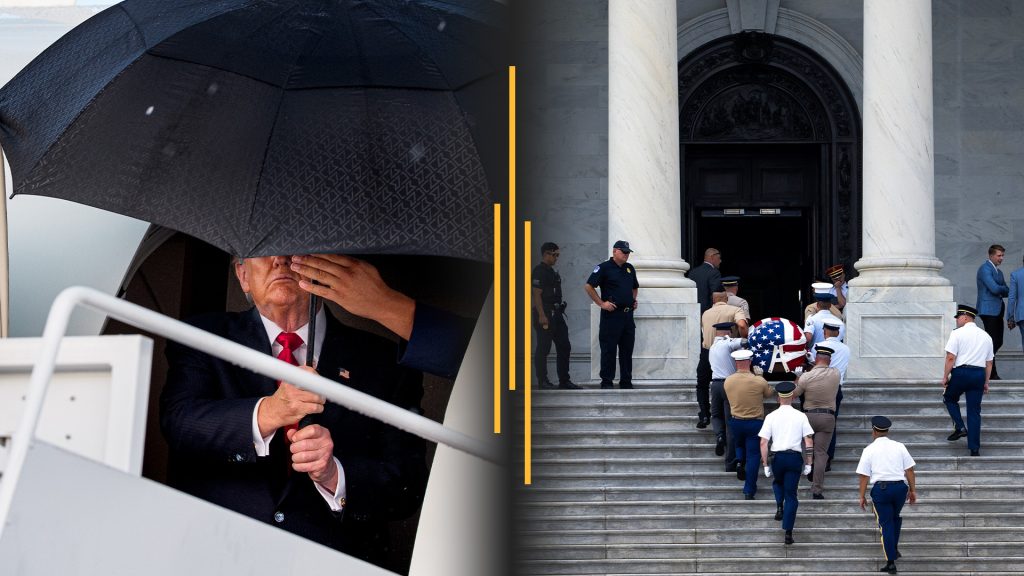
Drone attacks are back, but are peace talks? President Donald Trump says the U.S. and Iran are talking again, but Tehran says that’s simply not true.
Plus, two wars, two world leaders. Trump hosts Israeli Prime Minister Benjamin Netanyahu and Ukrainian President Volodymyr Zelenskyy in back-to-back meetings Tuesday at the White House.
And Europe’s wildfire emergency keeps growing. France and Spain are battling fast-moving infernos as an intense heat wave threatens to make a bad situation even worse.
These stories and more highlight your Unbiased Updates for Tuesday, July 28, 2026.
Peace talks face new doubt as Iran denies negotitions
New drone attacks have added to the uncertainty over whether the U.S. and Iran are even talking peace. Local sources said Iraqi armed factions attempted overnight drone strikes targeting the U.S. military base known as Tower 22 near the Syrian-Jordanian border.
Jordan’s state news agency said its military shot down a drone that breached the country’s airspace early Tuesday morning, while Israel said it also intercepted an unmanned aircraft near the Jordanian border.

The attacks come as Trump says the U.S. and Iran are holding talks, but he also told reporters he’s prepared to take action if those efforts break down.
“We’re having good talks so we’ll see what happens,” Trump said. “I think that there’s a good chance that something could happen, but if it does, good. If it doesn’t, we’ll go back to doing what we were doing two days ago.”
Iran has disputed Trump’s account. The country’s deputy foreign minister said Tuesday that Iran has not requested new talks and rejected a U.S. proposal to meet.
Leaders gather to honor Sen. Lindsey Graham in Washington
Washington takes a pause Tuesday to honor late South Carolina Sen. Lindsey Graham as presidents, prime ministers and lawmakers gather for his funeral.
Graham — one of the Senate’s most influential Republicans for more than three decades — died earlier this month at age 71 from an aortic dissection after returning home from a trip to Ukraine.

Two days of funeral services begin Tuesday in Washington, where Trump is expected to deliver remarks during an invitation-only service at the Washington National Cathedral.
Before that, Graham’s casket will be escorted into the U.S. Capitol rotunda by an armed forces honor guard, followed by a ceremony recognizing his decades of service in the Senate.

Then on Wednesday, the services move to South Carolina, where an F-16 flyover will kick off the day’s events, followed by a procession from the state house in Columbia to First Baptist church.
A public funeral service will be held at the church before Graham is laid to rest during a private family burial in Pickens County.
Trump holds back-to-back talks with Netanyahu, Zelenskyy at the White House Tuesday
Two of the foreign leaders in Washington for Graham’s funeral will also spend time at the White House on Tuesday.
Israeli Prime Minister Benjamin Netanyahu arrived in Washington Monday night for his first face-to-face meeting with Trump since the U.S.-Iran conflict began.

Simon Jones, POOL, AFP via Getty Images
Iran is expected to top the agenda as both leaders navigate a fragile pause in the fighting while also trying to show their partnership remains strong despite some recent public disagreements.
Later in the day, Trump is also expected to meet with Ukrainian President Volodymyr Zelenskyy as Russia intensifies its missile campaign and Ukraine continues to press for more air defense support.
Zelenskyy is also expected to meet with senators as lawmakers prepare to take up a Russia sanctions bill championed by Graham.
The back-to-back meetings put two of the world’s most pressing conflicts on the White House agenda all in a single day.
Trump takes mail‑in voting fight to the Supreme Court
Trump has taken his push to overhaul mail-in voting to the nation’s highest court. The administration asked the Supreme Court on Monday to let it move forward with a March executive order that would create a federal list of eligible mail-in voters and bar the Postal Service from sending ballots to people not on that list.
Lower courts have blocked the order in the 23 states and D.C. that sued, saying states are likely to succeed in arguing that the president lacks authority to change how elections are run.
Now the justices are being asked to step in, with the administration arguing the order is only policy guidance while federal agencies continue working out the details.
The appeal comes just days after Trump used a prime-time address to renew his claims that the election system needs stronger safeguards against fraud.
The states challenging the order say the changes could disrupt preparations for November’s midterms, while the administration says any new rules would need to be in place soon to have an impact this fall.
The Supreme Court has ordered the states to respond by Aug. 3, setting up what could become one of the most significant election cases before the midterms.
Extreme heat slows wildfire progress in France and Spain
Europe’s wildfire emergency isn’t over yet, and the weather threatens to make conditions worse. France has issued new heat warnings in the same southwestern region where firefighters are still battling a massive wildfire near Bordeaux.
President Emmanuel Macron has called it France’s worst wildfire crisis since World War II.
The fire in the Gironde region has burned more than 100,000 acres, about four times the size of Paris, and destroyed more than 240 homes. Officials said the fire has stabilized but is not yet contained.
-

ROMAIN PERROCHEAU / AFP via Getty Images -

ROMAIN PERROCHEAU / AFP via Getty Images -

Pablo Blazquez Dominguez/Getty Images -

Pablo Blazquez Dominguez/Getty Images -

Pablo Blazquez Dominguez/Getty Images -

Jose JORDAN / AFP via Getty Images -

Oscar DEL POZO / AFP via Getty Images -

Ed JONES / AFP via Getty Images -

Philippe Lopez / AFP via Getty Images -

Oscar DEL POZO / AFP via Getty Images -

Miguel RIOPA / AFP via Getty Images -

Oscar DEL POZO / AFP via Getty Images -

Jose JORDAN / AFP via Getty Images -

Philippe Lopez / AFP via Getty Images -

Philippe Lopez / AFP via Getty Images -

JORDAN / AFP via Getty Images -

MIGUEL RIOPA / AFP via Getty Images -

Kenzo TRIBOUILLARD / POOL / AFP via Getty Images -

Alain JOCARD / AFP via Getty Images -

Oscar DEL POZO / AFP via Getty Images -

Pablo Blazquez Dominguez/Getty Images -

Oscar DEL POZO / AFP via Getty Images -

Alain JOCARD / AFP via Getty Images -

Pierre-Philippe MARCOU / AFP via Getty Images -

Pierre-Philippe MARCOU / AFP via Getty Images -

Alain JOCARD / AFP via Getty Images -

OSCAR DEL POZO / AFP via Getty Images -

Oscar DEL POZO / AFP via Getty Images -

Miguel RIOPA / AFP via Getty Images -

Oscar DEL POZO / AFP via Getty Images
Spain faces a similar fight. More than 63,000 people have evacuated from areas near Madrid, Toledo, and Avila.
Officials said the fire near Avila has become the largest wildfire in Spain’s recorded history.
In eastern Spain, firefighters are also contending with unexploded ordnance left behind from the Spanish Civil War. There’s little relief in the forecast.
France is expecting more hot, dry weather with no significant rain, while parts of Spain could see temperatures top 104 degrees.
Officials in both countries warn it could take months to fully bring these fires under control.
Amazon enters wireless market, launching satellite network to connect phones
Have you ever been somewhere your cell phone just stops working? No bars, no signal and no way to make a call?

Amazon said it wants to change that with Amazon Leo. The company has asked federal regulators for permission to offer a new direct-to-device satellite service designed to keep cell phones connected even in areas without traditional cell coverage.
The service would use Amazon’s Project Kuiper satellite network, which plans to deploy more than 3,200 low Earth orbit satellites.

Amazon said customers could use their existing phones to make voice calls, send text messages, access emergency services and get other basic connectivity in remote areas. The company has already announced partnerships with Verizon, Vodafone and Hero as it builds out the network.
If the FCC approves the plan, Amazon said the direct-to-device service could launch as early as 2028.
More from Straight Arrow:

Inside the decades-long search for autism’s causes
Not long ago, many physicians believed autism wasn’t caused by biology at all.
Until the 1960s, a dominant theory held that autism resulted from emotionally distant parents.
“The idea that mothers caused their child’s autism because they were cold and withdrawn and they were not giving to their children was a prevailing view,” said Helen Tager-Flusberg, the former director of Boston University’s Center for Autism Research Excellence. She remembers those early days of research at the dawn of her career.
By the 1980s, physicians increasingly abandoned the “refrigerator mother” hypothesis, instead applying modern scientific tools to study autism’s biological underpinnings. Advances in genetics, neuroscience and developmental biology reframed autism as a neurodevelopmental disorder.
Over the following decades, landmark studies revealed that autism was far more common among closely related family members than among unrelated people, suggesting genetics played a central role. Researchers also identified hundreds of genes associated with autism.
“There is no question it’s largely genetic,” said Joseph Buxbaum, director of Mount Sinai’s Seaver Autism Center for Research and Treatment in New York City.
Not everyone finds that explanation satisfying.
Ella Rae Greene, Editor In Chief