Iran conflict escalates: new strikes, US aircraft crash, oil spike
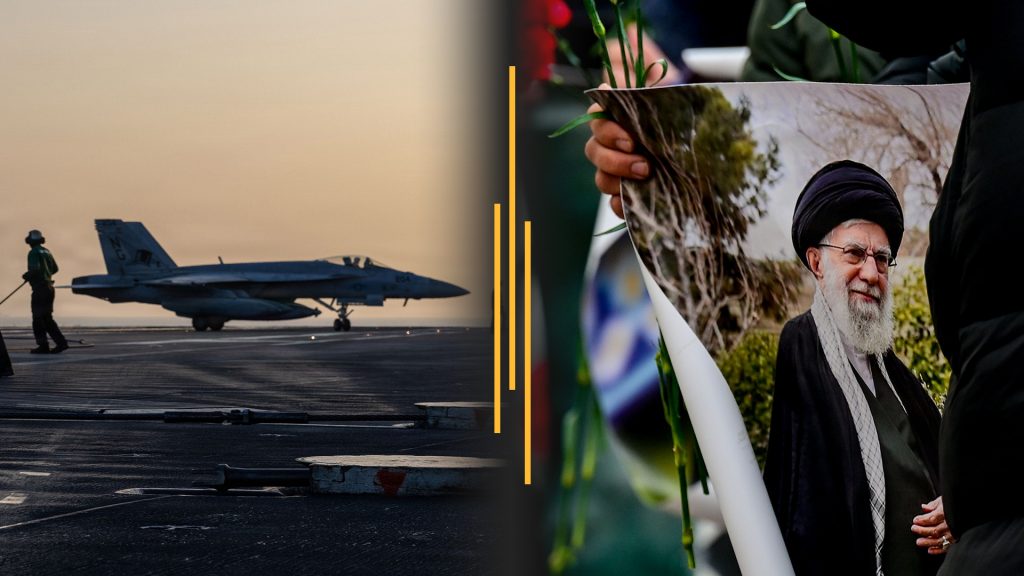
War in the Middle East escalates after U.S.-Israeli strikes kill Iran’s supreme leader. Tehran launches retaliatory attacks and activates its succession plan.
Plus, oil prices surge more than 10% as tankers halt near the Strait of Hormuz. Higher crude prices could push up gas prices within days.
And a shooting outside a bar in Austin leaves two dead and 14 injured. Investigators are examining whether the suspect was motivated by the strikes on Iran.
These stories and more highlight your Unbiased Updates for Monday, March 2, 2026.
US aircraft crash in Kuwait as war expands beyond Iran
The war in the Middle East is expanding after U.S. and Israeli strikes on Iran over the weekend killed the country’s supreme leader.
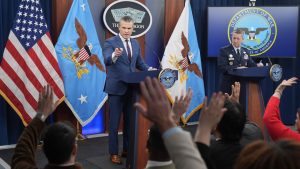
Defense Secretary Pete Hegseth and Joint Chiefs Chairman General Dan Caine are expected to provide an update Monday.

Here’s the latest:
Kuwait’s Ministry of Defense said several U.S. military aircraft crashed inside its borders Monday morning, but “all crews survived.” At least one of the crashes was caught on camera, with video appearing to show a pilot ejecting before impact. Another clip shows Kuwaitis surrounding a pilot who had ejected while awaiting authorities.
It is unclear whether the videos show the same incident, but U.S. Central Command said three U.S. fighter jets were shot down by Kuwait in a friendly fire incident. They said it was a mistake during active combat.
Iranian state television claimed that Iran targeted at least one of the U.S. aircraft that went down.
So far, three U.S. service members have been killed and five others seriously wounded in the U.S. attacks on Iran.
President Donald Trump said there are “likely” to be more losses in the coming weeks.
When asked by NBC News why he ordered the strike, Trump said it was “very simple,” saying Iran “wasn’t willing to say they will not have a nuclear weapon.”
Iran’s ambassador to the U.N.’s nuclear agency said U.S. and Israeli airstrikes targeted the Natanz enrichment facility, a site the U.S. bombed last June during the 12-day war between Iran and Israel.
“After that attack, we warned them never to resume their malicious pursuit of nuclear weapons, and we sought repeatedly to make a deal. We tried. They wanted to do it. They didn’t want to do it,” Trump said. “They didn’t know what was happening. They just wanted to practice evil. But Iran refused, just as it has for decades and decades. They’ve rejected every opportunity to renounce their nuclear ambitions, and we can’t take it anymore.”
In a social media post Sunday night, the secretary of Iran’s Supreme National Security Council said Tehran “will not negotiate with the United States.”
The conflict has since spread beyond Iran. Israel struck dozens of targets in Beirut and southern Lebanon after Hezbollah launched missiles and drones toward Israel overnight, calling it retaliation for the killing of Iran’s supreme leader.
Lebanon’s health ministry said the strikes killed at least 31 people and wounded 149 others.
Crude oil prices jump more than 10% following strikes on Iran
Oil prices have spiked following the U.S.-Israeli strikes on Iran and Iran’s retaliation in the Strait of Hormuz.
U.S. crude jumped roughly 12% in early trading Sunday night. Brent crude surged even more, up about 14%. The jump pushed prices near $80 a barrel. That’s an $8 move in a matter of hours.
Stock futures are lower ahead of the opening bell. Dow futures are down more than 500 points. S&P and Nasdaq futures are both down about 1%.
The flashpoint right now is the Strait of Hormuz, the narrow waterway that carries more than 20% of the world’s oil.

Missiles and explosives have struck at least two vessels near the strait. Shipping companies are now rerouting tankers, with dozens of vessels anchored outside the strait to avoid the risk of passage.
Overnight, the conflict widened.
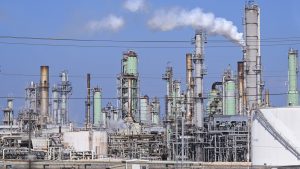
Saudi Arabia said an Iranian drone struck an oil-storage facility at the Ras Tanura refinery, one of the kingdom’s major export hubs. Operations were halted as a precaution after a small fire broke out.
Officials said the fire was brought under control.
Iran has warned ships not to pass through the strait. If traffic slows or stops, energy analysts said prices could rise quickly, and that would show up at American gas stations within days.
Every dollar move in crude typically adds about 2.5 cents to the price of a gallon of gas. At current levels, that could mean a 20-cent jump if this holds.
Iranian girls’ school hit in strike; 175 students killed
There’s mounting outrage over the apparent strike on a girls’ elementary school in southern Iran.
Video from Minab shows rescue workers and families searching through rubble, with backpacks and schoolbooks scattered amid collapsed walls and smoke.
Iranian officials said the missile hit the Shajareh Tayyebeh girls’ school on Saturday morning — the start of the school week — as children were in class.
State media reported that at least 175 people, most believed to be young schoolgirls, were killed, though exact figures are still coming in and independent verification remains limited.
Iran has condemned the strike as an atrocity.
The head of Iran’s Red Crescent called the scale of the killings unmatched even in recent conflicts, writing on X: “No such crime has ever taken place in history to date, not even in Gaza.”
UNESCO, the U.N. education agency, said in a statement:
“The killing of pupils in a place dedicated to learning constitutes a grave violation of the protection afforded to schools under international humanitarian law.”
UNESCO is deeply alarmed by the impact of the ongoing military escalation in the Middle East on educational institutions, students, and education personnel.
Initial reports indicate that an attack on a girls’ primary school in Minab, southern Iran, has resulted in the deaths of… pic.twitter.com/RGaqrUetFA
— UNESCO
#Education #Sciences #Culture
(@UNESCO) March 1, 2026
Nobel Laureate Malala Yousafzai called the deaths “unconscionable” and urged the protection of civilians under the law.
U.S. Central Command said in a statement that it is aware of reports of civilian harm and is reviewing them, but has not yet confirmed responsibility for any of the incidents. The Israeli military said it’s unaware of strikes in that specific area.
Iran activates succession plan after Supreme Leader Ayatollah Khamenei killed
Iran has set its succession plan in motion. After the strikes killed Ayatollah Ali Khamenei, Iran invoked Article 111 of its constitution and established a temporary three-member leadership council.
President Masoud Pezeshkian, who reappeared on Iranian state television Sunday after ABC reported he was also targeted in Saturday’s strikes, has joined the interim council. The other members include the head of Iran’s judiciary and a senior cleric.

Israel’s military said Saturday’s attacks killed 40 Iranian commanders, including the armed forces’ chief of staff.
Under Iran’s constitution, the 88-member Assembly of Experts must select a new supreme leader “in the shortest possible time.” The loss of senior commanders could further strengthen the Islamic Revolutionary Guard Corps, which has long served as the system’s power center.

 s Interim Leadership Council. Iranian authorities have announced an interim leadership council consisting of three members to govern the country following the death of Supreme Leader Ali Khamenei due to strikes by Israel and the United States. (Credit Image: © Tasnim via ZUMA Press Wire)
From exile in Paris, Iranian opposition figure Crown Prince Reza Pahlavi called the strikes a “humanitarian intervention” and said Iranians now have a chance to reclaim their country.
He told CBS News he wants to help lead a transition to democracy rather than restore the monarchy.
Gunman kills 2, injures 14 outside downtown Austin bar
Austin police are investigating whether the man who opened fire outside a Texas bar early Sunday had any connection to the weekend’s strikes on Iran. The shooting left two people dead and 14 others injured.
Authorities confirmed the suspect, identified as 53-year-old Ndiaga Diagne, was also dead. Police said Diagne, a U.S. citizen originally from Senegal, wore clothing bearing an Iranian flag and the phrase “Property of Allah.”
The shooting occurred outside Buford’s backyard beer garden in Austin’s entertainment district, a few miles from the University of Texas.
Investigators said Diagne drove past the bar multiple times before stopping and firing from his SUV into a crowd on the patio. He then exited the vehicle with a rifle and continued shooting along the street.
-

The Austin Police Department and the FBI investigate a shooting at Buford’s on West 6th Street in Austin, Texas, on March 1, 2026. (Photo by Stephanie Tacy/NurPhoto via Getty Images) -

AUSTIN, TEXAS – MARCH 1: Austin police work at the scene of a shooting on West 6th Street on Sunday March 1, 2026. (Jay Janner/The Austin American-Statesman via Getty Images) -

AUSTIN, TEXAS – MARCH 1: Police investigate the site of a shooting at Buford’s on west 6th street in Downtown Austin, Texas on Sunday, March 1, 2026. (Aaron E. Martinez/The Austin American-Statesman via Getty Images) -

AUSTIN, TEXAS – MARCH 1: FBI agents arrive at the site of a shooting at Buford’s on west 6th street in Downtown Austin, Texas on Sunday, March 1, 2026. (Aaron E. Martinez/The Austin American-Statesman via Getty Images)
Officers responded and shot him. He died at the scene.
The FBI said the motive remains under investigation and that terrorism has not been ruled out. NBC News reported that sources close to the investigation said Diagne had a history of mental illness.
NASA resets moon landing plan, targets 2028 return with annual missions
NASA will revamp its plan to return astronauts to the moon. Administrator Jared Isaacman said the updated architecture aims for a 2028 lunar landing and at least one surface mission each year thereafter.
The new plan follows a series of technical setbacks.
Earlier this year, hydrogen fuel leaks, and just last week, helium flow issues forced NASA to roll the Artemis II rocket off the pad and back into the Cape Canaveral hangar for repairs.
Artemis II — a mission that will send four astronauts around the Moon — is now targeting a launch no earlier than April.
Under the revised strategy, NASA will add an additional mission before a lunar landing.

In 2027, two astronauts would fly aboard an Orion capsule for a practice run, testing systems and operations ahead of a crewed moon landing.
Isaacman said the goal is a faster, more reliable cadence, modeled after the Apollo program, which landed a dozen astronauts on the moon between 1969 and 1972.
More from Straight Arrow News:

Chicago’s parking saga: What other cities can learn from ‘the worst deal of the century’
Chicago’s struggle to reclaim its streets from a 75-year private parking lease has morphed into a what-not-to-do case study for city planners across the U.S. While the deal originally provided a $1.2 billion “quick fix” for a 2008 budget crisis, Mayor Brandon Johnson told Straight Arrow News that the cost to buy back the meters now is “far too high.”
Experts told SAN that the situation serves as a high-stakes warning to other cash-strapped cities: An upfront cash infusion today could result in a loss of local control and revenue that lasts for generations.
City officials have been forced to retreat from plans to buy out the lease for the parking meters it sold nearly two decades ago. The lost revenue and increasing ticket prices for Chicagoans have made the deal, set to expire in 2083, burdensome to residents.
The meters went up for a bid last summer, and multiple bidders, including the city, were interested. But Johnson told SAN that the city decided against it due to the cost.
“The final purchase price is far too high, much more than we initially received for the sale and higher than most reasonable assumptions would support,” Johnson said. Read the full story now>
Ella Rae Greene, Editor In Chief