In blow to Voting Rights Act, Supreme Court limits districts drawn for Black voters
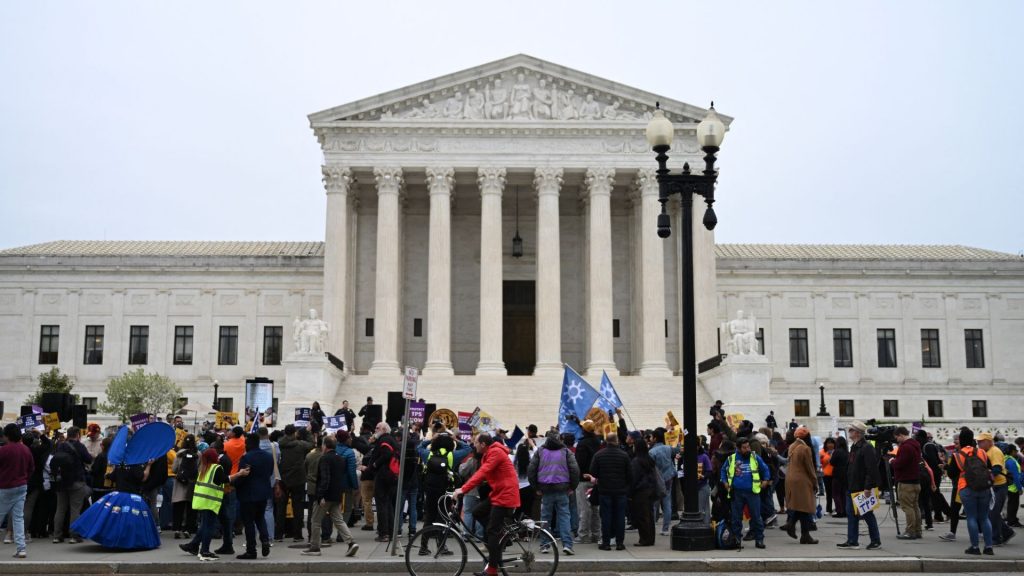
In a historic ruling on Wednesday, the Supreme Court said the Voting Rights Act — the landmark legislation from 1965 intended to protect Black Americans from disenfranchisement — does not permit states to draw voting districts primarily based on race.
The decision is expected to significantly limit how states and local jurisdictions draw congressional, legislative and other maps. Some legal experts say it could chill other racially conscious remedies more broadly.
The decision could have a significant impact on this year’s midterm elections. Several analyses suggest Republicans may gain as many as 12 House seats in Southern states that use the ruling to erase congressional boundaries that previously favored Black candidates in certain districts. Already on Wednesday, the Florida Legislature voted on party lines to adopt a new map that could lead to Republicans picking up four seats in Congress this November.
The Supreme Court’s 6-3 ruling came in Louisiana v. Callais. White voters in Louisiana challenged the creation of the state’s second majority-Black congressional district in 2024. The district runs along the Mississippi River north of Baton Rouge.
The majority opinion, written by Justice Samuel Alito, said the 2024 map amounted to “an unconstitutional racial gerrymander.”
Alito, however, contended that the ruling did not gut the Voting Rights Act, but merely set a new framework for considering the constitutionality of new voting districts.
Challengers to new maps will not have to prove a state “intentionally drew its districts to afford minority voters less opportunity because of their race,” Alito wrote. He said the court will reject challenges that “cannot disentangle race from the state’s race-neutral considerations, including politics.”
Justice Elena Kagan wrote a stinging dissent, forgoing the traditional caveat that she disagreed with the majority “respectfully.”
She described the decision as “this latest chapter in the majority’s now-completed demolition of the Voting Rights Act.”
“I dissent because the Court betrays its duty to faithfully implement the great statute Congress wrote,” Kagan said. “I dissent because the Court’s decision will set back the foundational right Congress granted of racial equality in electoral opportunity.”
The decision was the end of a long legal battle that twice made its way to the Supreme Court. In 2024, the court sent the case back to Louisiana, which ended up drawing new districts. But a three-judge panel in U.S. District Court threw out the map on the grounds that it was racially gerrymandered.
‘Equal protection’
The Trump administration sided with the white voters who sued to overturn the majority-Black district, and officials welcomed the Supreme Court’s decision.
“Extremely gratified to see this decision we’ve been waiting for!” Assistant Attorney General Harmett Dhillon, who heads the Justice Department’s civil rights division, wrote on X. She called the decision “perhaps one of the most important developments in decades in Voting Rights Act jurisprudence!”
Louisiana Attorney General Liz Murrill, a Republican, said the court issued “a seismic decision reaffirming equal protection under our nation’s laws.”
“The Supreme Court has ended Louisiana’s long-running nightmare of federal courts coercing the state to draw a racially discriminatory map,” Murrill said in a statement.
‘A moral indictment’
But the NAACP, in a post on X, described the decision as “a direct attack on Black voters” that “marks a shameful moment in our democracy.”
“This ruling opens the door to racial gerrymandering that will take us back to Jim Crow,” the organization said. “This ruling is a betrayal of Black voters and the promise of democracy.”
Martin Luther King III, whose father led a march from Selma, Alabama, to the state capital in Montgomery that built widespread support for passage of the Voting Rights Act, described the court’s decision as “not simply a legal setback, but a moral indictment that reflects a continued retreat from the promise of equal justice.”
“Dr. Martin Luther King Jr. understood that voting rights are the foundation of our entire democratic system,” the civil rights leader’s son said in a statement. “Without them, we are a democracy in name only. While future courts may address this ruling, the damage is immediate, and this moment demands that we choose whether to accept the erosion of our democracy or stand together to defend it.”
Ella Rae Greene, Editor In Chief