How the neurodiversity movement has left some autism families behind
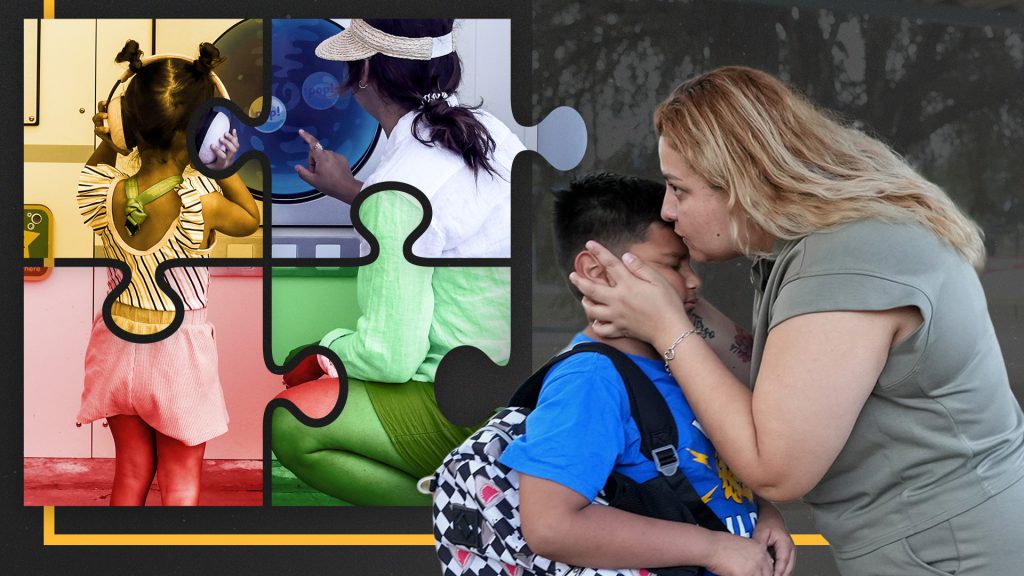
When Amy Lutz’s son, Jonah, was diagnosed with autism 27 years ago, she didn’t know any other parents raising autistic children.
At the time, autism was almost universally understood as a profoundly disabling developmental condition. That described Jonah Lutz. After his language development was delayed as a toddler, Amy Lutz initially wondered whether he might be deaf. Instead, a physician diagnosed him with autism when he was 2.
Today, Jonah Lutz has limited spoken language. He can communicate his likes and dislikes and recite lines from “Sesame Street,” but he cannot answer more abstract questions beginning with “how” or “why.” Despite years of treatment that helped control his aggressive behavior, he still bites his hand or hits his head when distressed. Amy Lutz has “Jonah-proofed” their house, adding code locks to all exterior doors to prevent Jonah Lutz from running off, a common compulsion among people with autism. Jonah Lutz requires round-the-clock care and will for the rest of his life.
In the decades since Jonah Lutz’s diagnosis, the definition of autism — and the public conversation surrounding it — has changed dramatically. Today, autism is increasingly understood not only as a medical diagnosis and disability but also as an identity embraced by many autistic people.
“I can’t believe I’ve lived to see this, but autism has become trendy,” Amy Lutz said. “It’s become something that’s self-diagnosed, that people celebrate as an identity, and that’s really had a deleterious effect on discourse around profound autism.”
This is part 5 of a 5-part series examining one of the most contested areas in modern medicine.
- Part 1: Autism research is entering a new era. Here’s what scientists are learning
- Part 2: Inside the decades-long search for autism’s causes
- Part 3: For decades, the definition of autism expanded. Is it now too broad?
- Part 4: Are more children developing autism, or are doctors diagnosing it differently?
The spectrum now encompasses people like Jonah Lutz alongside those who graduate from college, build careers and have their own families. For many autistic adults, autism’s growing awareness and shrinking stigma have brought greater acceptance, recognition and a rejection of the idea that autism is a disease to be cured. But Amy Lutz and other parents of people with profound autism argue that shift has come at a cost. As public attention, research and advocacy have increasingly focused on higher-functioning autistic people, they say, the needs of those who require lifelong care are increasingly overlooked.
The rise of neurodiversity
In the 1990s, the “neurodiversity” movement began challenging the traditional view of autism as a disorder or disease, arguing instead that it was a natural variation in how people’s brains develop and function.
“At its core, the neurodiversity movement comes from this idea that autism is not necessarily a pathology, or shouldn’t only be understood through a medicalized lens, but it can also be understood through a social lens and as a source of identity and social belonging, and as part of a larger political project of acceptance towards a variety of different types of being,” said Devon Price, a social psychologist, activist and associate professor at Loyola University Chicago.
Zoe Gross, the director of advocacy at the Autistic Self Advocacy Network, said that perspective does not mean denying the real challenges many autistic people face. Rather, she said, it reflects a different way of understanding autism itself.
“There are certainly medical disorders that autistic people are more likely to have. Examples are anxiety, depression, gastrointestinal issues,” she explained.
“But I don’t view autism itself as a medical disorder, regardless of the support needs of the person,” she said. “I think the word disability sums up the way autism affects people pretty well.”
Inspired by the broader disability rights movement, neurodiversity advocates championed acceptance, civil rights and inclusion, arguing that society should focus less on “fixing” autistic people and more on removing barriers and expanding accommodations in school, workplaces and health care.
Beginning in the early 2000s, autistic people increasingly shared their experiences through blogs, books and social media. Price credits these advocates and the broader movement with fundamentally reshaping how autism is understood, accepted and represented in society.
“Public attitudes toward autism and awareness about autism is really different now than it was even five years ago,” he said.
Today, it’s easier for people to be evaluated for and diagnosed with autism, allowing more people to access services and support that might previously have been out of reach. Employers are more willing to hire neurodivergent workers, and disclosing an autism diagnosis is no longer a “black mark on your career,” Price said.
The movement has also changed autism research itself. More autistic scientists are studying autism, bringing lived experience into a field that for decades was dominated by outside observers.
“We’re getting research that is more informed by how it actually feels to be autistic, and therefore it makes a lot fewer assumptions,” Price said. “Now there is a more critical and multi-dimensional analysis of what autism is in the research literature.”
A growing disconnect
Amy Lutz and other parents of people with profound autism say they support the neurodiversity movement’s goals of greater acceptance, dignity and civil rights. But some believe the same changes celebrated by the movement have contributed to a growing disconnect between how autism is commonly understood and the realities their families face.
Straight Arrow has interviewed dozens of families raising children with profound autism. Many described being turned away from autism day programs, camps and extracurricular activities because providers were unequipped to care for children with intensive behavioral or medical needs.
Others said that while schools developed individualized education programs, or IEPs, they lacked the staffing or specialized resources to carry them out. In many communities, parents said, there were simply no alternatives.
While some of these challenges are not unique to those with profound autism, parents said the consequences of those gaps are often greater because specialized alternatives are scarce or nonexistent. Many also felt that the broader autism service system has been built for children who are easier to help.
“Parents or support teams for autistic people with higher support needs are worried about their kids disappearing in terms of getting resources, in terms of getting public attention, and kind of being replaced by this image of like the slightly eccentric verbal autistic adults who can function relatively independently,” Price said. “I think when they’re worried about that, they’re completely right.”
Price said autistic adults like himself often receive more attention because they can advocate publicly for themselves and are more accessible to journalists, policymakers and researchers. This, he said, reflects broader societal biases about whose voices are heard rather than a flaw in the neurodiversity movement.
“Autistic people who put forward a more respectable vision of autism are taken more seriously, and that’s because of ableism as well as the privileges that we have,” Price said.
Should autism be treated?
For decades, scientists have searched for the biological causes of autism, hoping that understanding the condition might yield new treatments. Researchers such as Joseph Buxbaum, director of Mount Sinai’s Seaver Autism Center for Research and Treatment, say decades of genetic research have led to potential treatments for some of the rare genetic conditions associated with profound autism. Several are now in clinical trials.
Many neurodiversity advocates argue that pursuing treatments intended to eliminate or fundamentally alter autism is misguided.
“We need more research that helps autistic people live our lives. But most autism research focuses on trying to find out what causes autism, in order to prevent or ‘cure’ it. This is not research that autistic people want,” the Autistic Self Advocacy Network said on its website.
Gross agrees.
“I don’t think eliminating autism is possible. I don’t think curing autism is possible. I don’t think reversing autism is possible,” she said. “I think money spent pursuing those goals is essentially thrown down the drain.”
Buxbaum sees the issue differently. He said his work has never been about eliminating autistic people, but about helping those whose autism is accompanied by severe intellectual disability, epilepsy, the inability to communicate or a need for lifelong, round-the-clock care.
For years, he said, even suggesting that autism genetics might lead to new treatments made him a target.
“You could go to a scientific conference, and you’d be shouted down,” he said. “If you’re working on genetics, you’d really get shouted at, because the thought was that we’re going to commit eugenics.”
At one conference, Buxbaum predicted genetic testing for autism might become possible within a decade.
“Somebody put on the web the ‘Autism Genocide Clock,’ where they were counting down 10 years when Dr. Joseph Buxbaum would start selecting children to not have autism,” he said. “It was traumatic.”
Buxbaum is still accosted for his work to this day. The backlash partly explains why researchers increasingly distinguish people with “profound autism” from the broader autism spectrum.
“Given those criteria,” he said, referring to people who require 24-hour supervision, cannot communicate or have severe co-occurring conditions such as epilepsy, “do you really think that that person wouldn’t benefit from help?”
Even then, Buxbaum said, some people remain opposed to research aimed at developing treatments.
The debate over autism’s most common therapy
The autism community is similarly divided over one of the most common interventions for autistic children: Applied behavior analysis, or ABA.
Developed in the 1960s, ABA is a research-based behavioral therapy that aims to teach kids new skills and reduce behaviors that may be dangerous or interfere with learning, according to the Child Mind Institute. Today, it is the most widely used autism therapy in the U.S.; more than 60% of autistic children receive ABA at some point in their lives.
Medicaid spending on ABA has more than tripled in recent years, growing from about $660 million in 2019 to more than $2.2 billion, making it one of the largest public investments in autism services.
ABA is endorsed by many physicians, autism experts and leading medical organizations, including the American Academy of Pediatrics and the American Academy of Child and Adolescent Psychiatry. Many parents describe it as life-changing; others say it is the only therapy available to help their children.
But many neurodiversity advocates, including the Autistic Self Advocacy Network, strongly oppose the practice, arguing that its goal has historically been to make autistic people appear less autistic rather than supporting them on their own terms. They contend the therapy encourages children to suppress natural behaviors such as stimming — hand-flapping, rocking or other repetitive movements or sounds that help regulate emotions or sensory experiences — and prioritize conformity over well-being.
Price said some of those concerns are rooted in ABA’s origins. The therapy was developed by psychologist Ivar Lovaas, who also led the controversial Feminine Boy Project, which sought to make boys act less feminine and is now considered an early form of conversion therapy.
Lovaas believed autistic behaviors could be reshaped through intensive behavioral conditioning. Early ABA programs used rewards to reinforce desired behaviors but also relied on aversive techniques — including yelling, slaps and electric shocks — to discourage behaviors considered undesirable.
“Both of those behavioral therapies were about conditioning the child to behave in a more normative way,” Price said. “When it was first being founded, it involved a lot of stuff that I think everybody would find pretty upsetting today, like using electric shocks to punish kids, rewarding kids with kisses or giving them candy, conditioning their behavior like they were a trained animal. That kind of training has been linked to a lot of traumatic outcomes, and that lineage of ABA is still very much with us.”
Price said some ABA therapists still use electric shocks to punish children for misbehaving, although many practices have abandoned negative reinforcement for more positive life-skills training.
But valid concerns remain. As demand for ABA has surged, so too has the number of private clinics offering the therapy, many operated as for-profit businesses. Advocates and researchers have raised concerns about inconsistent quality, a shortage of experienced clinicians, limited oversight and financial incentives that can reward providing more hours of therapy rather than better care.
Guardianship and residential facilities
The tensions between the neurodiversity movement and some parents, particularly those raising children with profound autism, extend beyond research and therapy.
Neurodiversity and disability rights advocates broadly oppose guardianship, a legal process that transfers decision-making authority to another person when an individual cannot safely make certain decisions independently. They argue it strips people with disabilities of their rights and can leave them vulnerable to abuse, isolation and institutionalization. Instead, Price said, the movement favors supported decision-making, in which people with disabilities retain legal authority while receiving help making complex decisions.
“I think we assume somebody is incapable too soon,” Price said. “If you are someone who has a disability, you might have preferences about how you want to live your life, but you need somebody to help you figure out how to go to the bank, how to get your bills paid, what your medical decisions are going to be and things like that.”
Parents of children with profound autism told Straight Arrow that eliminating guardianship would leave some of the most vulnerable autistic adults without adequate legal protections.
Holly Connor, a mother of an adult son with profound autism in North Carolina said she faced criticism after becoming his legal guardian.
“I absolutely 100% don’t think my son’s incompetent,” she said. “But based on the system that we have, and in order to ensure his health and safety, the least restrictive option for him was guardianship.”
Similar disagreements extend to long-term housing.
“The big issue right now that’s haunting autism is what happens when autism parents die,” said Jill Escher, the president of the National Council on Severe Autism and mom to two children, now 25 and 18, with profound autism. “Our kids are going to need care for the rest of their lives.”
While many families hire caregivers to provide medical care and help with daily activities at home, several parents said that approach often falls short for people with profound autism and severe behavioral challenges. And some agencies are unwilling or unable to serve individuals with aggressive or self-injurious behaviors, while few can provide the continuous, round-the-clock care their children need.
Instead, some parents said they hope to place their children in long-term residential communities where they can receive specialized care and structured activity while living alongside peers with similar needs.
While some states — including New York, New Jersey and Virginia — have developed residential communities for adults with autism and other developmental disabilities, efforts to establish similar programs have faced obstacles elsewhere.
Amy Lutz lives in Pennsylvania, which she described as “one of the most restrictive states in the country regarding where disabled people with Medicaid waivers are allowed to live.”
READ MORE: What’s behind the vanishing safety net for families with disabled children
State regulations have made it difficult to establish residential communities for adults with autism, prompting a federal lawsuit in 2024 alleging the requirements discriminate against people with disabilities.
“We are not allowed to build any residential settings larger than four people, so that precludes all intentional communities, campuses, places that would be big enough to provide the kind of structure and activities and supports that one individual group home or apartment just could never support,” Amy Lutz said. “Jonah still lives at home because of this rule.”
Amy Lutz said she cannot imagine a future in which her son lives in his own apartment with a support person who is paid $15 an hour to sit with Jonah as he watches the same 30 seconds of “Big Bird Sings” on repeat.
“That it is not my idea of a meaningful life,” she said. “Yet that’s considered totally great by the inclusion advocates, as long as he’s in his own apartment and not in a larger community, even if his life would be much more meaningful and robust in a bigger community with lots of different staff at different levels, lots of different eyeballs on him, lots of activities, maybe lots of therapies, more freedom to move around.”
Amy Lutz said neurodiversity advocates have become influential voices in shaping disability policy, advocating for services centered on independence and community inclusion. She supports expanding those options, she said, but she worries they have increasingly become the default model for everyone on the spectrum.
“Neurodiversity advocates don’t believe in any kind of specialized disability-specific settings, because that’s not what they want for themselves. I respect that’s not what they want for themselves,” she said. “I just have never understood the logic. I don’t want something, therefore nobody should have it. It completely disregards the very different needs and preferences of not only people with profound autism, but even people with moderate or even high-functioning autism who might want to live and work with other disabled people.”
The neurodiversity movement has reshaped public understanding of autism, reduced stigma and helped ensure autistic people have a stronger voice in policies that affect their lives. But in the push for inclusion, Amy Lutz, Escher and other parents of people with profound autism say those same changes have fundamentally excluded their children.
They still face an uncertain future.
Round out your reading
- What does low water at the Hoover Dam mean for power in the American West?
- Could GLP-1 drugs become the first longevity medications? Scientists think it’s possible.
- ChatGPT told him he wouldn’t face charges. Then came the arrest warrant.
- How one small city built a second act as a bio hub inside empty cigarette factories.
- If permanent Daylight Saving Time is so popular, why is it dead in the Senate?
Ella Rae Greene, Editor In Chief