How an AI slop shop is flooding TikTok with pro-war disinformation
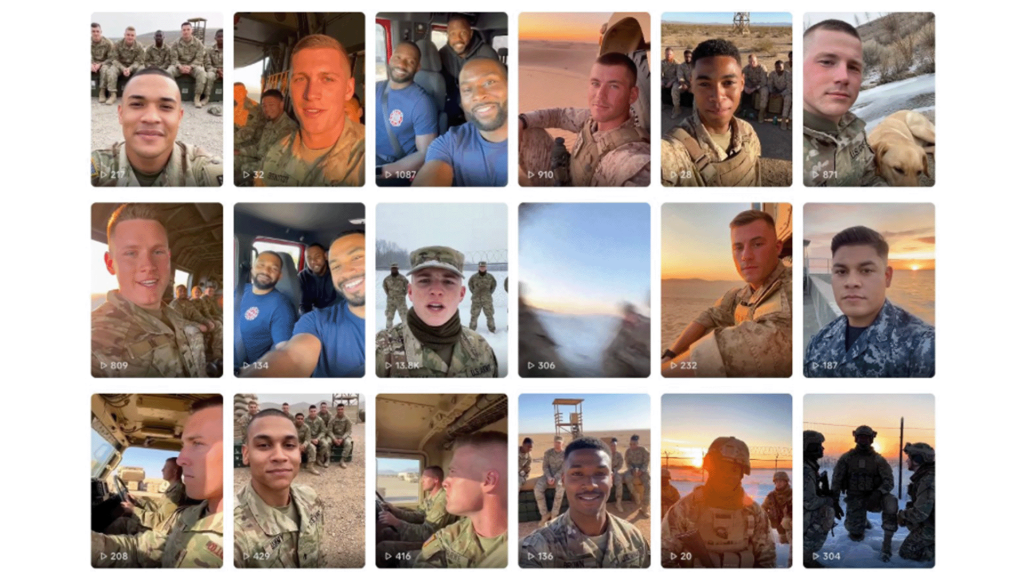
In one TikTok video, a young soldier stares into the camera and offers a heartfelt message.
“In case you never see us again, take good care of yourselves,” the soldier says, before declaring the motives behind his military service: “For you, for this country.”
The post, from a user who claims to be a decorated World War II veteran, is one in a flood of AI-generated videos on the social media platform carrying similar, even identical, emotional appeals. The “soldiers” speak of missing birthdays, hugs and quiet nights at home — ”all for the ones I love.”
Research released Monday claims the TikTok posts are about more than engagement farming designed to generate views and money. Instead, they’re part of a coordinated influence campaign engineered to normalize the U.S. invasion of Iran, according to the report by dotNex, a startup that leverages artificial intelligence to detect coordinated online influence operations.
The campaign, which researchers concluded is “likely of foreign origin,” encompasses more than 100 inauthentic TikTok accounts that have collectively posted more than 52,000 videos. So far, the videos have amassed more than 3.8 million views, 400,000 likes and 42,000 comments.
The goal behind the videos is to “suppress anti-war sentiment and normalize the war” in Iran, Luca Luceri, dotNex’s founder and CEO, told Straight Arrow.
“The objective is to create an illusion of public consensus” about the military operation, said Luceri, who is also a research assistant professor at the University of Southern California, where he helped develop a framework to identify coordinated disinformation on TikTok. The purpose, he said, is to influence TikTok users into believing “they are surrounded by people who think the war is good for the country.”

The research contradicts previous reports, including by Straight Arrow, that the flood of AI-generated videos of U.S. troops are motivated purely by profit. It also calls into question TikTok’s ability to prevent bad actors from using its platform to feed people disinformation.
A TikTok spokesperson declined to comment for this story without first reviewing the report’s findings.
TikTok policies allow the use of AI-generated content so long as it’s “honest” and is not used “to mislead, deceive or create false impressions about products, people or facts.” TikTok notes the platform “may take appropriate enforcement against AI-generated content and related accounts that violate” its standards based “on the nature, severity and frequency of the violation.”
The purported influence campaign comes at a time when many Americans — young Americans in particular — routinely turn to TikTok and other social media platforms for news.
Inside a TikTok influence operation
Researchers point to identical captions across videos and production errors to conclude the posts are part of a single production pipeline. The videos fall into two buckets. Some 75 accounts take on the personas of male soldiers in combat zones claiming active-duty credentials and, at times, “historically impossible” or absurd biographies, like the one claiming to be a World War II vet. A second cluster, spanning more than 30 accounts, depicts distressed female service members, often crying. All of the accounts leverage emotional narratives to win views and influence.
“I know you don’t care about the troops in Iran,” claim numerous videos across the accounts, “but texting ‘Hello’ makes my day.”
The report notes the “crying soldier” trope was previously attributed to an Iranian disinformation operation by researchers at Alethea, a technology company focused on exposing disinformation, and highlighted in The New York Times.

The dotNex report highlights multiple indicators leading researchers to conclude the posts originated from a single automated pipeline. The accounts posted the videos in “a synchronous fashion within tight time windows,” shared formulaic structures, included “anatomically impossible uniform configurations” with non-existent rank insignia and reused captions across users. While the accounts have amassed large followings, the users themselves follow few accounts, if any at all.
Several production errors led researchers to conclude the videos are part of a foreign influence operation.
Some videos included Indonesian-language captions referring to a volcanic eruption that had “nothing to do with U.S. soldiers or the U.S. military.” Chinese-language metadata present in some accounts suggest “foreign, likely Chinese-linked automated infrastructure,” the report concludes.
In one instance, an account linked directly to a Chinese AI-character generation platform, while other videos contained Chinese-language background speech while featuring a primary speaker “presenting as U.S. patriotic content creators.”
“We are confident in saying this is powered by Chinese actors, or somebody from China is behind this,” Luceri said. “In general, the emotional register was to somehow suppress anti-war sentiment” and build a sense of intimacy with military communities. The account operators motives, he acknowledged, are difficult to pinpoint with certainty. The report notes that attribution in influence operations “is rarely definitive” and that researchers’ conclusions about foreign interference “should be understood as the most parsimonious interpretation of the signals available.”
Although he concluded that the videos were designed to bolster pro-war sentiment among the U.S. public, he acknowledged that money is also at play. Among the videos of female soldiers in distress, some 30% later pivoted to promoting products, a tactic consistent with influence-for-hire account farms.
People increasingly use TikTok for news
Through its findings, Luceri told Straight Arrow, researchers aim to “protect governments and citizens from foreign influence” and disinformation campaigns that “try to manipulate public opinion.”
More than half of U.S. adults say they get news and information from social media sites like Facebook and TikTok at least sometimes, according to a recent Pew Research Center survey. While that rate has held relatively steady over time, the number of people using TikTok for news has increased exponentially as its popularity has grown more broadly.

Nearly 40% of U.S. adults reported using TikTok in 2025, as did 68% of teens ages 13 to 17. Roughly a fifth of teens reported using TikTok “almost constantly.”
Roughly half of U.S. adults who use TikTok reported to Pew researchers that they turn to their feeds for news, according to Pew. Compared to those of other social media platforms, TikTok users are more likely to report that news on their feeds “feels unique to them,” said Kirsten Eddy, a senior researcher at Pew Research Center focused on U.S. news and information habits.
“People often refer to the algorithm as unique to them, they talk about it being particularly strong at feeding them content that they enjoy,” Eddy told Straight Arrow. That personalization could influence TikTok users’ trust in the videos they watch.
“We are at the point now,” Eddy said, “that younger Americans, adults under 30, are about as likely to say that they trust the information that they get on social media as to say they trust information from national news organizations.”
Round out your reading
- Could a common dietary supplement accelerate Alzheimer’s?
- NY AG Letitia James gets hundreds of taunts, racial slurs in ICE public reporting portal.
- As Musk becomes the first trillionaire, historian sees warning signs.
- An experimental weight loss drug is so effective, many Americans don’t care it’s not FDA approved.
- How search engine optimization reduced Simone Biles to an ‘NFL wife’.
Ella Rae Greene, Editor In Chief