How a group of Florida volunteers is reshaping the future of public parks
ORANGE CITY, Florida — Over the course of Richard and Joy Fox’s 50-year marriage, they have prioritized their beloved outdoor adventures.
The two frequently traveled the country and state of Florida, traversing various state and national parks to hike and go birding. But when Joy’s back problems began hampering her mobility, the couple worried they’d never take another joint hike.
That was until the two heard about an all-terrain wheelchair program at Blue Spring State Park, about 45 minutes outside of Orlando, which allowed them to hit the trails.

“Hiking had been part of our routine for years, but it became inaccessible,” Richard Fox told Straight Arrow. “Now, it looks like that door is open again.”
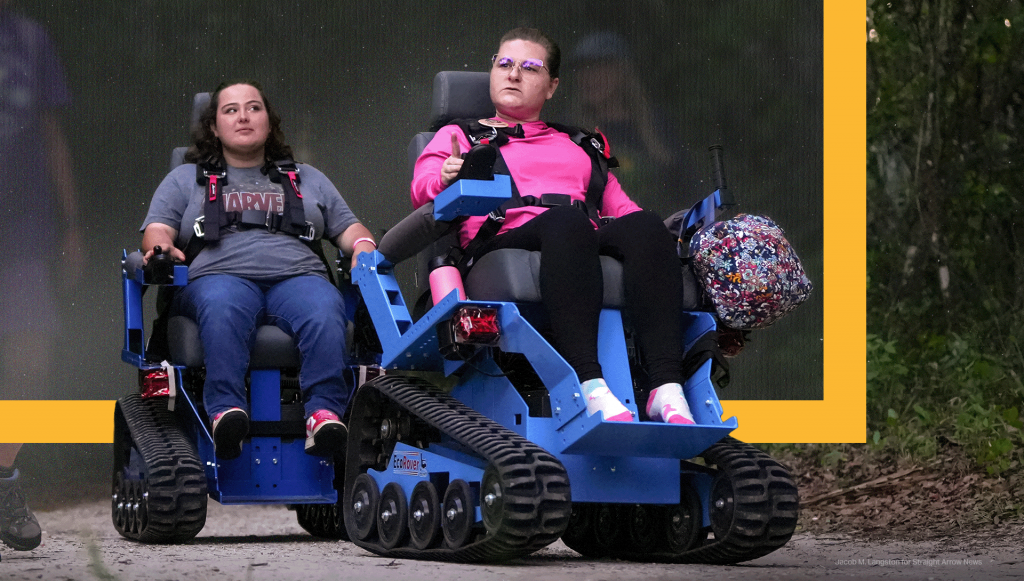
The program is the brainchild of Friends of Blue Spring State Park, a volunteer-run nonprofit that provides support for the park. It’s part of a growing national movement to make parks and trails more accessible, shifting the practice from infrastructure-based Americans with Disabilities Act standards — like a paved trail or accessible restroom — to treating accessibility as a necessary inclusive program.
By intentionally making outdoor spaces accessible, it allows people who may have never been in nature — or lost the ability to do so — to experience it.
The network of people working to make these moments happen is growing, despite federal pressure to curtail diversity equity and inclusion efforts across the country. While much of the debate centers around race and gender, disability access is often folded into the same bucket.
Where are all-terrain wheelchairs available?
Dan McNeal, director of the quality of life grants program at the Reeve Foundation, said the organization has seen applications for accessibility funds jump from 200 to about 350 in the past year. These requests often come from nonprofit organizations working in tandem with states or local jurisdictions to fund these efforts.

Georgia’s Department of Natural Resources partners with a non-profit to bring all terrain wheelchairs to nearly two dozen different parks across the state. In Texas, nine battery-operated track chairs are available at 10 state parks. And in Wisconsin, not only are all-terrain wheelchairs available at several parks, but they also have additional adaptive equipment for kayaking and cross-country skiing.
At Blue Spring State Park, the wheelchair is free, with park admission, for anyone to use — no questions asked. Participants do have to book in advance online. Once at the park, a volunteer accompanies guests on the hike for safety purposes, occasionally pointing out big clumps of tree roots or uneven ground. The guest can control their own chair or a volunteer can remotely control it. Guests can choose the length and duration of their hike and there are multiple trails, including one that is four miles long. While the chairs can reach a speed of 3 mph, this trail typically takes about three hours to complete.
The volunteer group offers regular hikes but also plans specialty ones, like during a full moon. Most recently, they schedule hikes during firefly season to make it accessible for all to see the park light up with flashes of yellow.
“We say this is your hike,” Kathleen Hallum told Straight Arrow. “If you want us to tell you about nature, we’ll tell you about nature and the plants or birds you’re seeing. If you want us to be quiet, we’ll be quiet.”
But Hallum and another volunteer, Nancy Jeffreys, have found most hikes build new connections.
“It’s so rewarding,” Jeffreys said. “Every time we go out, we say that was the best hike; and then the next time we hike, we say that was the best one.”
The program is personal for both women.
For Jeffreys, it allowed her and her husband to share hikes together again.
The couple always enjoyed the outdoors, she said, but a hiking accident left her husband with a spinal cord injury that only allows him to walk short distances. It had been almost eight years since they had been on the trails together. The all-terrain wheelchairs made it possible.

Jeffreys joked that since that hike, her husband, who was one of the first to try the wheelchairs, is the unofficial spokesperson for the program.
“Just for me to be out in the woods with him and to talk and be in the environment of the trees,” Jeffreys said. “He was very emotional and I was crying.”
About two years ago, Hallum was inspired by a friend with mobility issues and became determined to bring more accessibility to the park. She worked furiously on an in-depth analysis about why it would benefit the park. Little did she know the park was also working on it. Two days after turning in her report, a chair was donated.
That, she said, was the first of many lessons: It wasn’t the right chair for a proper hike. The balloon wheels made it lack stability on the rough terrain.
So, for several months Hallum said the park would borrow an all-terrain wheelchair from a friend at another state park. Eventually, Friends of Blue Spring learned of a grant that could fund the purchase of two wheelchairs at $16,000 each. Three weeks after submitting the grant, they secured the funds.
The program boomed.

Why is outdoor accessibility important for people with disabilities?
It went from the occasional user to once a month. Then, a few times a month and then once a week. Now, the group hosts at least three hikes a week.
It has become so popular, Hallum said, that the nonprofit recently purchased two additional chairs with the help of a large donation.
“So many of these people have been in a wheelchair for a long time and so when we tell them, ‘this is your hike,’ they get their independence back,” Hallum said.
One woman started crying over seeing pine cones — she was used to only seeing them in hobby stores.
Another married couple could not stop holding hands during their spin on the chairs — their final of countless hikes together as the husband faces the end stage of his life.
Kristen Laney O’Toole, 52, has multiple sclerosis and has been using a wheelchair for about 12 years.
Throughout that time, she never went off road or on a trail. She had tried adaptive kayaking, surfing and recumbent biking. But never a hike.

That is until last month, after a friend of hers found Blue Spring’s program. The two packed up in the car with her friend’s dog for the hourlong drive from Flagler Beach.
“You get so used to learning that you can’t do something because of the accessibility of the place,” O’Toole said. “Then, I was able to go on a very normal hike with my friend. It wasn’t a big event. It was just a Saturday morning hike.”
O’Toole had so much fun that she said she hopes to bring a similar program to one of the parks where she lives. That way, she said, she can access it on a more regular basis — and so can others.
It’s exactly what Hallum and Jeffreys would love to see, too.
“We have a formula here, but it takes a lot of enthusiasm and a lot of work so, maybe our success here can be heard someplace else,” Jeffreys said. “I’d like to see this in every park.”
Ella Rae Greene, Editor In Chief