Experts call foul on Trump and FIFA claims of a World Cup economic boom
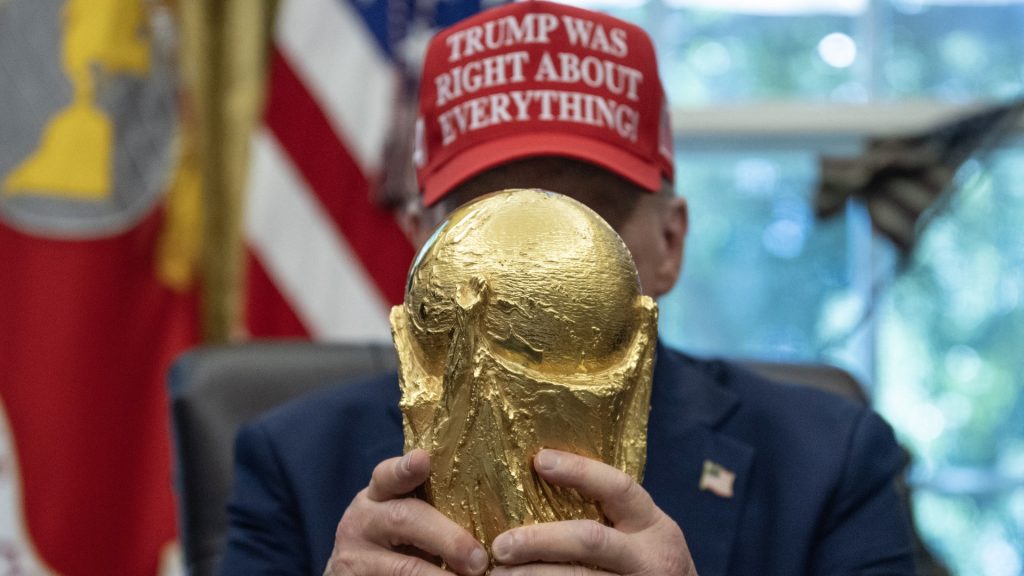
President Donald Trump and FIFA officials have kicked around bold claims about a 2026 World Cup economic boom for the U.S. and its 11 host cities. A White House task force predicted that the tournament, which kicks off Thursday in Mexico City and reaches Los Angeles on Friday, will boost U.S. gross domestic product by $17.2 billion and create more than 185,000 jobs.
The World Cup will “showcase the greatness of American world-class athletic competition,” Trump said in a November meeting with FIFA President Gianni Infantino. He said it “will also be an incredibly significant economic opportunity for countless American workers and businesses.”
But leading sports economists interviewed by Straight Arrow said the president probably sent the forecast wide of the net.
Decades of research on mega-events such as the World Cup and the Olympics, they said, show that host countries rarely enjoy the economic windfall they expect, and the final score usually falls short of the pregame hype.
No ‘massive spike’
If the goal is economic gain, hosting a major international sporting event is typically as low-scoring as a soccer match.
Ben Shoesmith, a senior economist at KPMG, said he expects job growth in the restaurant and hotel industries in the host cities, particularly in places like Kansas City, the site of a monthlong celebration featuring concerts and parties.
Many of the sports fans descending on these cities, he added, are well-heeled and have plenty of cash to spend, including thousands of dollars on tickets to the matches.
Even so, Shoesmith told Straight Arrow, “I don’t think this is going to be something where you see a massive spike.”
“I think there will be a small, transitory bump in local economic activity,” said Michael Leeds, an economics professor at Temple University in Philadelphia, a host city. “But its impact on our financial well-being will be negligible.”
One reason, Leeds told Straight Arrow, is the “displacement effect”: tourists who would otherwise visit these cities will avoid them during the tournament, and people attending the World Cup are unlikely to visit the cities’ traditional attractions.
Experts also mentioned the “substitution effect”: soccer fans who live in the area might splurge on the games but cut back elsewhere.
“It’s like moving the deck chairs around,” said Stefan Szymanski, a professor of sports management at the University of Michigan. Some consumers are just shifting their spending, not increasing it.
‘A drop in the bucket’
The 2026 World Cup will be the biggest in the tournament’s history as it expands to 48 teams, 104 matches and three host countries: the U.S., Mexico and Canada. In the November meeting with Trump, Infantino said these games could become “one of the greatest cultural events in world history.”
Szymanski said even though “people will be glued to this World Cup and it will take up their headspace,” that attention is unlikely to translate into significant economic value for the U.S. or its host cities.
Any economic gains will just be a “drop in the bucket of the U.S. economy,” he said. And that also applies on the local level.
“The amount of money that goes through the books in a major hospital in Philadelphia in one day probably exceeds the entire spending associated with the World Cup finals,” Szymanski said.
Leeds added that “even if one were to believe” the Trump’s administration’s estimate of a $17.2 billion windfall, that is still less than one-tenth of 1% of U.S. GDP.
‘Blank check’
Andrew Zimbalist, an economics professor at Smith College, told Straight Arrow that hosting the tournament could be damaging to the American cities hosting matches.
The Federal Emergency Management Agency (FEMA) awarded more than $800 million to host states collectively to help pay for policing, emergency response, cybersecurity, equipment and coordination, as well as drone protection and other security needs.
But Zimbalist said costs for just one city could exceed $100 million, leaving cash-strapped local governments holding the bag.
Citywide disruptions and increased threat levels, particularly in a moment of heightened geopolitical tensions, are also costly.
In 2018, Chicago backed out of the bid to bring this year’s World Cup to the U.S. over these very concerns.
“The guys from international soccer wanted us to underwrite their sporting event,” then-Mayor Rahm Emanuel said at the time. “I am not going to write a company a blank check that can fleece the taxpayers.”
Cautionary tales
Countries around the world spend years and billions of dollars competing for the prestige of hosting the World Cup or the Olympics. Still, studies have found that in most cases, the economic payoff of staging the games is negligible.
But there are exceptions.
For example, Tokyo made lasting improvements to its subway system ahead of the 2021 Olympics that still benefit residents, said Leeds.
And there are also cautionary tales. Montreal, Canada hosted the 1976 Olympics and spent three decades paying off debt from stadium construction overruns.
This World Cup, however, is being played in existing stadiums and has not required a major buildup of sports infrastructure in the U.S., said Leeds.
“That means fewer jobs created in the run-up to the event,” he said, “but fewer ‘white elephants’ once the games are over.”
A big opportunity
Hosting a major international event like the World Cup or the Olympics can put a city or small country on the map, and that can have economic value.
“These events make your country the center of attention,” said Szymanski, “the whole planet is concentrating on you, and that’s usually a positive thing when you’re throwing a massive party.”
The U.S. was widely praised for the success of the 1994 men’s World Cup held in Los Angeles, San Francisco, Detroit, New York, Dallas, Chicago, Orlando, Boston and Washington.
Szymanski said host countries typically “are on their best behavior and follow predictable patterns, because this is their big marketing opportunity.”
But with Trump, he said, “you just don’t know what you’re going to get.”
Round out your reading
- People are overdosing on GLP-1 injections. What does that look like?
- Researchers put chatbots in a simulation. Grok ended the world in 4 days.
- Fearing more e-bike injuries, Illinois looks to become 10th state to mandate registration, insurance.
- Why are young professionals facing such a tough job market? Hint: It’s not just AI.
- We’re building a new Straight Arrow. Help us shape our future by taking our survey.
Ella Rae Greene, Editor In Chief