Experimental drone design uses a simple trick to nearly disappear
Drones have become a mainstay on both the battlefield and the suburbs. Wherever they’re found, they’re typically easily found because they’re loud and fairly visible. New technology could make them much less visible.
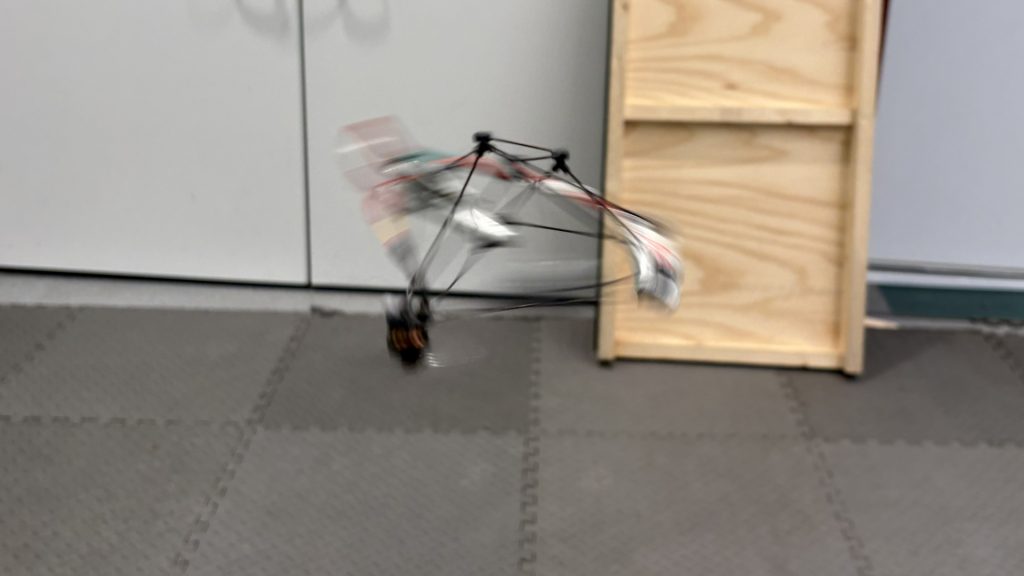
Researchers at Northwestern University created an experimental drone called Phantom Twist to test whether motion blur could make a drone harder to see.
The drone does not rely on camouflage, transparent materials or light-bending technology. Instead, it spins so fast that its parts blur together, making it harder for the human eye to separate the drone from its surroundings.
The drone spins up to 25 times per second. Northwestern said the design is about 10 times less visually perceptible than a conventional quadcopter.
How it works
A typical quadcopter has spinning propellers, but its body stays visible. Phantom Twist changes that setup.
The drone has one motor and one propeller. As the propeller spins one way, the rest of the drone spins the other way. Because no major part stays still, the drone appears less like a solid flying object and more like a faint haze.
“Imagine a cooling fan, spinning round and round. If it spins fast enough you lose appreciation of the blades. The visual system can’t cope,” David Whitaker, Dean of the School of Healthcare Sciences at Cardiff University, said. “When things are moving fast, the visual system merges those moving objects with the background, so they become relatively invisible.”

“The motion blur essentially turns all of the mechanical components into this slight haze,” Northwestern researcher Emma Alexander told New Scientist.
AI helped design the blur
The drone’s unusual shape was not hand-designed. It’s the size of a palm and weighs about 30 grams.

New Scientist reported that a computer first generated millions of possible designs, which were narrowed to about 20,000 that could theoretically fly. Northwestern said researchers then used artificial intelligence and other tools to arrange the drone’s parts to reduce visibility while keeping it stable in flight.
The research paper reports that the team tested multiple prototypes and found that one design significantly reduced visibility compared with conventional quadcopters. The paper’s figures also compare simulated blur with long-exposure flight photos, showing how the optimized drone appears as a faint circular haze rather than a clear object.
Why it matters
The technology could have nonmilitary uses.
Northwestern said a harder-to-see drone could monitor wildlife, survey wetlands or inspect infrastructure while causing less visual disruption. Drones can change how people or animals behave simply because they are noticed.

But the idea also raises obvious scalable questions. Peter Lee of the University of Portsmouth told New Scientist that stealthy drone technology has clear military applications. He added that, at this point, it has serious limitations.
The limits are real
Phantom Twist is not invisible.
The drone becomes harder to notice only because the visual system blends its fast-moving parts with the background. It can still be seen under some conditions, especially if the background does not closely match the drone’s color.
It can also still be heard.
The design has practical limits, too. Adding sensors or payloads would likely make it more visible. Extra weight or a larger frame could create stronger centrifugal forces, making flight harder or causing parts to break. Its spinning motion also makes quick direction changes difficult.
For now, the researchers said the drone can hover steadily, but it cannot maneuver like a standard quadcopter.
What’s next
The Northwestern team said future versions could use more transparent parts and quieter propulsion to make the drone even less noticeable.
The researchers are presenting the work on July 16 at Robotics: Science and Systems 2026 in Sydney, Australia.
Round out your reading
- With more prison space than prisoners, correctional facilities are shutting down.
- ‘Game changer’: New cancer treatment turns major surgery into an outpatient procedure.
- Viewers overwhelmingly support ‘The View’s’ fight against the FCC. Will that matter?
- Why an ICE shooting in Houston isn’t leading to mass protests.
- Milwaukee detective is the latest officer charged with misusing Flock cameras.
Ella Rae Greene, Editor In Chief