Does your state partner with ICE? Here’s who does, who doesn’t, who’s wavering
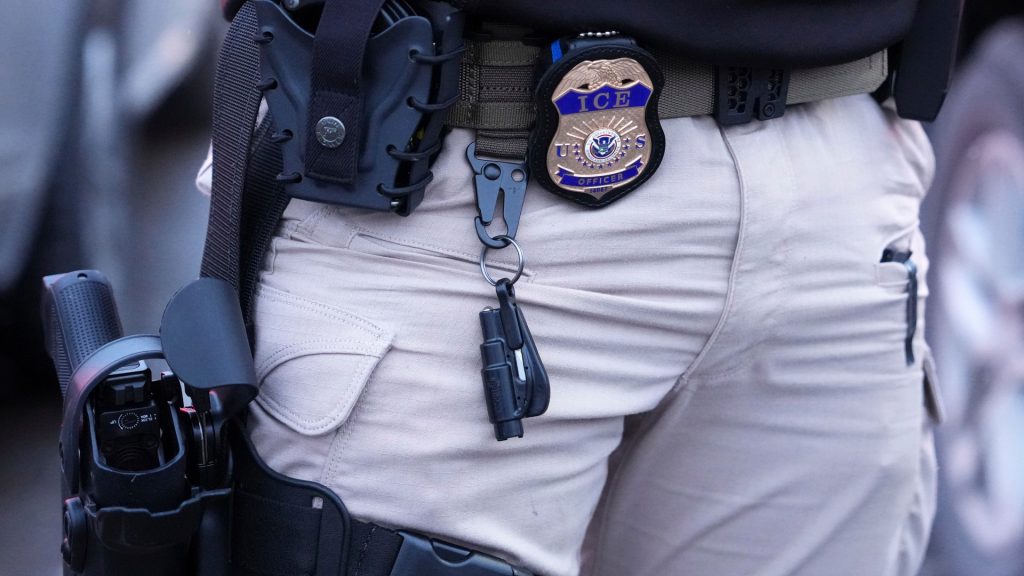
As scrutiny of how law enforcement agencies collaborate with U.S. Immigration and Customs Enforcement increases, some are signing new contracts, seeing it as a public-safety tool. Still, activists criticized the program, fearing racial profiling by agents.
Public reaction to how local law enforcement interacts and works with ICE has become tense in some places as people point to the killings of 37-year-olds Renee Good and Alex Pretti in Minnesota. States like Maryland are having second thoughts about police enrolled in the program. Meanwhile, Texas has mandated that all sheriff’s offices with jails sign agreements, KXAN reported.
“The goal in signing this legislation is the goal that you and I have everyday, and that is to make our state more safe,” Texas Gov. Greg Abbott, a Republican, said in July when he signed the bill into law. The new requirement went into effect on Jan. 1, and the state has 291 agreements in place, just behind Florida’s record high of 341 contracts.

Partnerships are formalized under the Illegal Immigration Reform and Immigrant Responsibility Act of 1996 to allow the agencies work hand-in-hand on immigration enforcement, according to ICE.
The program has four methods of participation: jail enforcement, task force, tribal task force and warrant service officer. Jail enforcement is used to identify people with pending or current criminal charges who are also eligible for removal. The two task force models enable local and tribal police to enforce immigration laws with ICE oversight.
Under warrant service, local police are trained, certified and deputized by ICE to carry out administrative warrants for immigrants held in their respective jails. None of the models distinguish between enforcement for suspected unauthorized immigrants or immigrants in general.
Anti-immigration groups like the Federation for American Immigration Reform praise the program for its impact on public safety.
“In an era of porous borders and strained resources, 287(g) isn’t just good—it’s essential,” according to FAIR. “The 287(g) program, far from being a divisive gimmick, is a pragmatic solution to enhance American security, and its expansion should be celebrated, not curtailed.”
The Cato Institute, a right-leaning think tank, found in September that 8,501 task force officers in local police departments were deputized to conduct immigration arrests without coordinating with ICE. The Justice Department criticized the model in 2011 and found several instances of those officers racially profiling people.
Search for your local agency
Maryland, NY bills seek to end 287(G) agreements
States like Maryland and New York are taking an offensive stance to bar such agreements. New York Gov. Kathy Hochul introduced legislation on Jan. 30 to bar local agreements. A combination of 14 county and municipality police agencies have active contracts with ICE.
“Over the last year federal immigration agents have carried out unspeakable acts of violence against Americans under the guise of public safety,” Hochul said in a news release. “These abuses – and the weaponization of local police officers for civil immigration enforcement – will not stand in New York.”
Frederick County, Maryland, Sheriff Chuck Jenkins said the agreements are a “true public safety tool” and his department turns people over to ICE rather than releasing them on the streets, local news outlet Maryland Matters reported on Jan. 20. His office has a jail enforcement agreement with ICE.
Jenkins was supported by other sheriffs and some state Republicans before the legislature passed bills designed to prohibit agreements. Each chamber passed its own legislation, which must be passed by the other before heading to Democratic Gov. Wes Moore’s desk.
Moore hasn’t stated his intentions about the bills, but if signed, Maryland would immediately become the latest state to bar the agreements.
States bar participation in program
According to ICE, seven states prohibit any law enforcement agency from entering into agreements with the federal agency for immigration enforcement, as of Feb. 3. Those states are:
- California.
- Connecticut.
- Illinois.
- Maine.
- New Hampshire.
- New Jersey.
- Oregon.
- Washington.
Thousands of active agreements across the nation
A Straight Arrow News analysis of current agreements showed that at least 40 states and the Northern Marina Islands have active partnerships with ICE. The most common type of partnership was the task force model.
The Virginia State Police is in a task force model agreement with ICE as of Feb. 28, according to ICE records. The agreement allows state police to interrogate anyone who’s a noncitizen or believed to be a noncitizen, arrest noncitizens making attempts to enter the U.S., process jailed noncitizens and hold any noncitizen ICE has arrested within their jails.
“Immigration enforcement activities conducted by participating LEA (law enforcement agency) personnel will be supervised and directed by ICE,” according to the memo. “Participating LEO personnel are not authorized to perform immigration officer functions except when working under the supervision or direction of ICE.”
Memos for the jail and warrant officer models are similar. The jail enforcement model allows local officers to identify and process noncitizens booked into their facilities for possible removal, according to a contract signed with the Benton County Sheriff’s Office in Arkansas. The warrant officer model allows local personnel to facilitate custodial transfers of noncitizens in their jails to ICE for removal.
Departments enter new agreements
The Stinesville Police Department in Indiana and the Pleasants County Sheriff’s Office in West Virginia applied to participate in ICE’s task force model. Neither has shared information on their social media pages or in public records about why they joined the program.
The post Does your state partner with ICE? Here’s who does, who doesn’t, who’s wavering appeared first on Straight Arrow News.
Ella Rae Greene, Editor In Chief