Do beach umbrellas kill millions? How Google perpetuates a legend
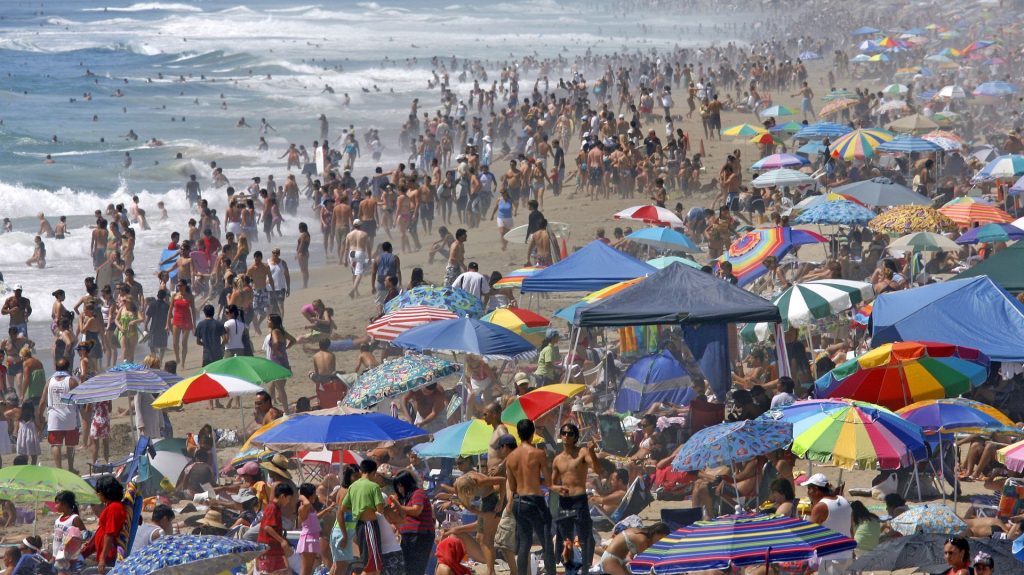
It was a warm summer day, and Ed Quigley was relaxing on the beach in Delaware when a strong wind gust nearly cost him his life.
A beach umbrella broke free from the sand that Independence Day weekend, struck him in the face “like a sledgehammer” and punctured his left eye.
“I died on the operating table,” Quigley, now 78, recalled in an interview with Straight Arrow about that life-changing accident in 2015. Doctors revived him through extensive emergency medical procedures, including brain surgery. “If it had hit me in my temple, I’d be gone.”
Quigley’s experience offers a cautionary tale: Inadequately secured beach umbrellas can break free from the sand and, with “magnitudes and magnitudes of force,” he said, become dangerous — even deadly — projectiles. As people prepare to descend on sandy beaches to celebrate America’s 250th birthday this Independence Day, a Google search result could give them pause.
The humble beach umbrella was designed to keep people safe from the sun’s blistering hot rays. But an oft-cited statistic suggests the shady canopy puts beachgoers at incredible — perhaps unbelievable — odds of being bludgeoned to death.
“The curved top of a beach umbrella is like the wing of an airplane,” Quigley said. Wind “can just lift it straight up” and send it flying through the air.
But this story is about more than beach umbrella deaths. It offers a second cautionary tale about how search engines can perpetuate misinformation and reinforce peoples’ beliefs in false claims.
“Globally, there are roughly 2 million deaths per year from umbrella-related accidents,” according to the top Google Search result, a webpage maintained by an injury law firm in South Carolina.
It’s an alarming statistic. But is it true? The law firm didn’t offer a citation for the statistic.
If so, beach umbrella accidents would be deadlier than car crashes, gun violence and shark attacks — combined.
The origins of a legend
Imagine this. You’re sitting on the beach when the wind begins to tug on the colorful fabric of your beach umbrella. You’ve heard that beach umbrellas can become dangerous, even deadly, projectiles.
But how dangerous are we talking? You turn to Google Search for hard data, only to find contradicting numbers.
Such a scenario sent Straight Arrow down a Google Search rabbit hole — one that left this reporter with more questions than answers.
According to a Straight Arrow search of Google about umbrella deaths, the AI overview notes that beach umbrella fatalities are extremely rare, even though they do pose serious risks. “Nationwide, they cause a few documented deaths and an estimated 3,000 emergency room injuries per year,” the search giant’s AI explainer notes.
The traditional search results, which point to links for third-party websites, are far more alarming.
The top result is from the Law Offices of David L. Hood which, according to the search engine, was published in April with the 2 million-deaths-a-year claim. The firm didn’t respond to interview requests about the webpage.
“If you or a loved one is hurt because of umbrella dangers, you may be wondering who is at fault,” the law firm’s page says, directing victims to contact their attorneys following an accident. “In many cases, the person who set up the umbrella can be held responsible if they acted carelessly.”
Another automated feature on Google — a section called “People also ask” — parroted the statistic, with a citation to the law firm.
“Globally, there are roughly 2 million deaths per year from umbrella-related accidents,” according to the Google Search feature, which cites the Law Offices of David L. Hood.
The second result points to a recent Medium post by Mandy Goodall, who writes a blog about “spirituality, personal life stories and experiences (amongst other things).”
“It has been reported on multiple news sites that a whopping 2 million deaths occur globally from umbrella, parasol and canopy related accidents each year,” read one blog post by Goodall, who couldn’t be reached for comment.
Indeed, the third search result is a news article from The Herald-Mail, a daily newspaper serving readers in Washington County, Maryland, as part of the USA Today Network.
“This common household item is killing millions of people worldwide,” the article’s headline, from 2017, says. The article repeats the claim about 2 million global deaths, citing the source as “Central European News” while linking to an article from Fox News that published without a byline.
The Herald-Mail notes the article was written by Emily Brady of “FamilyShare,” an award-winning website that creates and aggregates content that “engages and strengthens hundreds of millions of families worldwide.” Brady did not respond to Straight Arrow’s requests for comment.
The Fox News article also attributed the statistic to Central European News, but didn’t provide a link to the original source.

Straight Arrow was unable to track down the original article from Central European News which, according to its website, has “been leading the field in finding viral news content since the 1990s.” The company doesn’t appear to list news articles on its website. It has 40 followers on the social media platform X and 478 followers on LinkedIn.
Google didn’t respond to requests for comment from Straight Arrow. The search giant notes on its website the company sorts through “hundreds of billions of webpages and other digital content to present the most relevant, useful results on the first page in a fraction of a second.”
Relevance, quality and usability are among factors in search results, according to the company. The company says it makes frequent changes to its systems to achieve “the right balance of information relevance and authoritativeness to maintain your trust in the results you see.”
In this case, however, when the beach umbrella legend became fact, Google printed the legend.
Should people trust Google’s top results?
Quigley’s beach umbrella injury has been life-changing. Gone are the days of enjoying some of his favorite hobbies: riding motorcycles, painting and drinking ice cold beer.
He still visits the beach, he told Straight Arrow, but he has also set out to warn others about the risks. He now operates the website “Beach Umbrella Safety,” which offers beach-time safety advice and a newsfeed of dangerous accidents.
“I’m not selling anything, I just want you to know your umbrella is not safe in the wind,” he said. “And the wind changes dramatically, so I do what I can as far as advocacy.”
It’s unclear where the statistic claiming 2 million annual deaths originated, but Quigley isn’t buying it. He’s aware of only two fatal umbrella incidents in the United States.
“That sounds like a very high number, but I don’t know if I’d trust Google’s ability to add all of those up,” he said. “You’d have to be careful of the source before quoting that.”
Oftentimes, however, people do just that. A 2020 study into billions of Google searches found that people click the first result more than a quarter of the time. From there, click-through rates dropped precipitously.

For people who turn to Google to “do their own research,” such a reality could leave them misinformed. Low-quality results from Google and other search engines could leave people more misinformed about the world around them than before they turned to the internet for answers, according to a 2023 study in the peer-reviewed journal Nature.
Across five experiments, the researchers found that for most people, conducting online searches to evaluate the truthfulness of false news articles “actually increases the probability of believing” misinformation. The issue, the researchers concluded, comes down to a “data void” created by low-quality search results designed to perform well on Google — a practice known as search engine optimization. If Google-optimized articles containing misinformation rise to the top of search results, people may never scroll far enough to find credible information.
In the last few years, significant attention has been paid to AI-generated search results, and their tendency to include misinformation. One recent report on the AI Overviews concluded that Google serves users inaccurate information in about 10% of searches — which, given the high volume of queries, equates to about 1 million inaccuracies per minute.
Regulators have taken notice. Earlier this month, a German court ruled that Google can be held liable for false AI Overview claims and required the tech giant to prevent the tool from disseminating misinformation. Google plans to appeal the ruling.

In this case, Google’s AI Overview highlighted a government source, the U.S. Consumer Product Safety Commission, and concluded that beach umbrella deaths are exceedingly rare. Here, Google points to another oft-cited statistic: “around 3,000 people are injured,” the search engine concludes, every single year.
Here, again, official government sources tell a slightly different story.
Over an eight-year period “from 2010-2018,” the agency notes in a warning flyer, “an estimated 2,800 beach umbrella-related injuries were treated in ERs nationwide.”
So how many people die annually from rogue beach umbrellas? We may never know. But if you’re planning to visit the beach this Independence Day, perhaps you should wear body armor under your bikini — just to be safe.
Round out your reading
- Not red or blue: America’s politically homeless middle.
- Peter Thiel’s ‘Dialog’ network was super-secret. A data leak changed that.
- The novel legal strategy that Taylor Swift and Matthew McConaughey are using to fight AI.
- Illinois balances budget with new $200 million social media tax that tracks in-state users.
- When Trump serves up ‘Just the News,’ it comes with a side of bias.
Ella Rae Greene, Editor In Chief