Data center data is hard to come by. Erin Brockovich wants to change that
Artificial intelligence is confusing, so confusing that many companies don’t even understand how their AI works, often labeling their systems a “black box.” But another aspect of AI that’s led to confusion is the infrastructure propping it up.
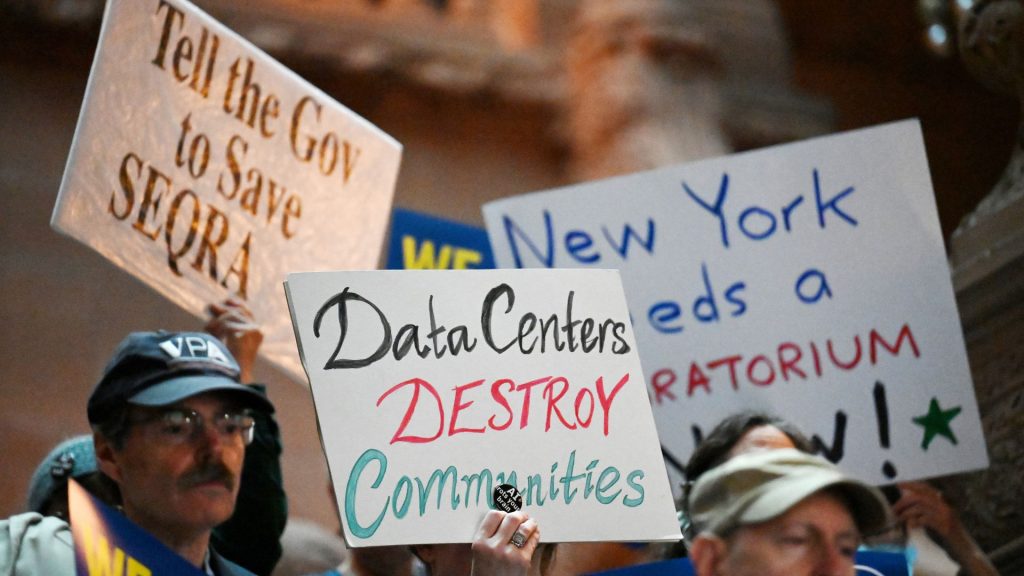
For AI to work, it needs data centers to process massive amounts of information. These data centers have become a bipartisan sticking point, with residents alleging they are loud, obnoxious and an eyesore — and a drain on water and electrical supplies. Some researchers have even claimed the sounds produced by these facilities are harmful to people.
But data on data centers is sparse, making it difficult to get a precise number of how many exist, and which ones are used for general internet services and which ones are used to run AI.
That’s where famous environmental activist Erin Brockovich comes in.
Mapping data centers
Brockovich says her new website — Brockovich AI Data Center Reporting — gives people a platform to share criticisms about AI data centers. While the site gives information about AI data centers and offers recent news about them, its main focus is a crowd-sourced interactive map.
The map identifies nearly 2,800 AI data centers that are either already operating or are under construction. The map’s accuracy, however, is unclear.
The majority of the centers are listed as “community reported” by “concerned citizens” and others.
Although users are asked to provide information such as the name of the data center’s owner and a photo of the facility, the site’s frequently asked questions section says that not all the “community reported” data points represent an actual AI data center. Some, it says, are “rumored or proposed projects.”
The map shows the greatest number of data centers in Texas and Pennsylvania — 612 and 233, respectively. The most reported centers in a single town was 300 in Sulphur Springs, Texas. That’s where Engadget reports MSB Global is building one of the largest AI data centers in North America.
What is the data on data centers?
With no government agency tracking private data centers across the country, reliable information on their total number is hard to come by. Some groups are even working to hunt down hidden data centers, as 404 Media reports.
What is publicly known is that data centers use large amounts of electricity — about 1.5% of the world’s total electricity usage, according to the International Energy Agency. But that number is expected to skyrocket in the coming years.
Researchers at MIT believe data centers’ global energy usage to exceed 1,000 terawatt-hours by 2026. That’s about the same energy output as Japan.
But the Data Center Coalition, a group supporting data centers, said the industry is “committed to being a good neighbor” and that other industries use more resources than it does.
“Collectively, the data center industry used significantly less water than other essential industries in 2025, including the agriculture, power, food and beverage, and semiconductor sectors,” the group told Straight Arrow. “Data centers are also committed to paying their own way for the energy they use.”
Despite the industry’s assurances, public outcry has inspired a torrent of new legislation.
The Data Center Transparency Act, introduced in Congress early this year, would require the Environmental Protection Agency to maintain a public website with exact data on how much water data centers consume nationwide, their total electricity draw and water pollution they may have caused.
Another bill in Congress, the AI Data Center Site Selection Transparency Act, would require tech companies to inform local communities of their plans to construct massive AI campuses before deals are finalized. The bill’s authors said this would give residents a chance to hold public hearings and weigh in on the plans.
“Data centers are often shrouded in mystery, with plans moving forward before meaningful public input,” said Rep. Andre Carson, D-Ind., one of the bill’s sponsors. “Our bill will change that, requiring data centers to be transparent. Neighborhoods have to deal with the consequences of data centers — and so neighborhood input should be central, not an afterthought.”
Round out your reading
- Tennessee officials will pay $835,000 for jailing man over Charlie Kirk meme.
- Why the immune system turns on women more often than men.
- More than 340 newspapers block the Wayback Machine. What that means for the future of the internet.
- Why Rep. Cohen filed articles of impeachment against Supreme Court Justice John Roberts.
- We’re building a new Straight Arrow. Help us shape our future by taking our survey.
Ella Rae Greene, Editor In Chief