Court allows Louisiana law requiring 10 commandments in schools to take effect
The Fifth U.S. Circuit Court of Appeals ruled on Friday that it’s too early to determine the constitutionality of a Louisiana law that requires public schools display the Ten Commandments in their classroom.
Friday’s 12-6 decision vacates a federal district court’s preliminary injunction from November 2024, which initially stopped the law from taking effect.
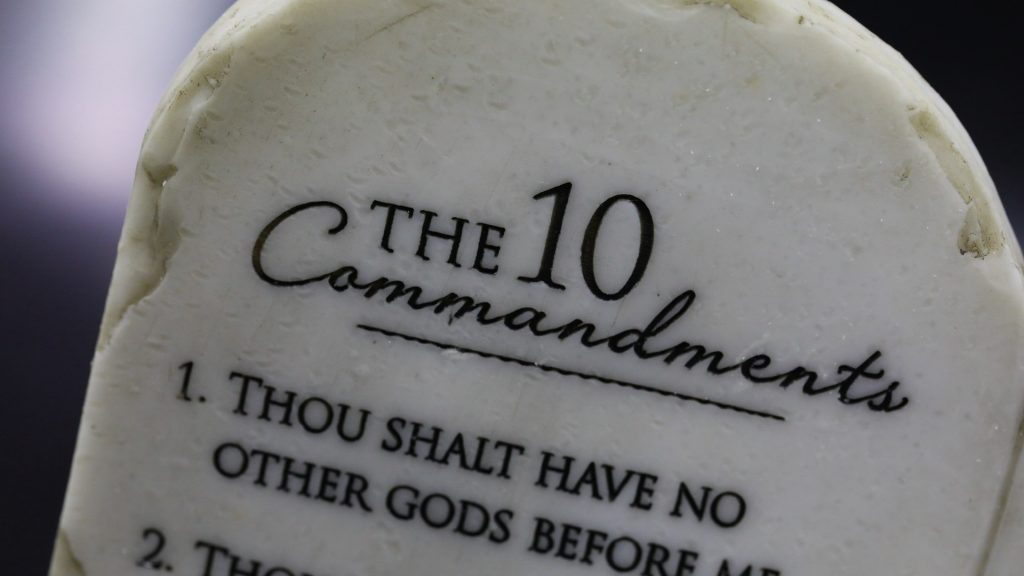
Louisiana officials set certain “minimum requirements” in H.B. 71, the circuit court wrote that the “the nature of the display” is left to the discretion of local school boards. The law dictates that all public K-12 schools and state-funded university classrooms need to have the Ten Commandments hung on a poster or framed document that’s at least 11 inches by 14 inches, with the text being the central focus and “printed in a large, easily readable font.”
“We do not know, for example, how prominently the displays will appear, what other materials might accompany them, or how — if at all — teachers will reference them during instruction,” the court said in its ruling. “More fundamentally, we do not even know the full content of the displays themselves.”
The court said it cannot evaluate “how the text is used,” because it does not know this yet.
“Asking us to declare — here and now, and in the abstract — that every possible H.B. 71 display would violate the Establishment Clause would require precisely what Texas forbids: the substitution of speculation for adjudication,” the court said. “It would oblige us to hypothesize an open-ended range of possible classroom displays and then assess each under a context-sensitive standard that depends on facts not yet developed and, indeed, not yet knowable.”
Doing this, the court said, exceeds the judicial function.
“It is not judging; it is guessing,” the court said. “And because it rests on conjecture rather than a concrete factual record, it does not cure the ripeness defect — it compounds it.”
Still, the court noted, nothing in its ruling prevents future challenges to the legislation.
Dissenting judges wrote in their own opinion that “by placing that text on permanent display in public
school classrooms, not in a way that is curricular or pedagogical, the State elevates words meant for devotion into objects of reverence, exposing children to government‑endorsed religion in a setting of compulsory attendance.”
“That is precisely the kind of establishment the Framers anticipated and sought to prevent,” the six dissenting judges wrote.
Louisiana Attorney General Liz Murrill celebrated the decision on X, and added that her office has issued clear guidance to public schools on how to comply with the law.
“We have created multiple examples of posters demonstrating how it can be applied constitutionally,” she wrote. “Louisiana public schools should follow the law.”
Organizations representing the nine Louisiana families with public school students who are suing the state said in a statement the ruling is “extremely disappointing and would unnecessarily force Louisiana’s public school families into a game of constitutional whack-a-mole in every school district.” These organizations include the American Civil Liberties Union, ACLU of Louisiana, Americans United for Separation of Church and State and the Freedom From Religion Foundation, with Simpson Thacher & Bartlett LLP serving as pro bono counsel.
They said they’re exploring all legal pathways to fight “this unconstitutional law.”
“Longstanding judicial precedent makes clear that our clients need not submit to the very harms they are seeking to prevent before taking legal action to protect their rights,” the groups said. “But this fight isn’t over. We will continue fighting for the religious freedom of Louisiana’s families.”
The post Court allows Louisiana law requiring 10 commandments in schools to take effect appeared first on Straight Arrow News.
Ella Rae Greene, Editor In Chief