Canada and Mexico allow Chinese EVs into their markets. Why not the US?
A bipartisan group of lawmakers introduced legislation to bar Chinese-made electric vehicles from entering the U.S., a bill likely to be addressed during President Donald Trump’s and Chinese President Xi Jinping’s meeting in Beijing. Scholars are split on the bill as some say it fans the flames of anti-Asian hate, while others say it safeguards Americans against China.
Sens. Elissa Slotkin, D-Mich., and Bernie Moreno, R-Ohio, introduced the legislation known as the Connect Vehicles Security Act to bar imports of Chinese electric vehicles and related auto parts in the U.S. Their bill isn’t the first, as Slotkin and other lawmakers have tried, and failed, in the past to limit Chinese EVs from entering the U.S.
“Any Chinese company, by virtue of Article 19 of the China Company Law, means that the CCP is in effective control of Chinese companies,” Stephen Ezell, vice president of global innovation policy at the Information Technology and Innovation Foundation, told Straight Arrow. “There’s a very real security risk that Chinese vehicles driving around the United States could collect data about drivers, users, America’s runway, that does create, in our view, a national security risk.”
Ezell said the issue at play is how much China’s ruling party subsidizes innovation and signs off on intellectual property theft. He added China has a rare control of minerals and resources needed, which undercuts the cost of electric vehicles.
A connected vehicle is essentially a car with internet access components that increase convenience and road safety for drivers. Some of the most common forms are braking assist and lane maintenance. A more complex form is seen in Waymos, the fully automated, self-driving vehicles seen in many U.S. metros.

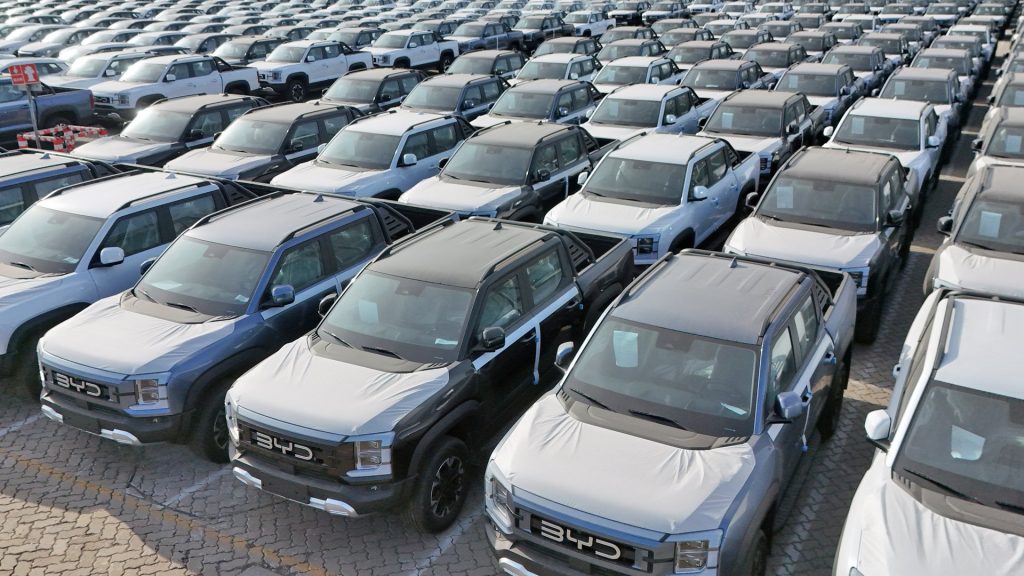
Lawmakers are targeting the electric vehicles that Chinese automakers sell as the country gains a larger presence in the international EV market. The cars are already being sold in Mexico and are just starting to enter the Canadian market following a tariff deal.
BYD, a Chinese automobile manufacturer, sells its Dolphin Mini in Mexico at MXN$415,800 — or $24,128 USD — and the BYD Dolphin around CAD$33,000, or $24,090 USD.
Kyle Chan, a fellow at the Brookings Institution focusing on U.S.-China relations, told Straight Arrow that while the legislation could resemble Japan’s entry into the auto industry, the technologies at focus are vastly different, and China is a main competitor to the U.S. in multiple industries.
On the other hand, he said that allowing China to enter the U.S. auto industry could reignite the competitive spirit of Detroit’s Big Three — Ford, GM and Stellantis — and force them to focus more on the consumers.
“We’ve seen that an injection of new technology, extra competition can kind of jolt them out of complacency,” Chan said. “But the other big thing is that we would get more affordable cars in the United States.”
Detroit’s Big Three, UAW support legislation
The Big Three automakers support the legislation, saying it would “strengthen American manufacturing” and their competition, according to a press release from Slotkin’s office.
They each noted the legislation promotes a “level playing field” for all interested companies. United Auto Workers President Shawn Fain added that it would put “common sense guardrails on a major threat to our nation’s auto industry.”
According to OpenSecrets, Slotkin received the third-most contributions from the auto industry in 2024 at $120,767. She ran and won the U.S. Senate seat in Michigan. She trailed behind Trump and former Presidential Candidate Kamala Harris, who received $396,794 and $884,504, respectively.
Moreno received $5,000 from Toyota and $2,000 from Mercedes-Benz during his 2024 campaign, according to OpenSecrets. This year, Moreno has received $26,000 in total from automotive manufacturers like Toyota, Ford, General Motors and the Alliance for Automotive Innovation, which also supports the bill.

“We need to make sure we’re all playing by the same rules, but Chinese automakers are flooding markets around the world with cut-rate vehicles,” John Bozzella, president of the automotive alliance, said. “Sens. Moreno and Slotkin don’t want that to happen here. They’re right.”
Ezell added that the ITTF has a firm stance of a total ban against Chinese automakers with no possibility of entry, as it could decimate competition. He noted companies in the U.S. could become competitive again through private and government-supported innovation.
For the government, Ezell said it could be giving companies a 25% tax credit for using more robots or other forms of automation on the assembly line, similar to what Kia/Hyundai, Honda, Mazda, Nissan, Toyota and Subaru have been doing for at least a decade.
“We need to be mindful that one reason China has come to dominate an EV battery innovation of production is because they completely vertically dominate the critical mineral supply chain all the way from the mines in China or Africa, to processing and refining,” he said. “If we want to compete in batteries, we have to compete in critical minerals.”
Happy medium seen in Canada
Chan said Canada shows there is a way for China to enter the U.S. automotive market without sacrificing securities, but forcing companies to become more competitive.
Canada, Chan said, is taking a measured approach: having China invest and build up production, then limiting how many vehicles can be sold and doing it in partnership with a domestic dealership. The CBC, a Canadian news site, reported on March 31 that Canada struck a deal with Xi in January and reduced the 100% tariff down to 6.1% and will see about 49,000 EVs, likely luxury models, at the onset.

“That kind of framework, the Canadian approach, at least points to a way to do this in a gradual way rather than an all-or-nothing approach,” he said.
Chan added that consumers may not see the $10,000 price tag if the Chinese EVs were sold in America. Wages and supply chains in Canada and Europe would drive up the cost, but it would still be an overall savings with the U.S. EV market averaging at $57,245 in August for a new vehicle, according to Kelly Blue Book.
If the U.S. didn’t want to adopt Canada’s plan, Chan said they could replicate what was done with Japan by requiring the companies to build plants in the U.S., build cars with American workers and start using American suppliers for parts.
“If we were to let the Chinese automakers in, the big message would be, ‘you need to invest in the United States, in terms of the workers, in terms of the supply chain, in terms of the technology,’” Chan said.
Round out your reading
- Are aliens real? Pentagon’s newly released UFO files suggest the truth is out there.
- A million Americans get this knee surgery every year. But does it work?
- Is the apocalypse now? One man is tracking flights by the rich to find out.
- ‘No Mow May’: A boon for the bees or a well-intended mistake?
- We’re building a new Straight Arrow. Help us shape our future by taking our survey.
Ella Rae Greene, Editor In Chief