California’s laws are your laws. You just don’t realize it
People across the country are subject to regulations enacted in California and other states they don’t live in.
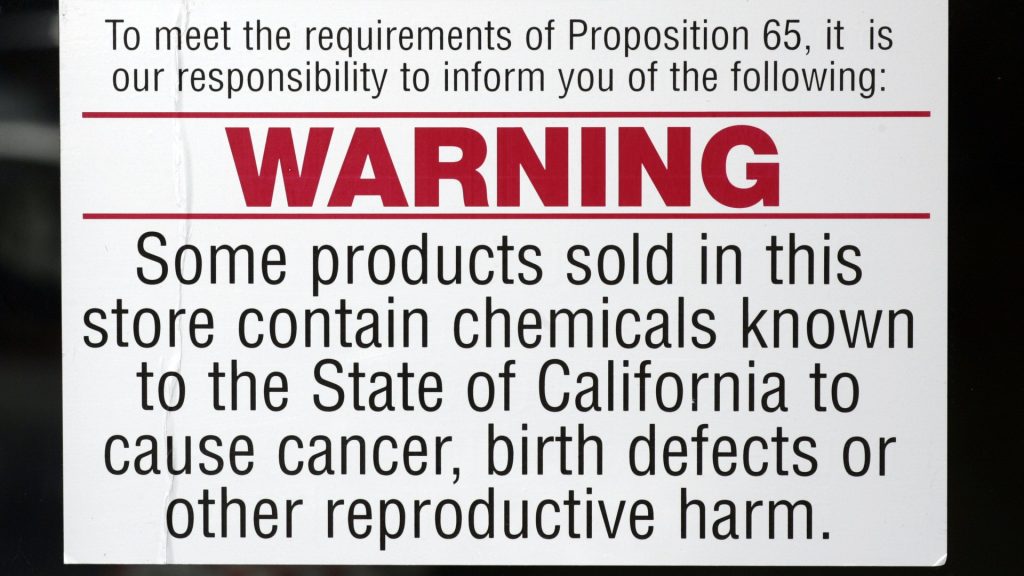
From a box of hair dye on a New York City shelf labeled as being “known to cause cancer in the state of California” to vehicle emissions standards, companies opt to change their products nationwide to adhere to a single state’s mandate. It could even affect the bacon you cook up tomorrow morning.
It’s known as the “California Effect,” but other states have been known to impact federal regulations as well.
Why it happens
One of the most recent examples is California’s EV mandates. The state has been given waivers from the federal government to set different vehicle emissions standards than the rest of the country, although the Trump administration is pushing back on that.
California is the largest automobile market in the country.
Because of that, automakers began building cars to meet those requirements.
It’s not financially beneficial for major automakers to build one set for California and one set for the rest of the country, so the rest of the country will see the impact of those rules.
Those companies have even urged the federal government and California to get on the same page.
“California has enacted many appliance efficiency standards, some of which then get adopted by the federal government, and some of which get adopted by other states, and some get adopted voluntarily by manufacturers for the whole country,” Vogel said.
The same thing happened in the 1970s, when the state adopted energy-efficiency standards for appliances due to energy issues. So, manufacturers began making all their products to fit that mold.
That example differs from EV mandates because about a decade later, the federal government adopted similar regulations nationally in the National Appliance Energy Conservation Act of 1987.
That’s, in part, because other states followed California’s lead.
“Other states saw those standards made sense in reducing the need for new power plants, and they adopted them,” Vogel said.
Sometimes, a state law affects people nationwide because the federal government simply likes it.
In 2006, Massachusetts adopted Romneycare, named after the governor at the time, Mitt Romney. That framework became a basis for the Affordable Care Act, also known as Obamacare, which was enacted in 2010.
Then there’s state-to-state adoption. When state leaders see something in another state that they believe makes sense for their constituents, they will act.
It’s usually called model legislation or policy diffusion.
“If a state enacts a policy that looks like it’s attractive and working, then other states might well choose to follow it,” David Vogel, professor emeritus of political science at the University of California, Berkeley, told Straight Arrow. “I think that’s happened very often.”
That’s another example of where California has led the way recently.
Last year, the state passed regulations that allow Californians to opt out of data collection and deletion requests in one place instead of doing it company by company.
Dozens of states followed suit.
State-to-state adoption is also where California has recently become a follower instead of a driver in this space. The state passed legislation modeled after a law in Illinois to prevent advertisements from being played louder than the content being watched. That law took effect Wednesday.
Another example is Florida’s Stand Your Ground law, which went online in 2005. More than 30 states went on to adopt similar legislation.
America saw many state-to-state policy changes during the COVID-19 pandemic.
“When states didn’t have time to evaluate all of these policies, but we’re just sort of seeing, ‘Well, what are you all doing?’ Maybe we should do the same thing here,” Craig Volden, professor of public policy and politics at the University of Virginia and co-director of the Center for Effective Lawmaking, told Straight Arrow.
Another way state laws impact change in other states is simple economics.
If one state is making money doing something, a nearby state may see that same market.
“Everybody’s buying fireworks in the next state over,” Volden said. “Maybe we should have firework sales here, because we’re losing revenue.”
Historical precedent
Historically, it has been the states leading the charge when it comes to major changes in the U.S.
The oldest example can be traced back to 1797 when New York adopted repeat offender sentencing enhancements for criminals. That quickly spread to the other states.
Some of the largest changes to happen in this country also started on a state-by-state basis before becoming federal law.
“There is a theory about functional federalism, which suggests that states and localities will work more on morality policies,” Volden said.
Women did not get the right to vote in America because the federal government one day decided it was the right move.
It started slowly in places like Wyoming and Utah and then spread to nearby states like Idaho, Washington and California.
Eventually, Congress ratified the 19th Amendment, forcing other states to comply with those states that had already made those changes.
Long before Brown v. the Board of Education in 1954, states, including Massachusetts, began repealing segregation laws.
Massachusetts was also the first state to allow gay people to marry, with other states gradually following suit before it became legal at the federal level in 2015.
Anyone under 30 likely doesn’t remember you used to be able to smoke in restaurants.
“We’ve done some work on various anti-smoking policies that were spreading through the 1990s and early 2000s and there we can actually trace how they bubbled up from localities to states, and eventually from states to the national government over time, as people were more comfortable seeing, ‘Oh, I guess that didn’t lead people to not go to our restaurants, since there was non-smoking there,’ and it does seem like we can adopt these nationwide as broader standards,” Volden said.
Federal response
Despite states leading these charges and changing laws, the federal government is far from powerless here.
“If Congress passes a policy, then it can preempt state policies,” Vogel said.
The federal government’s power comes from the purse.
Annually, the government shells out more than $1 trillion to the states.
When the feds decided the national drinking age should be set to 21 in 1984, they forced states to comply.
The Reagan administration threatened to withhold 10% of federal highway funds from any state that did not adopt that legislation.
When states refused to cooperate with desegregation, the feds pushed back with lawsuits and court orders.
The Trump administration has used a similar playbook, although more in the education sector.
“Maybe we shouldn’t have those grants flowing to these various universities,” Volden said.
Up next is likely a tug-of-war between the states and federal government over artificial intelligence legislation.
That began with Trump calling for a national AI legislative framework that would preempt any state-level regulations.
Despite that, many states have already passed AI regulations with no real federal framework in place.
As the feds work on any potential regulations, Volden said it could end up being like many other sectors in this country, which began at local and state levels before going national.
“I imagine a wave of AI policies will play out similarly,” Volden said.
Round out your reading
- America at 250: Straight Arrow’s week-long look at the pressures testing modern America.
- Ketamine is booming in America. The reasons go beyond drugs.
- Cluster of AI news sites suddenly goes dark after human reporter starts asking questions.
- A 79-year-old, obese, well-connected man gained exclusive access to a new weight loss drug. Is it Trump?
- Newsom pushes national wealth tax after opposing California billionaire tax.
Ella Rae Greene, Editor In Chief