AI data centers are popping up everywhere. What exactly do they do?
From people being forced to sell their family home or face it being taken by the state, to others being told to “consider selling” by a mayor facing complaints, stories about the impact of AI data centers aren’t hard to come by.
They’re known to strain existing infrastructure and water supplies and create nuisance noise — issues not only the federal government, but state and municipal governments, as well, have long brushed off as the end justifying the means.
Artificial intelligence is a lucrative and fast-burgeoning market, and it seems like every Big Tech company is scrambling to expand its capabilities, buying up land and building data centers nationwide. They take up hundreds of acres, go through trillions of gallons of water a year, can use as much power as entire cities — and some even emit enough constant noise to cause permanent hearing damage — but why?
What do AI data centers do?
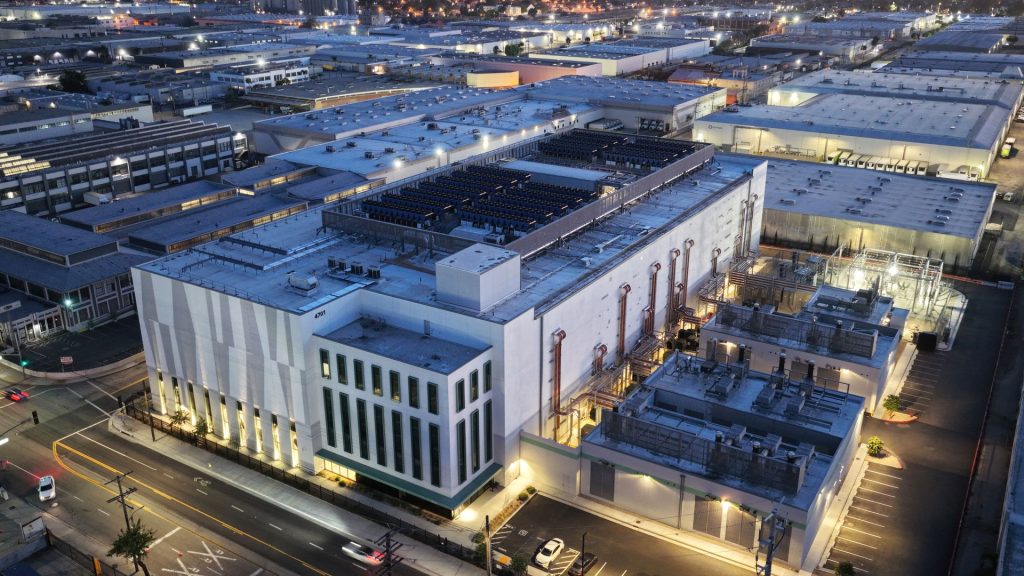
Data centers are buildings full of computer hardware used to process and relay digital information worldwide. They’re essentially physical buildings that house the invisible foundation of the internet.
Everything you do online — from reading this story or looking at silly cat memes to streaming your favorite show and tapping your card to pay for dinner — goes through some sort of data center.
The hardware, including servers, storage and networking gear, runs nonstop to ensure everything stays online. But there are other key components AI data centers can’t go without, like powerful cooling systems and backup power sources that play into a center’s water and energy consumption as well.

And not all data centers are created equal. They fall into five major categories:
- Hyperscale: These are the most common centers behind the current building boom. They are run by multiple tech companies and take up the most space and resources because they convey massive amounts of AI and cloud data for some of the biggest tech giants — think Amazon, Microsoft and Google.
- Cloud: These are in charge of storing your information so you don’t have to. They power services like iCloud and Google Cloud, where users pay to use storage space.
- Enterprise: Built, owned and run by a single organization, these are common for banks, hospitals and government agencies for their own use.
- Colocation: This kind of data center rents space, power and cooling to customers who supply their own servers, much like office space in a commercial building is rented out.
- Edge: These are the smallest, often only the size of a shipping container. They’re placed closer to users to cut down on delay and are essential for things like gaming and streaming.
Now, what do they use all that land, energy and water for?
A big investment — literally
As the demand for AI grows, so do the sizes of data centers. Some of the largest facilities being built today will cover hundreds of acres, according to the Lincoln Institute of Land Policy.
“Demand for data centers and processing has just exploded exponentially because of AI,” Kim Rueben, a former senior fiscal systems advisor at the Lincoln Institute of Land Policy, said.

The Lincoln Institute says the number of data centers in the U.S. more than doubled between 2018 and 2021 and had doubled again by late 2025. There are currently at least 4,000 data centers in the U.S., and with more and more states offering incentives, the number just continues to grow.
“Each one of those buildings is using as much as a city’s worth of power, so that power infrastructure is having a huge impact on our communities,” Julie Bolthouse, the director of land policy at Piedmont Environmental Council, told the Lincoln Institute. “All the transmission lines that have to be built, the eminent domain used to get the land for those transmission lines, all of the energy infrastructure, gas plants, pipelines that deliver the gas, the air pollution associated with that, the climate impacts of all of that.”
Right now, 38 states have incentives in place to attract data centers. Those incentives range from sales and energy tax exemptions to reduced property taxes.
A burst of energy
A standard data center, like a cloud data center, uses as much electricity in one year as 10,000 to 25,000 households, according to the International Energy Agency, but hyperscale data centers can use as much power as more than 100,000 households.
One data center currently being built in Cheyenne, Wyoming, is expected to draw more energy each year than all of the homes in the state combined.
According to a congressional report, U.S. data centers consumed 176 terawatt-hours of electricity in 2023. That’s about as much as the entire country of Ireland, per the Lincoln Institute. And a Berkeley Lab report says data center energy use is expected to double or even triple as soon as 2028.
“AI, particularly large language models, requires enormous computational resources,” Mahmut Kandemir, a professor in Pennsylvania State University’s Department of Computer Science and Engineering, said. “Training these models involves thousands of graphics processing units running continuously for months, leading to high electricity consumption. By 2030–2035, data centers could account for 20% of global electricity use, putting an immense strain on power grids.”
AI is thirsty
Data centers consume massive amounts of freshwater, as well. With so much electricity flowing in, things can get hot quickly — which is dangerous for the delicate hardware required to run these centers.
Many data centers rely on evaporative room cooling, which is regarded as one of the cheapest and easiest ways to keep equipment at a safe temperature, but that means the water disappears instead of turning into wastewater that can be recycled. And while some use closed-loop systems to keep things cool, the trade-off for recycling the water is using more electricity.

“Even if they’re using reclaimed or recycled water, that water is no longer going back into the base flow of the rivers and streams,” Bolthouse said. “That has ecological impacts as well as supply issues. Everybody is upstream from someone else.”
Hyperscale data centers use up to 5 million gallons of water per day, equivalent to the water use of a town populated by 10,000 to 50,000 people, according to the Environmental and Energy Study Institute. That’s more than 1.82 billion gallons per year — enough to fill 2,757 Olympic-sized swimming pools. It’s estimated there are between 500 and 600 hyperscale data centers in the U.S., using up to 1.92 trillion gallons of water every year.
Why are they so loud?
Transmitting information across the globe via the internet may be silent, but some data centers certainly aren’t. Data centers that use fans for cooling can emit more than 90 decibels of sound, according to the industrial communication company Sensear.
Sounds above 85 decibels are considered harmful to the human ear, but some studies have shown that noise above 65 decibels is enough to increase stress and blood pressure.
The hums of cooling systems, rumbling of generators and whirring of fans can be heard from hundreds of feet to even a mile away, according to The New York Times, but acoustics can spread them farther. And some of the noise is infrasound — ultralow-frequency sound waves that are considered too low for human hearing, but can be physically felt through pressure fluctuations.
Nearly 40% of U.S. homes are within five miles of at least one operational data center, a Pew Research Center analysis found. In July, residents of three different cities filed lawsuits against data centers specifically because of the noise.
Round out your reading
- With more prison space than prisoners, correctional facilities are shutting down.
- ‘Game changer’: New cancer treatment turns major surgery into an outpatient procedure.
- Viewers overwhelmingly support ‘The View’s’ fight against the FCC. Will that matter?
- Why an ICE shooting in Houston isn’t leading to mass protests.
- Milwaukee detective is the latest officer charged with misusing Flock cameras.
Ella Rae Greene, Editor In Chief