Lake Mead hit a record-low water level. Why experts say the benchmark needs context
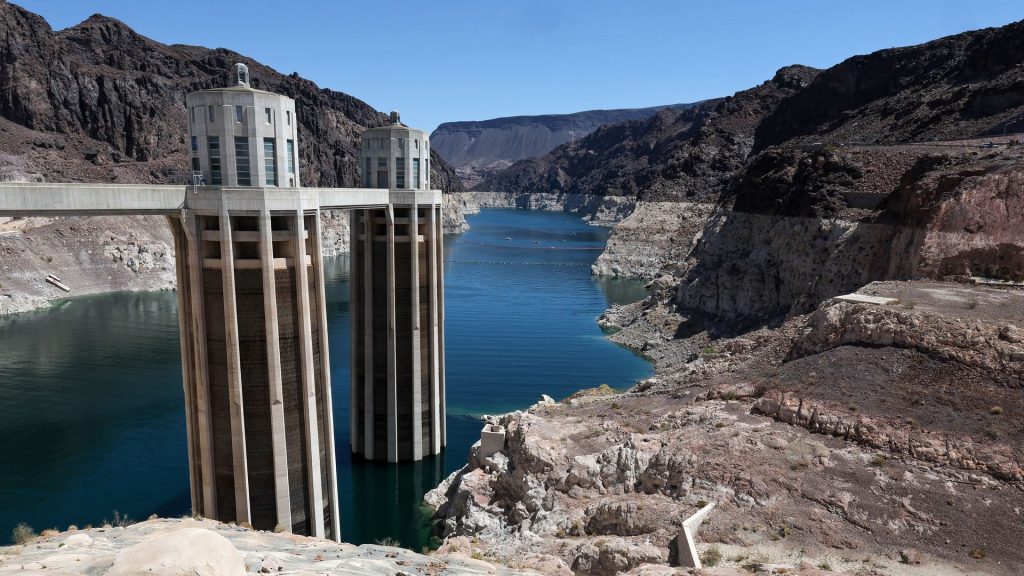
Lake Mead just dropped to its lowest elevation on record. As of Aug. 6, 2026, the surface level sits at 1040.50 feet above sea level, marking the least amount of water sitting in the reservoir since it was filled in the 1930s.
While it seems like a milestone to gawk at, experts who have studied the reservoir and the Colorado River Basin for decades say the benchmark needs context.
“Every record that’s broken is a teaching moment,” Jack Schmidt, director of the Center for Colorado River Studies at Utah State University, told Straight Arrow. “When Babe Ruth’s home run record was broken, it was a monumental record, but it was only one home run. But what it is is a teaching moment to then reflect on what the context of that original record is that gets broken.”
The previous record-low elevation, set in July 2022, was 1040.58 feet, after several years of historic drought. Lake Powell, the other large reservoir in the Colorado River Basin system, also hit a record low that season, albeit seven months later.
Lake Mead and Lake Powell hit their lowest combined storage level in July for the first time since 1957, when construction was wrapping up on the Glen Canyon Dam and Lake Powell had not yet started to fill. Schmidt and a working group of hydrologists found that the combined storage dropped because there was no recovery to the system last winter, thanks to a historically low snowpack and warm spring season.
-

A vehicle tows a boat toward Lake Mead on July 25, 2026, in the Lake Mead National Recreation Area, Nevada. (Photo by Ethan Miller/Getty Images) -

National Park Service water intake pipes that used to draw water from Lake Mead are shown going down the side of Pyramid Island, which is no longer surrounded by water, on July 25, 2026, in the Lake Mead National Recreation Area, Nevada. (Photo by Ethan Miller/Getty Images)
“In some ways, the biggest thing to look for is, ‘In some day in August does Mead stop dropping?’ That’s the first big question,” Schmidt said. Typically, Lake Mead begins recovering at the end of July or early August. “So if Mead doesn’t hit its trough because the inflows from Powell are just not enough to meet to match what’s being released, that would be a big deal if it kept going down. It would just accelerate the rate at which we’re approaching 1,035.”
The 1,035-foot mark Schmidt referenced is the next major elevation benchmark hydrologists will monitor because unlike the record line, it’s a benchmark triggering immediate impacts for those relying on the river.
What about hydropower?
Lake Mead still has about five feet to drop before hitting that first major milestone for hydropower cuts — 1,035 feet. Once elevation drops to that point, several turbines at the Hoover Dam will shut down — representing 70% of power generated. But as Straight Arrow previously reported, hydropower generation along the Colorado River Basin dropped significantly over the last two decades as drought persists. It hit a 22-year low in 2023 — the same year Lakes Mead and Powell previously hit record lows.
“The amount of electricity produced by turbines in any hydropower plant is directly proportional to the amount of water flowing through,” Schmidt said. “Every tenth of a foot that these reservoirs drop, there’s less electricity being produced because the height of the fall is less.”

The U.S. Bureau of Reclamation’s latest 24-month projection, released in mid-July, anticipates Lake Mead will come extremely close to that 1,035-foot benchmark as reservoir water levels drop until November. But because of improvements made at the Hoover Dam over the last several decades, the plant can still generate some power until it reaches 950 feet.
Lake Powell loses its capacity to generate hydropower at 3,490 feet. It’s currently sitting well above that point, at 3,521 feet. Unlike Lake Mead, however, Lake Powell does not have the same gradual drop off — it loses all meaningful hydropower production at 3,500 feet.
“Powell was designed under the assumption that we would never be in this situation,” Schmidt said.
The same 24-month projection estimated that while Lake Powell won’t hit either number this summer, it would fall between 3,500 and 3,490 by April, before any snowmelt hits the reservoir.
What happens next?
The Colorado River Basin needs the El Niño system projected to hit the U.S. this winter to deliver significant moisture to recover.
“The world now is warmer with less runoff,” Schmidt said. “Even if we were to have a big El Niño winter, the soils are so dry, and the world is so much warmer than it was the last time we had gigantic El Niño years that we really are in uncharted territory.”
The U.S. Bureau of Reclamation’s plan for the basin for the next 10 years preserves water levels in the reservoirs and cuts significantly from the Lower Basin — Arizona, California and Nevada. It asks those states to cut 3 million acre feet of water demand.
Schmidt said looking at water usage data from the last 16 years, each state’s lowest monthly water usage would only represent a 2.5 million acre foot cut. But that looks at every lowest month on record non-sequentially (i.e., January 2013, February 2017, March 2020, etc.), so the realistic historic lowest-use case leaves a much larger gap between reality and the USBR’s plan.
The U.S. Bureau of Reclamation’s formal operating plan for the 2027 water year, which begins in October, is expected within the next few days.
Round out your reading
- Why Gen Z is staying home on the weekends.
- Autism research is entering a new era. Here’s what scientists are learning.
- The big reason small cities want data centers. Hint: It’s not permanent jobs.
- High school teacher arrested at city meeting after clapping for anti-data center speech.
- Off Script: Everyone’s watching Michigan. Our reporter explains why the race just changed.
Ella Rae Greene, Editor In Chief