The viral ‘$50k or coin-flip for $1M’ question is less about math and more economic hardship
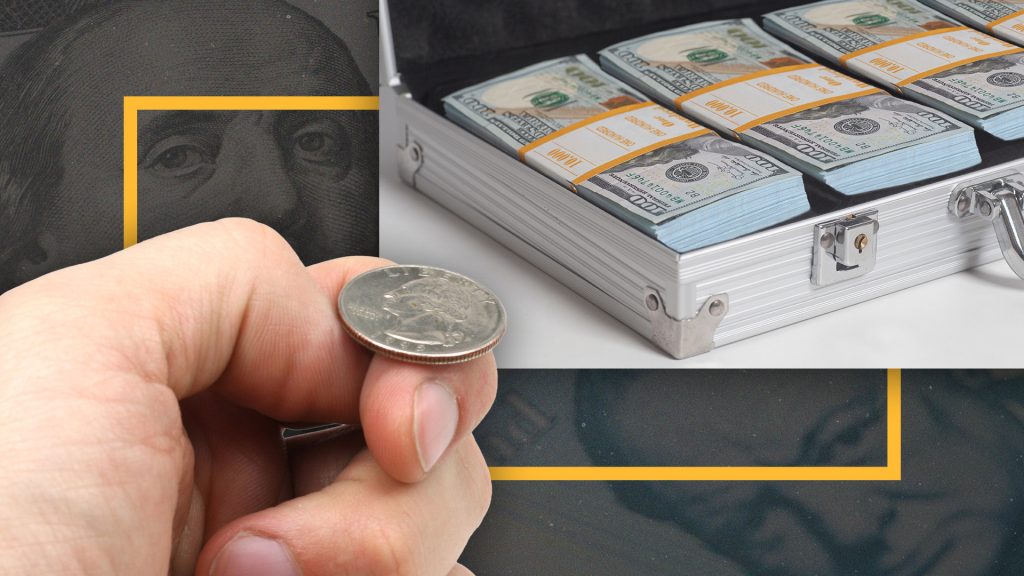
Would you take $50,000 or flip a coin for a 50% shot at winning $1 million? Most Americans and Britons opted for the quick money, a behavior that an economist told Straight Arrow isn’t likely to fade away as the world ushers in an era of tough economic times.
Pollster YouGov asked 15,887 Americans and 4,598 British adults what they would do if they had the chance to choose $50,000 instantly, or a 50/50 chance at winning $1 million. Most chose instant cash. A slightly higher number of Americans were more willing to test their luck. It’s been debated throughout social media.
“Easily the $100k now,” Redditor Gunner Bat wrote on a post in the Hypothetical Situation subreddit that asked Redditors if they want $100,000 now or a coin flip for $1 million. “I don’t need money that’s going to fundamentally change my life, I need money that will help make my life easier to manage.
Unbiased. Straight Facts.TM
About 71.5% of Americans said they’ve felt concerned and stressed about their personal finances, according to a CBS News/YouGov Poll.

The Redditor went on to say the $100,000 will clear out their loans and debts, allow their fiancé to pay school and kickstart a small business, save for a wedding and pay at least a month of rent.
Uri Gneezy, economics professor at the University of California San Diego, told Straight Arrow that people are more likely to opt for the instant money for similar reasons the Redditor stated.
He called the behavior risk aversion and said that it’s not a far-fetched scenario. Gneezy and other scholars tested the theory out on about 1,200 Nairobi college students who were given financial incentives to get a logical problem correct. Some received no incentives, while others got a nominal amount and others had payments that exceeded a monthly income for correct answers.
The research showed that despite a higher amount of money at play, the students showed little to no accuracy improvements. They did answer questions roughly 40% faster.
That same behavior is reflected in the coin-flip scenarios people toss around.
“If you give me another annual salary, it’s a life-changing event. I’ll remember it for the rest of my life. It’s really big,” Gneezy said. “If I say no and then lose, I’ll be devastated.”
Putting fate in the quarter
At least one person has lost out on an actual sum of money.
A man named Togi told Caleb Hammer on his Financial Audit podcast that he gambled a $1.9 million home on a coin flip. If the flip went in his favor, he’d keep the home and get $2 million.
He lost.
Togi appeared to approach the decision from a position of wealth, telling the podcaster that he didn’t even know the address and had only stayed in the home for a handful of days.
From an academic standpoint, Gneezy said there isn’t an economic model that could clearly explain the results. The closest is regret theory. It plays out with people anticipating that they’ll regret their choices, so they opt for instant money.
The other side of it, Gneezy said, is also people knowing they’ll have the instant cash and won’t think about the “what ifs” associated with losing the money.
“Each time I have to pay the utility bills, I think, ‘Oh, I could have paid it with that money,’” he said.
A behavior different from gambling
The coin flip scenario and risk aversion that follows it isn’t reflected in gambling, Gneezy said. With it, people are aware that they may win big with the long shot option.
“You’re coming and suggesting this thing, and I think about it as income,” he said. ”With gambling, you think about it as something different, something extra, not as part of my income.”
With bets, especially on sporting events, he said that people assert a set of confidence in teams that they’ll win a game against another. Other possible connections to the risk aversion seen in the coin-flip question are evident on social media, where Gneezy said people boast about stock trades.
Not all trades make money, but he said people are more likely to brag about their big trades and how much money they made, and then encourage others to follow them. If a person is reading an online post or video about it and didn’t follow the person’s stock advice, Gneezy said they’d feel similar levels of regret that others experience in risk aversion.
However, the choice between $50,000 or a chance at $1 million boils down to someone’s financial situation.
“Despite what economists tell them, there is no right or wrong answer to this question,” he said. “The economists will tell them that they chose wrongly, but that’s not true.”
Round out your reading
- What does low water at the Hoover Dam mean for power in the American West?
- Could GLP-1 drugs become the first longevity medications? Scientists think it’s possible.
- ChatGPT told him he wouldn’t face charges. Then came the arrest warrant.
- How one small city built a second act as a bio hub inside empty cigarette factories.
- If permanent Daylight Saving Time is so popular, why is it dead in the Senate?
Ella Rae Greene, Editor In Chief