How record land prices threaten the next generation of American farmers
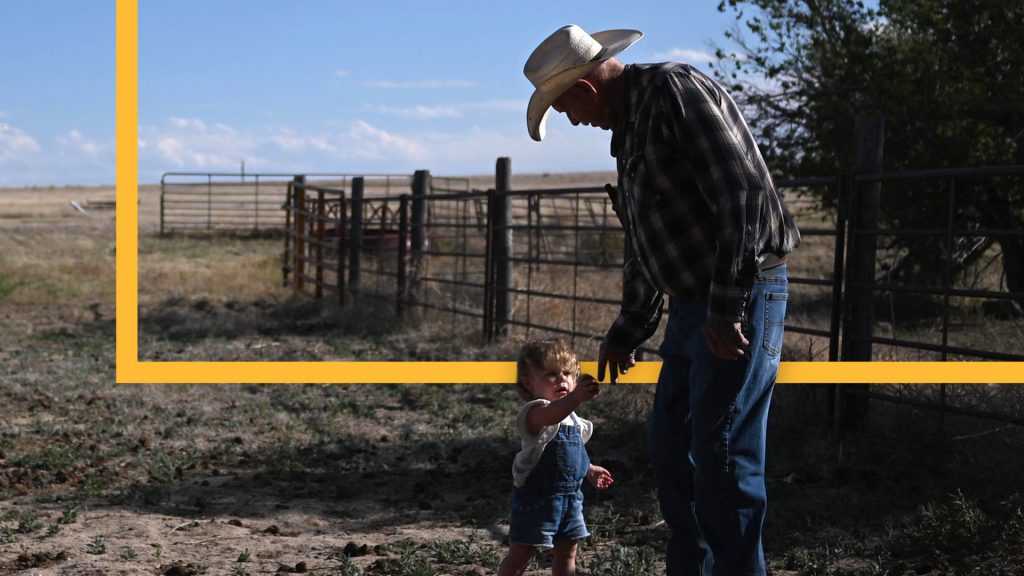
Jediah Smith has worked on his parents’ South Dakota farm for nearly his entire life.
The 23-year-old’s job description includes everything from fixing equipment to tending the seemingly endless rows of corn and soybeans sprouting from the rich dark soil on the state’s eastern edge.
“I’ve been doing that ever since I can remember,” he told Straight Arrow.
It’s work he takes on enthusiastically. Smith grew up in a region where vast crop fields fill the space between strings of towns with population counts in the dozens, and he’s long dreamed of someday running the farm.
But as the price of farmland rises, those dreams have been tinged with misgivings. Running the farm requires someday buying from his parents.
READ MORE: These ranchers heal the land. The power company drew a line through it
“I know I’ll be able to farm in some capacity, but I’m more doubtful,” he said.
It’s a problem familiar to young, aspiring farmers across the United States.
The next generation of farmers face several problems, but property values are especially vexing.

How land values influence land use
“The tight housing market has an impact on farmers getting started,” said Claudia Kenny, land access and transfer senior specialist for the American Farmland Trust. “Especially if you’re not inheriting a farm or housing.”
The average value of agricultural real estate hit a record $4,350 per acre last year, a 4.3% increase from 2024, which itself saw a 5% increase from 2023, USDA figures show.
Values are even higher in corn belt states. Farmland cost $9,790 per acre in Iowa last year, according to USDA figures.
“Land is fundamentally inaccessible unless you’re a millionaire,” Jamie Fanous, policy and organizing director for the Community Alliance with Family Farmers, told Straight Arrow.
Several nonprofits have raised money to buy land for beginning farmers, but many of those efforts are in their infancy.
Fewer people are working the fields today. Between 2024 and 2025, 15,000 farms called it quits in the U.S., lowering their count to 1,865,000 farms last year, USDA figures show. The drop mirrors historic trends, and agriculture experts and farmers told Straight Arrow they worry property values will further contribute to the decline.

Why are farmland prices going up so much?
Farmland is most expensive in heavily populated states where farmers and property developers clash over level earth that’s conducive to new housing and growing crops.
“There are a lot of competing uses for farmland,” Jennifer Hashley, director of the New Entry Sustainable Farming Project, a Massachusetts nonprofit that helps aspiring farmers get started, told Straight Arrow.
Flat land that’s easily farmable and close to bodies of water is the most developable, she said.
Farmland exceeds $13,000 per acre in California, “You can grow so many high-value specialty crops there,” David Anderson, an economist for Texas A&M agricultural extension, told Straight Arrow. “Strawberries, wine, grapes, all kinds of fruits and vegetables, all of these things are much higher value crops.” And they appeal to heavyweight investors, he said.
When farmers look to buy more land “they’re competing not only with other farmers, but hedge funds or investment groups,” Anderson said.
And in states like Connecticut, where New York City suburbs increasingly inch north and east, farmland is enticing to developers eyeing new space for growing exurbs.
“Farmers are competing with the entirety of the real estate market in Connecticut,” said Ella Kennen, coordinator for the New Connecticut Farmer Alliance. “For first-generation farmers who haven’t inherited land, that makes it really daunting.”

Billionaires such as Bill Gates, who alone owns roughly 275,000 acres of farmland, have gobbled up millions of acres in recent years looking to invest in property that can be leased to farmers.
That infuriates Dallas Leduc, who grows grains, lentils and field peas on his farm in the Canadian province of Saskatchewan and said out-of-province investors often swoop in to outbid locals.
Poverty levels in the province sit above Canada’s national average, and farmers on tight profit margins risk losing out on land purchases or leases.
“This area, [land costs] over $3,000 an acre,” Leduc said. “That might sound cheap compared to the corn belt, but here it is very expensive.”
A spokesperson for Cascade Asset Management, which manages Gates’ real estate holdings, declined to comment on the record.
Not everyone agrees that billionaires and investors are driving up land prices in farm country.
“That’s overblown,” said Steve Bruere, president of The People’s Company, a real estate brokerage that works with land buyers.
Instead, he said, the increase in property values hews closely to overall inflation.
“There’s a limited supply of farmland,” which, Bruere noted, generally results in higher prices. “Bill Gates is not the reason” farmland is growing more expensive, he said.
Bruce Sherrick, director of the TIAA Center for Farmland Research at the University of Illinois, agreed. The share of acreage purchased by investors and developers is a vanishingly small portion of total farmland in the United States, he told Straight Arrow.
“The amount taken out of production for housing and solar and wind is minor,” he said.
And, he said, the barriers to entry are hardly unique to farmers.
“Pretend we aren’t using the word ‘farming’ for a minute,” he said. “Can young people buy any business? You wouldn’t expect them to just buy a shoe store.”

Can renting land help young farmers stay in the game?
When property is unaffordable, farmers owning their fields “isn’t practical,” Breure said.
That leaves growers with another option: renting.
The USDA’s most recent census of agriculture in 2022 found that 39% of farmland is leased, which creates another set of headaches for the nation’s farmers. Investments made in rented properties won’t pan out if a farmer is priced out of a lease.
Soil health, for example, keeps many farmers up at night. Growers constantly work to create and maintain fertile ground through conservation practices.
READ MORE: The hidden cost of dwindling agricultural research
However, “if you have that kind of instability it’s hard to invest in the soil, it’s hard to invest in the infrastructure you don’t know if you’re going to be there next year,” Fanous said.
Buying property is one of the best ways to keep a farm in the family, farmers said.
“When you own that ground you don’t have to worry about it getting sold out from underneath you,” Jacob Smith, Jediah’s father, told Straight Arrow.
And purchasing land saves money in the long run, since leasing land year after year amounts to “paying for the same ground over and over again,” Smith said.

Why is it so hard to break into farming?
Will O’Meara and his wife first tried to break into Connecticut agriculture in 2020 in a state where USDA figures show the cost of farmland is $14,400 per acre.
They found themselves constantly on the move as rental costs rose.
“In our first three years of business, we moved the farm three times,” said O’Meara, who grows fruits and vegetables. “It’s difficult to start a farm from scratch. Moving that many times made it really challenging to make investment in soil and infrastructure.”
The O’Mearas hope to buy the piece of land they settled on three years ago, but that purchase will set them back roughly $800,000.
That will buy some certainty for the young farm, but O’Meara and his wife will be paying it off for years, siphoning away money that could be invested back into their business.

What is being done to help farmers afford land?
The Farmers Land Trust is among the organizations fighting to keep croplands in growers’ hands. The nonprofit secures land, which it rents to farmers on 99-year leases at affordable rates.
“We are a very young organization, not even three years old,” Kristina Villa, the trust’s co-executive director, told Straight Arrow.
The group’s reach is still limited: It holds property in seven states, and its largest parcel is 40 acres.
Still, said Villa: “It’s shocking what we’ve been able to do.”
The organization has raised around $28 million, its website says, and has secured land for farmers in states like Washington, Tennessee and Wisconsin.
Jacob Smith bought a plot of land from his father — Jediah’s grandfather — for a hefty sum this year, but now worries about the feasibility of future investments.

The future of farming
“That’s really going to hinder my ability to be able to help my 23-year-old son transition into farming,” the elder Smith said. “We’re going to be financially handicapped if we want to help him.”
He’s not without ideas, though the current plan is far from a perfect solution.
“To do this in the near future, we’re going to have to sell this ground back to him at a loss so he can afford to keep it in the family,” he said.
Round out your reading
- With more prison space than prisoners, correctional facilities are shutting down.
- ‘Game changer’: New cancer treatment turns major surgery into an outpatient procedure.
- Viewers overwhelmingly support ‘The View’s’ fight against the FCC. Will that matter?
- Why an ICE shooting in Houston isn’t leading to mass protests.
- Milwaukee detective is the latest officer charged with misusing Flock cameras.
Ella Rae Greene, Editor In Chief