Trump administration trying to force reporters to identify sources on Air Force One story
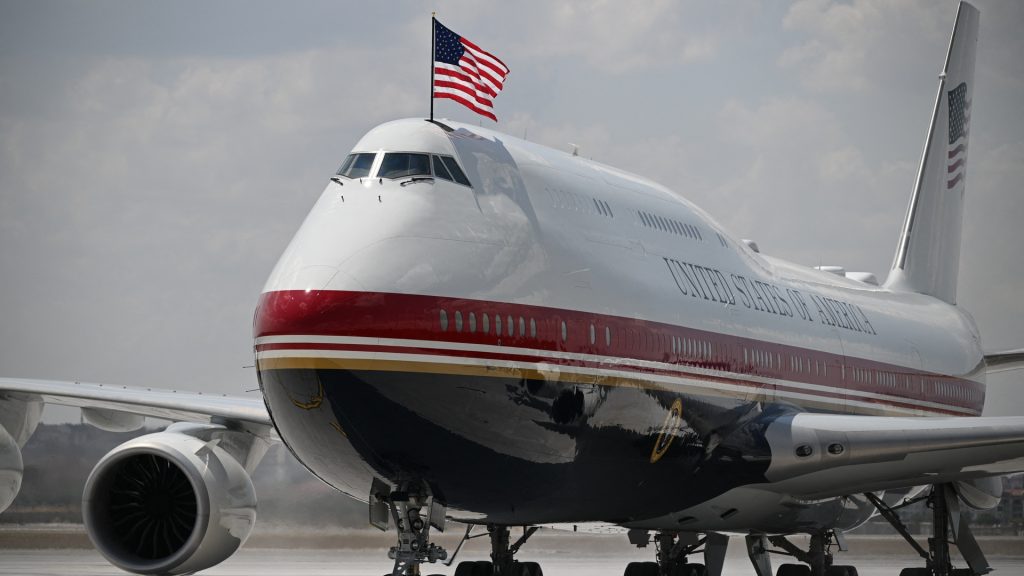
The Trump administration is trying to force several New York Times journalists to reveal their sources for stories that reported security concerns about the president’s new Air Force One.
Subpoenas issued Friday to at least four Times reporters represent a significant escalation of the administration’s efforts to attack critical reporting. Although federal officials have sought information from other journalists, this investigation concerns a pet project of President Donald Trump’s: the Boeing 747-8 donated by the Qatari government to serve as his principal aircraft.
The Times reported earlier this week that Trump flew on the old Air Force One when he left a NATO summit in Turkey because the Secret Service raised security concerns. A second article said that the new, retrofitted jet lacks advanced security features, such as systems that detect and deter missile attacks.
Both articles quoted government sources who sought anonymity because they were discussing sensitive security issues.
The Times said Saturday that federal agents went to the homes of at least some of the reporters. A newspaper spokesperson described the subpoenas as a “brazen act” by the Trump administration.
In a statement Saturday to Straight Arrow, the Justice Department acknowledged an investigation into the stories but said the reporters were not targets.
“Every administration has addressed the crime of leaking national security information,” a Justice Department spokesperson said. “To the extent that we have to investigate breaches of national security, that’s something we will continue to do. To be clear, reporters are not the target, those leaking classified information are.”
Even so, the investigation clearly is a high priority for the administration.
The Times reported late Saturday that the White House instructed FBI Director Kash Patel to oversee the investigation. He directed agents from the White House, rather than from FBI headquarters, for about eight hours on Friday, The Times said.
Both the White House involvement and running an operation from there are highly unusual.
New plane reportedly lacks security features
Questions about security features on the new Air Force One began swirling after Trump left a NATO summit in Turkey on Wednesday aboard the older aircraft, a 747-2 that has been in service more than 30 years. The trip coincided with increased tension with Iran, a neighbor of Turkey’s, over a tenuous ceasefire in its more than four-month-old war with the U.S.

Officials flew the new plane — without the president — to Mildenhall Royal Air Force Base in Suffolk, England. Trump switched planes there and flew to Washington aboard the new aircraft.
“The swap,” The Times reported Wednesday, “deepens questions about whether the new plane, which the president had pressed to be ready as soon as possible, was retrofitted with sufficient security measures over the last year.”
The Times reported Thursday that the new aircraft, despite $400 million in upgrades, lacked some of the security features — in particular, antimissile capabilities — of the old Air Force One. The absence of those capabilities are believed to make the president vulnerable to attack by foreign adversaries.
Trump denied any security concerns. He said on social media that the new plane was taken to Mildenhall so it could be shown to U.S. service members stationed there.
He brushed off a question about whether Iran had threatened to attack Air Force One.
“I have a threat all the time,” Trump told reporters. “I’m No. 1 on their list.”
‘Shock the conscience’
The Times reported Saturday that a senior FBI official contacted the newspaper on Wednesday, asking that the first article not be published. The official also asked a top editor to disclose the newspaper’s sources. The editor declined.
The subpoenas contain few details, the newspaper said, beyond calling on the journalists to testify “in regard to an alleged violation of federal criminal law.”
A lawyer for The Times described the subpoenas as an affront to the First Amendment.
“The appearance of federal law enforcement agents on the doorstep of news reporters should shock the conscience of any American who believes in the Constitution and the press freedom it protects,” David McGraw, The Times’ deputy general counsel, said in a statement. “Our journalists report the facts and advance the American public’s right to know how their government is operating and their taxpayer dollars are being used. This brazen act should be seen as nothing more than an attempt to prevent the public from knowing what is happening in their country by intimidating journalists from doing their jobs.”
Press freedom groups supported The Times’ position.
“In the end, press freedom is about the rights of the public — to learn how their community and country are being run and to make informed decisions based on independent reporting,” Stephen J. Adler, chairman of the Reporters Committee for Freedom of the Press, said in a statement Saturday. “When the public’s right to know is crushed, as the Trump administration is trying to do with its subpoenas against The New York Times, all of us suffer irreparable harm, as does the freedom upon which this nation is built.”
‘We are not going to ignore the law’
The effort to force testimony by reporters from The Times comes a month after the Justice Department issued subpoenas to a Washington Post reporter and three journalists from The Wall Street Journal, all of whom cover national security issues. Prosecutors withdrew the subpoenas after the news organizations challenged them in court.
Earlier this year, FBI agents searched the home of a Washington Post reporter, Hannah Natanson, seizing phones, laptops and a smartwatch. Natanson had been reporting on the Trump administration’s efforts to reduce the federal workforce. An alleged source, a government contractor, was later charged with mishandling classified material.
A federal judge criticized the FBI for failing to explain how searching Natanson’s home complied with a 1980 law, the Privacy Protection Act, which prohibits such searches unless authorities have probable cause to believe a reporter committed certain crimes.
Press freedom advocates have criticized Trump and his administration for repeated attacks on the media, including a series of lawsuits against news organizations. Most recently, Trump sued The Times, claiming it tried to undermine his 2024 campaign, and The Journal, saying it defamed him in a story about his connections to the late sex offender Jeffrey Epstein.
In its statement to Straight Arrow on Saturday, the Justice Department said the subpoenas of the journalists from The Times is about protecting national security, not stifling reporting.
“We value and appreciate the important role that the press plays in this country,” the statement said, “but DOJ also plays an important role to make sure that the people entrusted with our nation’s secrets do what they’re supposed to do with that information, which means not sharing classified information. We recognize there may always be natural tension there, but we are not going to ignore the law and stop investigating people who work in the administration and think it’s okay to leak classified information impacting national security.”
Round out your reading
- Scientists are now eyeing a possible ‘Mega El Niño’.
- Critics mocked Mamdani’s AC request. Republicans made the same ask.
- Social Security was supposed to be a safety net. To young Americans, it’s a broken promise.
- What happens when the water dries up? Much of the American West is close to finding out.
- Political insiders are targeting the two-party system’s grip on America.
Ella Rae Greene, Editor In Chief