Data shows how renewable energy fared in the year since One Big Beautiful Bill
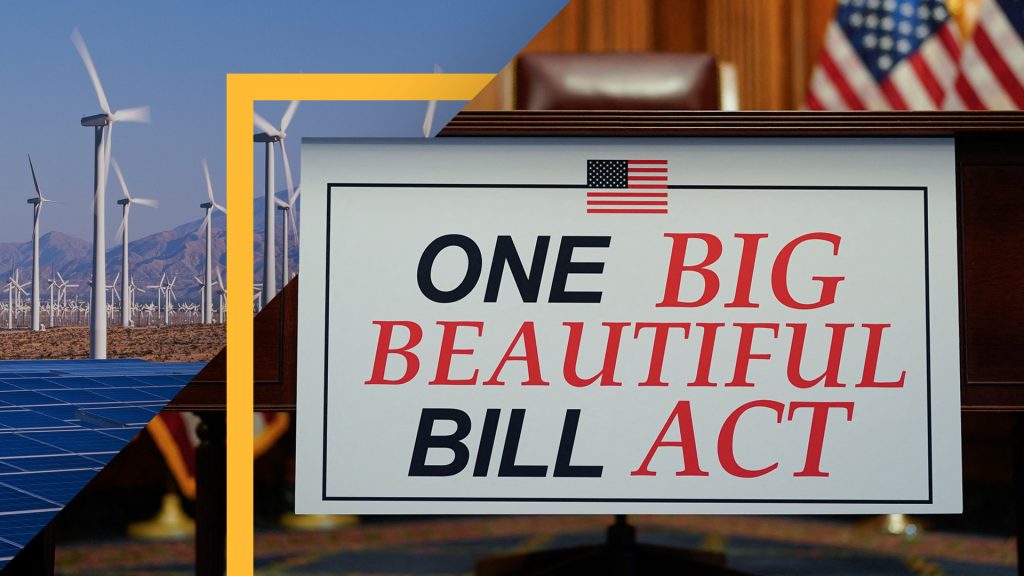
A year after Congress rewrote federal renewable energy policy, solar power continues to be the fastest-growing source of U.S. electricity. But a rise in project cancellations after years of rapid growth shows the effect of cutting off taxpayer support.
Signed on July 4, 2025, the “One Big Beautiful Bill Act” accelerated the deadlines for wind and solar energy projects to qualify for tax credits. For most projects, that deadline to receive taxpayer subsidies came last Saturday, on the anniversary of the bill’s signing.
“Tax credits expiring absolutely are going to have an effect on the amount of renewables that are built in the United States,” Doug Sheridan, founder of the firm EnergyPoint Research, told Straight Arrow.
Renewable energy is a constant flashpoint in the debate over electricity prices and what’s driving increases on Americans’ monthly bills. Renewables can lower prices because once wind and solar farms are built, electricity can be generated at no cost. And the cost of resources like solar panels and batteries has continually dropped.
But critics of renewable energy argue it raises overall costs. Intermittent resources that rely on specific weather conditions require another power source to fill the gaps. Traditional power plants mostly fill that role, but batteries are now stepping in during key hours as the sun goes down. Another cost from wind and solar comes from transmission lines needed to connect the rural areas where renewables are built to population centers.
In a social media video celebrating the July 4 tax credit deadline, Energy Secretary Chris Wright said wind and solar provide “a relatively small amount of low value energy,” adding that “the wind doesn’t always blow and the sun doesn’t always shine. So they drive up the system costs.”
Where does solar stand in 2026?
While the wind power industry has been engaged in a sequence of legal battles with the Trump administration, solar has remained steadier over the past year. In May, solar generated more electricity than coal for the first time.
In the first quarter of 2026, the grid added 7.8 gigawatts of solar and battery storage, according to the Solar Energy Industries Association. That’s enough to power about 6 million homes, if the solar panels and batteries all produce electricity at the same time. Those additions accounted for 91% of new resources added to the grid during that period.
READ MORE: What does the ‘Big, Beautiful Bill’ mean for wind, solar energy production?
Texas has attracted the largest share of new solar investments.
Sheridan said Texas’ solar boom is due to the tax credit deadline and the fact that Texas’s isolated power grid has the fastest turnaround for new resources to begin construction and connect. And he added one more factor: Data centers.
Meta and Google have been the largest purchasers of renewable energy so far in 2026, according to the Financial Times. The FT also reported that with Big Tech demand for power and the tax credit deadline, prices for new renewables could rise 40% to 120%.
Sheridan said Big Tech wants to “give themself a little bit of a green halo” by signing agreements with solar developers while building data centers that drive up demand for power. Even while the data centers consume electricity from whatever power source is active on the grid, many tech companies have environmental pledges to offset their consumption with investments in zero-emissions power sources.
For Sheridan, who favors investment in new power plants, a slowdown is welcomed news. “You’ve got all these renewables piling onto the Texas grid that aren’t needed.”
However, the growth of data centers may take over as the driver of renewable energy growth.
“Demand is soaring,” Leah Qusba, CEO of the renewable advocacy group GoodPower, told Straight Arrow. “The economics will force us to meet that demand with the cheapest, fastest electrons that we can get, and right now that is solar and storage.”
Is the industry slowing down?
But that good news for solar is coming at the end of a period where tax credits spurred new development, and masks another story below the surface.
Michael Timberlake, a director at the renewable energy business group E2, described “a ratcheting up of cancellations that we did not see in previous years.”
In research compiled in a monthly report, E2 identified 46 projects that were canceled or indefinitely paused through April of 2026 — more project cancellations than in all of 2022 and 2023 combined. Those projects would have added 9.8 gigawatts of capacity to the grid and created 42,000 construction jobs with $16 billion invested, according to E2.
“There’s a scale back in the size and scope, and a scale back in the number of projects,” Timberlake told Straight Arrow. He added that monthly project announcements now typically total less than $500 million after peaking between $2 billion and $3 billion during the Biden era.
“Businesses want to know what the laws and the financials of their projects are going to be years and years out,” Timberlake said, “and the U.S. made it very clear that it’s really hard to have that certainty.”
Round out your reading
- Scientists are now eyeing a possible ‘Mega El Niño’.
- Critics mocked Mamdani’s AC request. Republicans made the same ask.
- Social Security was supposed to be a safety net. To young Americans, it’s a broken promise.
- What happens when the water dries up? Much of the American West is close to finding out.
- Political insiders are targeting the two-party system’s grip on America.
Ella Rae Greene, Editor In Chief