Dayslong funeral begins for Iran’s late Ayatollah Ali Khamenei
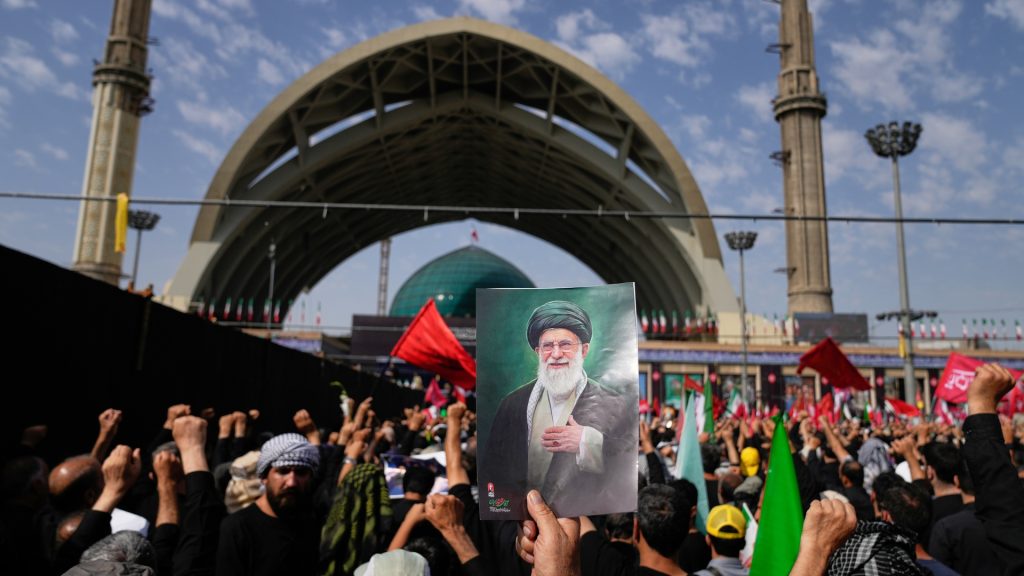
Iran on Saturday began funeral proceedings for Iran’s Supreme Leader Ayatollah Ali Khamenei, who was killed during joint U.S. and Israeli airstrikes in February.
A spokesperson for the funeral preparations said in a statement that ceremonies commenced four months after Khamenei’s death because of “war conditions,” as well as “the brutal U.S. invasion,” NPR reported.
The late Ayatollah’s body will be taken to cities in Iran and Iraq. On Sunday, there will be a prayer for the dead at the Grand Mosalla. Then, on Monday, Khameni’s and his family’s bodies will be taken through the streets of Tehran.
After that, the body will be transported to Qom for a Tuesday ceremony, and on Wednesday, it will go to Karbala, Iraq, before ultimately being laid to rest in Mashhad, Iran.
“With hearts heavy with sorrow and wills filled with hope, the great nation of Iran will prove that the flag, for whose continued soaring the martyred leader strove, will not fall to the ground,” Iranian President Masoud Pezeshkian said on X.
Funeral prayers were also given for four members of Khamenei’s family, who were killed in the Feb. 28 strike that started the war with Iran, according to Tasnim News Agency. These are his son-in-law, Dr. Mesbah al-Hoda Baqeri Kani; his daughter, Seyedeh Boshra Hosseini Khamenei; his daughter-in-law Zahra Haddad Adel; and granddaughter, Zahra Mohammadi Golpayegani.
“What sin did she commit?” Ayatollah Mohammadi Golpaygani, 14-month-old Zahra Mohammadi Golpayegani’s other grandfather, asked, per the New York Times.
Mojtaba Khamenei, Khamenei’s son and successor, has not been seen publicly during the funeral events.
Hundreds of thousands of mourners beat their chests in front of a glass case that held Khamenei’s coffin, which was covered with a flag, The Associated Press wrote. Some of these mourners called for revenge against those who killed Khamenei.
Mourners also carried photographs of victims in the strike on a girls’ school in Minab that killed over 100 children, according to the New York Times. Multiple media outlets have reported that U.S. officials said a military investigation found that the strike was done by American forces. Humanitarian organizations have said such an attack is a breach of international law.
Foreign dignitaries who attended a ceremony for Khamenei include Iraqi President Nizar Amidi, Pakistani Prime Minister Shehbaz Sharif and Turkish Vice President Cevdet Yilmaz, among others, CNN said.
Abbas Araghchi, Iran’s foreign minister, said Iran was “pleased to have received representatives from more than seventy countries who chose to participate in honoring our Supreme Leader.”
Reza Pahlavi, Iran’s Crown Prince, who has been exiled for decades, said in a message to foreign representatives in Iran that the country is not mourning Khamenei, but the “more than 40,000 sons and daughters slaughtered on January 8 and 9” during protests under his regime.
“What you see today is not a nation in grief for its ruler,” he said. “It is a nation filled with righteous anger, and that anger and heroic bravery will bring down what remains of this criminal regime.”
US, Iran negotiations temporarily suspended
Talks between the U.S. and Iran aimed at ending the war permanently are paused for now, with U.S. President Donald Trump saying before the funeral that the United States “gave [Iran] a week off for a funeral.”
Iran’s deputy foreign minister for legal and international affairs Kazem Gharibabadi still took to social media Saturday to respond to a joint statement by the United Kingdom’s prime minister and French president about the Strait of Hormuz, a key sticking point in negotiations.
In their statement, outgoing UK Prime Minister Keir Starmer and French President Emmanuel Macron said the Sultanate of Oman agreed to work with both countries to “ensure that its sovereign territorial waters are safe for navigation.”
“The UK and France also stand ready to deploy the wider Multinational Military Mission to support freedom of navigation in the Strait of Hormuz,” the statement said.
Gharibabadi, who shared the statement on X, said the strait is “not a theater for the military display of extra-regional powers.”
“Iran, as the responsible power and guarantor of the Strait’s security, warns with sensitivity to any military movement in this waterway,” he said. “The security of Hormuz lies with the coastal states; the crisis-makers will be held accountable for the consequences of their adventurism; this is a serious warning.”
Round out your reading
- America at 250: Straight Arrow’s week-long look at the pressures testing modern America.
- Ketamine is booming in America. The reasons go beyond drugs.
- Cluster of AI news sites suddenly goes dark after human reporter starts asking questions.
- A 79-year-old, obese, well-connected man gained exclusive access to a new weight loss drug. Is it Trump?
- Newsom pushes national wealth tax after opposing California billionaire tax.
Ella Rae Greene, Editor In Chief