Political insiders are targeting the two-party system’s grip on America
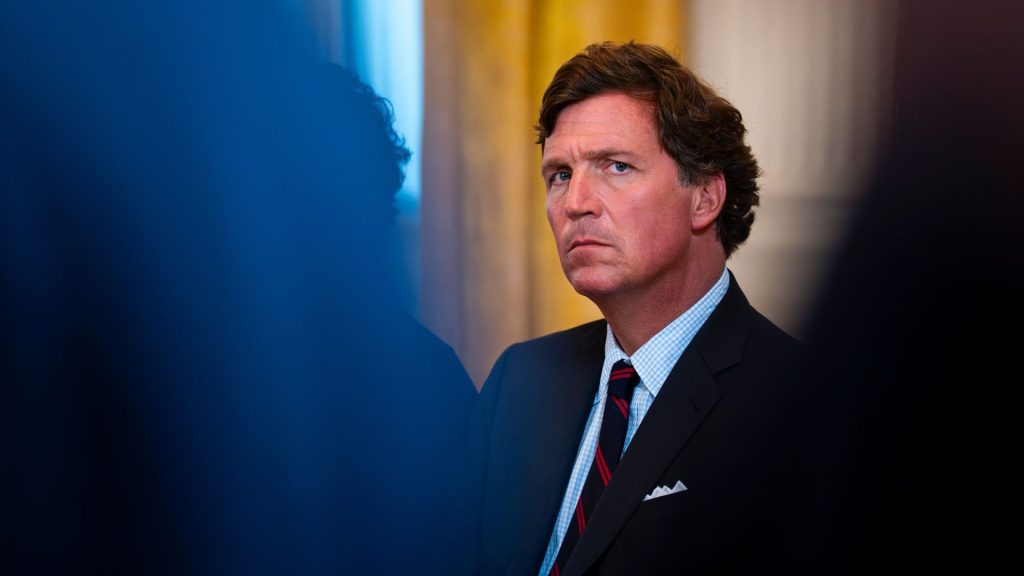
It’s no revelation that America has a two-party political system. But as more Americans continue to believe neither party truly represents them, cracks are beginning to emerge inside American politics.
In the same week, prominent voices on opposite sides of the political spectrum have discussed moving away from America’s political duopoly.
On the right, former Fox News host Tucker Carlson told the Columbia Journalism Review that he’s going to “help build a third party.” And on the left, longtime Democratic strategist James Carville went on his podcast and said it’s time for Democrats to talk about a formal “schism” with the party’s rising democratic socialist wing.
What’s happening on the right?
Carlson told the Columbia Journalism Review that his resentment towards the Republican Party has been building since 2025, when the U.S. launched a wave of strikes on Iran. But he said it boiled over after President Donald Trump launched an even bigger attack earlier this year.
“I haven’t spoken to [Trump] since the regime-change war began,” Carlson told the outlet. “I’m not interested in talking to him. I feel sorry for him. He’s not a man in charge of his own life at this point.”
In his interview, Carlson said the two-party system has become “a one-party state posing as a democracy,” saying “it needs to be broken” and that he is “going to do everything I can to bring that about.”
Carlson insisted that he wouldn’t run for office himself. His party’s plans are vague, but he said he believes in “ending all immigration today.” He said he can’t justify immigration “when half of all white-collar jobs are going away because of AI.”
Meanwhile, former Georgia Republican Rep. Marjorie Taylor Greene told Piers Morgan this week she is having “serious conversations” about launching a third party following her public split with Trump and the Republican Party.
“It’s difficult to launch a third party, so the reality is this isn’t something that gets off the ground in just a couple of campaign cycles,” Greene said. “This is a movement that has to be developed and would take time to develop.”
What’s happening in the middle?
While Carlson and Greene are still in the planning stages of new political parties, former Democratic presidential nominee Andrew Yang has spent four years building his Forward Party.
During that time, Yang has pushed for ballot access and recruited candidates. According to Ballotpedia, the party qualifies on four state ballots as of May 2026: Florida, New Mexico, South Carolina and Utah. The most recent access victory is New Mexico, which announced this spring Yang’s party had achieved official minor-party status after it submitted more than 5,500 signatures. The party is now recruiting state house and county candidates ahead of the November election. Forward is also fielding more than two dozen candidates in Utah.
The party is co-chaired by Yang and former New Jersey Democratic Gov. Christine Todd Whitman. Forward’s pitch doesn’t speak much on ideology, but rather on process. Its platform centers on ranked-choice voting and open primaries, with the brand: “Not Left. Not Right. Forward.”
In 2026, only three minor parties are recognized on ballots in more than 10 states: the Libertarian Party (35), the Green Party (20), and the Constitution Party (12).
What’s happening on the left?
Further to the left on the political spectrum, the battle isn’t about leaving to build something new — it’s about who gets to stay.
After two candidates backed by self-proclaimed democratic socialist and New York City Mayor Zohran Mamdani unseated incumbents in New York’s June 24 primaries and a third won an open seat, Democratic strategist James Carville spoke out against the movement on his podcast.
When discussing Darializa Avila Chevalier, one of the Mamdani-backed candidates to win, Carville said their political views were entirely different.
“Lady, I ain’t in the same party as you. I’m sorry,” he said on his podcast. “I’m just not, and I actually do think it’s time for Democrats to talk ‘the S-word.’ ‘Schism.’ I really do.”
During an interview with NewsNation, Carville said Avila Chevalier shouldn’t be seated in the Democratic caucus at all.
Carville isn’t entirely rejecting the left flank of his party. He’s said he could be in the same party as Rep. Alexandria Ocasio-Cortez, D-N.Y., but not in the newer democratic socialist-aligned group of candidates.
Some have criticized Carville’s comments. The Nation published an article shortly after Carville’s remarks, pointing out the irony of Carville “praising pluralism while calling for a purge.”
What do people think of the two-party system?
The political divisions are not limited to those inside political circles. As Straight Arrow has previously reported, more Americans now say they don’t fit neatly into either major political party.
The finding comes from a recent Pew Research Center study that grouped 10,000 adults into political camps that go beyond just Democrat or Republican. One example of this was the “Order and Opportunity Left,” who are voters who back tougher public safety policy but also want bigger government.
University of Rochester political science professor James Druckman warned about how far to take this in a winner-take-all two-party system.
“I think the report is helpful to a point, but the reality is the electoral system in the U.S. means voters have two choices and so differentiating groups at too fine-grained a level, while interesting, does not necessarily help explain voting,” Druckman told Straight Arrow.
Past fears of a two-party system
In his 1796 Farewell Address, the nation’s first president, George Washington, warned at length against “the baneful effects of the spirit of party,” fearing factions would eventually let one group seize power and subvert the will of the people.
James Madison was more resigned to the prospect, writing in Federalist No. 10 a few years earlier that he considered factions inevitable in any free society. But he hoped a large, diverse republic would dilute any single faction’s power rather than eliminate parties altogether.
On the eve of the 250th anniversary of the signing of the Declaration of Independence, the fight over whether to fix, split or replace today’s duopoly mirrors discussions Washington and Madison had with each other at the start.
Round out your reading
- America at 250: Straight Arrow’s week-long look at the pressures testing modern America.
- Ketamine is booming in America. The reasons go beyond drugs.
- Cluster of AI news sites suddenly goes dark after human reporter starts asking questions.
- A 79-year-old, obese, well-connected man gained exclusive access to a new weight loss drug. Is it Trump?
- Newsom pushes national wealth tax after opposing California billionaire tax.
Ella Rae Greene, Editor In Chief