
What happens when the water dries up? Much of the American West is close to finding out

As the United States marks its 250th birthday, Straight Arrow is taking a fresh look at the institutions, systems and social contracts that shaped modern America — and the pressures now testing them.
John Wesley Powell led the first expedition through the Colorado River Basin in 1869, filling in the last blank spot on the map we now call the United States as the country celebrated its 93rd birthday. As America turns 250, the reservoir that bears his name is in danger of hitting dead pool, marking a crisis point for the river complex and the 40 million people who rely on it.
While civilizations made homes along the Colorado River for thousands of years, America’s development boom along the waterway coincides with a period of extended drought. That drought has intensified within the past 25 years as the climate shifts and one of the country’s largest river basins dries.
“This problem in the Colorado River,” said Brad Udall, a senior water and climate research scientist at the Colorado Water Center, “is unique globally and it represents a human-caused climate change shift in how we operate.”

The latest dry spell
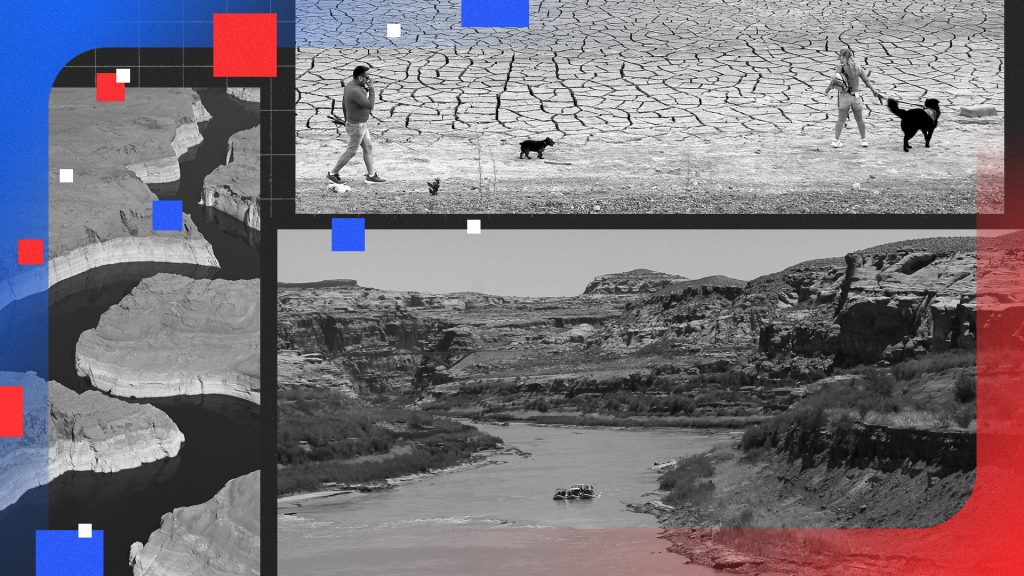
Since the start of this century, the annual flow of water through the Colorado River is down about 20% compared to the century before. In the past seven years, flows dropped to a third lower than the 1990s. Lake Powell and Lake Mead, two of the largest reservoirs in the country, are only about a quarter full and nearing dead pool — a point when water can no longer flow out of the reservoirs and generate hydroelectric power.
“The reality here is we have less water,” Udall told Straight Arrow. “We can’t kick the can down the road anymore. These reservoirs are levels such that that’s just not possible. We’ve spent down this bank account as shown by the reservoir levels over the last 27 years, and we’re close to being broke here.”
A historically dry winter and warm spring led water managers to implement a contingency plan for just the second time: release water from Flaming Gorge Reservoir in Wyoming and Utah.
-

A sign showing where Lake Mead water levels were in 2002 is posted near the Lake Mead Marina on August 19, 2022, in Lake Mead National Recreation Area, Nevada. (Photo by Justin Sullivan/Getty Images) -

Lake Powell, Utah, in 2000. (Photo by Bruno PEROUSSE/Gamma-Rapho via Getty Images) -

Water levels remain low at Lake Powell in Glen Canyon National Recreation Area on April 30, 2026, near Big Water, Utah. The flight for aerial photography was provided by LightHawk. (Photo by RJ Sangosti/MediaNews Group/The Denver Post via Getty Images)
“Due to water demands downstream and evaporation, that movement of water is pretty much vanished right now, and so both Lake Mead and Lake Powell continue to decline,” John Tracy, an ecosystem science and sustainability professor at Colorado State University, told Straight Arrow. “By the end of the summer, they’re going to be dangerously close to a dead pool, and that’s where everybody concerned is starting to sweat a little about that now.”

How the Colorado River Basin is managed
Climate scientists agree the long-term agreement managing use of the river — the Colorado River Compact, signed in 1922 — contributed to many of the problems faced today. It allocated water to basin states and split them into two camps: the Upper Basin of Colorado, New Mexico, Utah and Wyoming, and the Lower Basin of Arizona, California and Nevada. The compact promises each of the seven states a certain amount of water annually based on flow rates from 1922.
“[The compact] allocated water without considering how movement of that water out of the natural river course would use water,” Tracy said.
Each time water gets diverted from the river, it spreads out the water’s surface area, leading to faster evaporation rates, Tracy explained. For every canal or reservoir added, even more water leaves the system.
“Now that was fine until we built all the infrastructure to deliver the water, such as Lake Mead, Lake Powell, the Central Arizona Project, continuation of projects of delivering water into Southern California,” Tracy said. “Once all of that got in place to deliver the water that everybody was promised, there just simply is not enough water in the system.”
-

Reservoir site of the Boulder Dam, now known as the Hoover Dam, in 1929. (Photo by Bettman via Getty Images) -

The Boulder Dam on the Arizona-Nevada border, now known as the Hoover Dam, pictured in 1936.(Photo by Keystone/Getty Images) -

Aerial view of the Central Arizona Project canal east of Marana, Arizona, looking NW towards Picacho Peak in the distance. A Marana housing development, San Lucas, with farmlands behind is in upper left corner of this photo. Aerial support by LightHawk. (Photo by Wild Horizon/Universal Images Group via Getty Images)
Historically, more water flowed through Lee’s Ferry — a point in Arizona just below Lake Powell that is the official split between the Upper and Lower Basins — than was required. So decreasing flows were not, legally or contractually, a problem. As the Colorado River drops to historically low levels, the water flow through Lee’s Ferry also drops, creating tension between the two basins.
“Forty million people in the U.S. and Mexico rely, in whole or in part, on this river for businesses, for residential homes, for irrigation, for industrial use,” said Anne Castle, a senior fellow at the University of Colorado Boulder’s Getches-Wilkinson Center. “We’ve built up uses and expectations over the years for more water than we’re currently getting, and we could do that when we had water stored in the reservoirs.”
“Those supplies are getting so depleted that we can’t count on being able to offset the gap between supply and demand with reservoir water anymore,” Castle told Straight Arrow. “We have to reduce uses in order to balance the system.”
A flawed 104-year-old agreement
That falling water level comes as nearly all of the operating agreements to conserve water within the basin, collectively called the “Law of the River,” expire.
“One-hundred plus years of water law policy treaties, congressional legislation, all kinds of agreements basically need to get thrown out and replaced with something else,” Udall said. “I think this might be the first time worldwide where a water-related issue is causing this much of an upset.”
The seven basin states spent the past several years attempting to come up with a new operating agreement. Multiple times, the federal government delayed its deadline to give stakeholders more time to work out an agreement.
But the discussion largely remained the same. Each stakeholder claims it uses less water than it receives as part of the 1922 allocations and they have special issues — business, agriculture, housing or otherwise — that keep them from taking a significant cut.
-

The Colorado River flows under U.S. Route 191 through Moab, Utah, on June 21, 2026. White rings on the underpass supports indicate peak flow levels, typically seen in June. (Photo by Ally Heath/Straight Arrow) -

The Colorado River enters Lake Powell in Hite, Utah, on June 20, 2026. Shrubs grow on riverbanks where the reservoir, which dropped to historically low levels in 2026, used to fill in. (Photo by Ally Heath/Straight Arrow).
An additional problem comes into play when stakeholders consider where water for Native groups comes from. A 1908 Supreme Court decision gives tribes the most senior water rights, meaning the highest priority, but only specifies they get enough water to maintain their way of life. That allocation wasn’t considered in 1922, but amounts to about a quarter of the total water within the Colorado River Basin.
“There’s still this question of, well, is it the individual state’s obligation, so if you have the Navajo Nation in Arizona, is it Arizona’s part of water the Colorado River Compact that they have to give up for the Navajo, or should it be part of, hey, this nation gets so much water as part of the compact,” Tracy said. “It’s kind of being backed into these negotiations and discussions where I think it ended up being such a fundamental flaw in the compact in the first place.”
The seven states failed to work out an agreement before their final negotiating deadline in February. There was wiggle room to come to a new deal after the deadline, but it has to happen before mid-summer, when water managers need to start implementing plans for the 2027 water year. However, negotiators who spoke to Straight Arrow said an agreement is not likely.
“No one wants to blink,” Tracy said. “If you are tagged with giving away Colorado’s water to somebody else, especially California, you’re dead. Your political career is over, and I think you know, and all the states are like this.”
In May, the Lower Basin states proposed water cuts over a two-year period, but the Upper States rejected the proposal, saying it was not nearly enough.
“It’s not enough to meet the gap that we’re currently experiencing, and so there will be more discussion about that in the future,” Castle told Straight Arrow at the time.
Without a signed agreement that addresses all of those concerns, the federal Bureau of Reclamation steps in and dictates how water will flow through the Glen Canyon Dam at Lake Powell and the Hoover Dam at Lake Mead.
-

Hoover Dam and Lake Mead. The light-colored bathtub ring around Lake Mead shows how much water level has dropped because of drought. (Photo by: Marli Miller/UCG/Universal Images Group via Getty Images) -

Construction underway of the Glen Canyon Dam on the Colorado River in northern Arizona, United States, circa 1960. (Photo by Archive Photos/Getty Images) -

Glen Canyon Dam, a concrete arch-gravity dam, is located on the Colorado River in northern Arizona, near the city of Page, United States. The 710-foot-high dam was constructed by the Bureau of Reclamation from 1956 to 1966 and forms Lake Powell, one of the largest man-made reservoirs in the United States with a capacity of more than 25 million acre-feet (about 12.3 million Olympic-sized swimming pools) of water. (Photo by Thomas O’Neill/NurPhoto via Getty Images)
The proposals are based on science and raw data — math equations that say if we need x more water in Lake Powell to keep the hydropower generators running, California, Nevada and Arizona will need to take w, y and z less water, respectively, which totals x, to maintain water levels upstream. Or, if Lake Mead is short x, Colorado, Utah, Wyoming and New Mexico need to give up a, b, c and d amounts that equal x, and so forth.
The Bureau of Reclamation is set to release a plan by mid-August, but hasn’t said exactly when it will unveil its temporary solution for next year.
The bureau’s proposals put forward, however, make none of the parties happy, because science and raw data can’t be the only factor in determining a solution. One of the solutions, for instance, drew a possibility of communities trucking in water to survive.
“It’s an issue around values and economics and policies,” Udall said. “Science certainly has a really important role to play here, but science can’t tell you what to value and what not to value it, can only tell you if you do this, this is what will happen.”
What happens now?
When the latest mass development wave — data centers — began to hit the West, the first thing many people asked was whether there was enough water to support the facilities.
While there have been a few instances of developers making attempts to pull significant amounts of water for their projects, most communities, despite rapid growth, are managing water now better than ever before. The Las Vegas area is a prime example, using significantly less water now than it did 20 years ago, even as its population grew by about 70%.
Tracy and Udall both argue that agriculture needs to be the primary focus in water reductions. Agriculture accounts for 70% of the water usage within the Colorado River system.
“It’s just clear that there’s going to have to be some sharing,” Udall said, because farmers have senior rights over municipalities. “The question is, how do you? Can you do it in such a way that, you know, allows these farmers to continue to grow important winter produce that much of the U.S. relies upon, and maybe reduce their ability to grow less valuable crops during the summer.”
“We’re going to get to figure this out,” he said. “It’s going to be hard, awkward, maybe ugly a few times, but because we need a quick solution, because it’s a critical resource, it will get solved.”
Round out your reading
- America at 250: Straight Arrow’s week-long look at the pressures testing modern America.
- Ketamine is booming in America. The reasons go beyond drugs.
- Cluster of AI news sites suddenly goes dark after human reporter starts asking questions.
- A 79-year-old, obese, well-connected man gained exclusive access to a new weight loss drug. Is it Trump?
- Newsom pushes national wealth tax after opposing California billionaire tax.
Ella Rae Greene, Editor In Chief