
In rebuke of Trump, Supreme Court upholds birthright citizenship
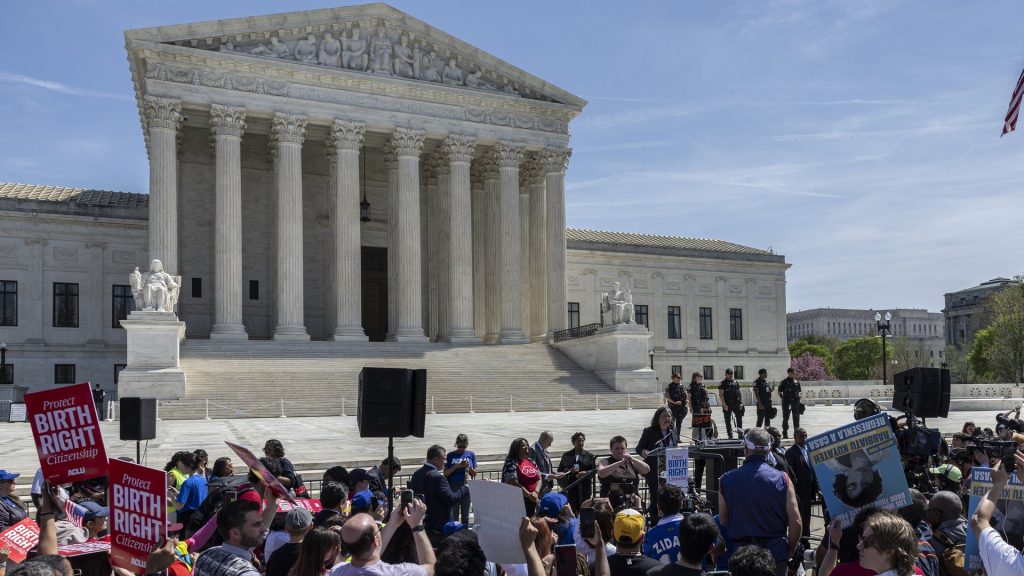
Babies born on American soil will continue to receive American citizenship, regardless of their parents’ immigration status, the Supreme Court ruled Tuesday in strong rebuke of a key element of President Donald Trump’s immigration agenda.
In its 6-3 decision, the court rejected the Trump administration’s argument that the Constitution does not guarantee citizenship to those born in the United States. Trump sought to bar so-called birthright citizenship through an executive order on Jan. 20, 2025, the first day of his second term in the White House.
Children born to parents unlawfully in the U.S. or who are temporarily in the country will receive American citizenship under the 14th Amendment’s citizenship clause. The ruling upheld a longstanding legal precedent: All babies born in the U.S. are automatically citizens.
‘We keep that promise’
Justice John Roberts, writing for the majority, traced the origins of birthright citizenship to English common law as well as the 14th Amendment. The principle was firmly established in a landmark 1898 Supreme Court decision in United States v. Wong Kim Ark, which held that the 14th Amendment guarantees birthright citizenship.
“Citizenship, then and now,” Roberts wrote, “was the right to have rights — to freely participate in our political community. The Framers of the Fourteenth Amendment extended that promise to ‘every free-born person in this land.’ We keep that promise today.”
The Trump administration, Roberts wrote, did not adequately prove its reinterpretation of the longstanding law.
“Again and again, the dissents cast the common law as ‘feudal,’ ‘medieval’ — a remnant of ‘the darkness of the middle ages,’” Roberts wrote in the court’s 194-page decision, about the size of a book. “That was not the view of the Reconstruction Congress. Where the dissents see feudalism, the Framers of the Fourteenth Amendment saw emancipation. By the time of the Glorious Revolution in 1688, in fact, the tie created by birth was less a ‘duty’ than a ‘right’ — the foundation of the ‘ancient liberties of ‘free-born subjects.’”
Justices Amy Coney Barrett, Ketanji Brown Jackson, Elena Kagan and Sonia Sotomayor joined Roberts in the majority. Justice Brett Kavanaugh concurred in part but also disagreed with portions of the ruling.
Justices Samuel Alito, Neil Gorsuch and Clarence Thomas dissented from the ruling.
Had the court sided with the Trump administration, it would have redefined what it is to be American — and would have departed from more than a century’s worth of constitutional understanding.
Trump not giving up
Shortly after the court released its opinion, Trump reacted on Truth Social by sharing an article from the conservative news site Just the News with the headline, “Trump’s efforts to reverse birthright citizenship may succeed with or without SCOTUS.”
The story reported that several bills in Congress, primarily the Birthright Citizenship Act, aim to reverse the 14th Amendment citizenship provision by amending the federal Immigration and Nationality Act.
Round out your reading
- America at 250: Straight Arrow’s week-long look at the pressures testing modern America.
- Ketamine is booming in America. The reasons go beyond drugs.
- Cluster of AI news sites suddenly goes dark after human reporter starts asking questions.
- A 79-year-old, obese, well-connected man gained exclusive access to a new weight loss drug. Is it Trump?
- Newsom pushes national wealth tax after opposing California billionaire tax.
Ella Rae Greene, Editor In Chief