The age of outrage: Why everyone is so mad at everyone else all the time
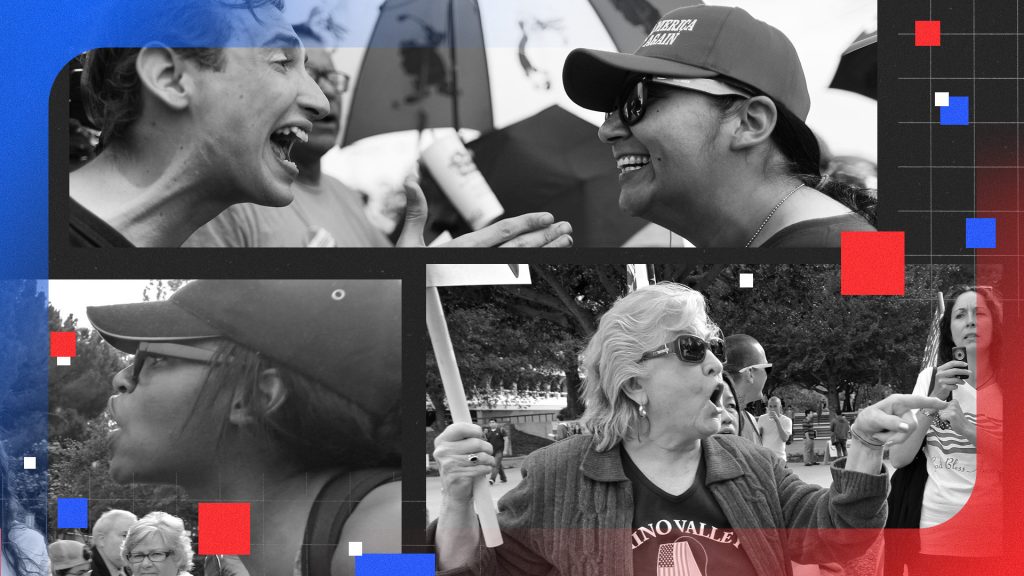

As the United States marks its 250th birthday, Straight Arrow is taking a fresh look at the institutions, systems and social contracts that shaped modern America — and the pressures now testing them.
Wilk Wilkinson was frustrated with the state of the country and the lack of respect people showed when discussing politics. Like many others, he watched Americans attack each other online as uncivil conversation plagued what used to be a much calmer and more polite environment.
Unlike most, though, he was moved to action.
“I’m a conservative, I care about the country, and I was watching the contempt on all sides just corrode everything,” he told Straight Arrow. “I wanted to do something that wasn’t just yelling into a feed.”
Wilkinson pursued work at Braver Angels, a nonprofit organization aimed at depolarizing American politics. He is now the organization’s director of media and operations and host of the “Derate the Hate” podcast. He describes its mission as “bettering the world, one attitude at a time.”
But the lack of civility that led him to Braver Angels has grown increasingly apparent across the country over the past two decades as political conversations moved from real life to online.
The state of the nation
More and more, Americans see a lack of respect and care for others, particularly those with different political views. Comment sections on sites like Facebook and X are full of debates and arguments, with scant civil conversation.
And politicians have descended into name-calling and personal attacks.
President Donald Trump has recently taken to calling Democrats “Dumocrats,” while Democratic lawmakers have called the president things like a “fascist” and even compared him to a Nazi.
“People have always disagreed about politics,” Wilkinson said. “What’s changed is the contempt. There’s this assumption now that if someone lands on the other side of an issue, they must be stupid or evil. That’s new. Or at least it’s louder than it used to be. And once contempt enters a conversation, the conversation is likely going nowhere.”
This divisiveness is something that Americans, and a lot of data, bear witness to. But what’s the cause? As the nation celebrates the 250th anniversary of its founding, an act that required a communal effort to break free of a foreign monarchy, why are Americans so hostile to each other? And why does it feel inescapable?
A lack of civility
In 2010, a nationwide study by the public relations firm Weber Shandwick found that 94% of Americans considered the country’s overall tone and level of civility a problem; 72% said it had worsened significantly in the years leading up to the survey.
That remains true, according to 2026 data from the Ronald Reagan Center on Civility and Democracy, which found that just 32% of Americans see the current state of civil discourse as “healthy.”
Americans point to government and politics becoming more uncivilized, hinting at a broader issue: democracy itself.
Democracy is a central part of American politics, allowing Americans to have a say in how things work and who is elected.
But Emily Sydnor, an associate professor at Syracuse University’s Institute for Democracy, Journalism and Citizenship, told Straight Arrow that data show American democracy has been in decline for years. Many Americans, she said, used to think the U.S. was a good example of democracy, but that’s no longer the case.
“The combination of these two patterns presents a challenge,” Sydnor said, “as democracy weakens and people become more skeptical, how do we facilitate a conversation about democratic renewal and the possibilities democracy offers to all those skeptics?”
What or who’s to blame?
But before looking ahead at how to combat recent trends, it’s important to note how Americans arrived here in the first place.
“There are a variety of institutions and individuals that have contributed to rising tensions in politics and how people talk about political topics,” Sydnor said, noting that social media, the news media and politicians are a good place to start.
She said social media and the news media play on a similar relationship between conflict and engagement, but at varying degrees.
“Social media is driven by attention and engagement, and research shows that conflict, outrage and negativity all attract greater attention and engagement,” Sydnor said. “Similarly, more traditional news outlets have economic incentives to keep you watching, and so they play on the same relationship.”
Meaning, social media and news media know that conflict keeps people watching, so showing combative and sometimes harsh content can benefit them.
Wilkinson echoed Sydnor’s point.
“Rage engagement creates revenue,” he told Straight Arrow. “The system rewards escalation. That’s true of cable news, social media, and politicians on both sides. None of them invented division, but a lot of them have learned to profit from it.”
Politicians’ role
Political candidates and elected officials “know that they’ll be more likely to get media attention or go viral if they play into the same approaches,” Sydnor said. “So there can be electoral strategies that center around picking fights with the opposing party online, or saying something shocking in an interview.”
Politicians have been told for decades to use divisive phrasing when talking about the opposing political party, Archon Fung, a Harvard professor and director of the Ash Center for Democratic Governance and Innovation, told Straight Arrow.
Fung pointed to a 1990 memo from GOPAC, a political education and training organization for the Republican Party.
When talking about Democrats, the memo encouraged Republicans to use words like “failure,” “crisis,” “pathetic,” “lie,” “liberal,” “shallow,” “incompetent” and “greedy.”
“So a lot of people point to this as one of the inflection points at the elite level of the decline of discourse, because the explicit advice is to draw a friend/enemy distinction,” Fung said.
He noted another contributing factor may be the number of issues dividing Americans today. Fung said that from the Ronald Reagan administration to Barack Obama’s second term, Americans agreed on a lot.
“Political disagreement in the United States just wasn’t that great,” Fung said. “Republicans and Democrats agreed on globalization and free trade. They agreed that America should be the policeman in the world. They agreed that the welfare state should be smaller. They agreed on all these things.”
Since then, something has changed.
“The range of disagreement has gone way, way wide,” Fung said, “and this creates big problems for civil discourse, especially right now.”
Simply put, Americans have more issues to disagree on.
Is there a way to go back?
However, hope persists. Organizations like Braver Angels and Wilkinson’s podcast “Derate the Hate” are actively working to bring civility back to democracy.
“What I’ve seen working at Braver Angels is that when you actually remove people from that environment and put them in a room together for real conversation, face to face, the temperature drops almost immediately,” Wilkinson said. “People are almost always surprised by each other. That tells me the problem isn’t the people. It’s the environment we’ve built around them.”
He went on to offer tips for bringing civility back into your own conversations.
“Be curious before you get combative,” he said. “Ask a genuine question. Not a trap, not a setup.”
Then, Wilkinson said, listen with “the intention to understand, not just respond. Most people have never had someone on the other side do that. It changes things.”
And always separate the person from the position, he said.
“You can think someone is dead wrong without deciding they’re a bad human being. And know what you’re actually there to do,” Wilkinson told Straight Arrow. “If the goal is to win the argument, you’ve probably already lost. People don’t change their minds when they feel beaten. If the goal is to understand, or even just to be understood, the whole thing goes differently.”
In addition to how we, as Americans, speak to each other, Fung said politicians must change how they speak to constituents.
If he could ask for one thing, it would be for “political leaders of all kinds to talk to their political adversaries, but especially American citizens, in ways that respect our intelligence and political agency,” Fung said. “Don’t simply try to get us on their side, or to do what they want us to do.”
Round out your reading
- America at 250: Straight Arrow’s week-long look at the pressures testing modern America.
- Ketamine is booming in America. The reasons go beyond drugs.
- Cluster of AI news sites suddenly goes dark after human reporter starts asking questions.
- A 79-year-old, obese, well-connected man gained exclusive access to a new weight loss drug. Is it Trump?
- Newsom pushes national wealth tax after opposing California billionaire tax.
Ella Rae Greene, Editor In Chief