Can Big Tech’s biggest AI disruptors ease the disruption? This group thinks so
The same companies warning that artificial intelligence could devastate the American workforce are now writing checks to fix it, and at least one of them is also the reason the alarm exists.
Eric Holcomb, a former Republican governor of Indiana, and Gina Raimondo, a former Democratic governor of Rhode Island and the former U.S. commerce secretary, launched a nonprofit on Thursday called Raise Us, aimed at helping American workers navigate the transition to an AI-driven economy.
The former governors have raised more than $500 million toward a $1 billion goal to fund programs.
Among the major donors: Amazon, which has spent the past year cutting tens of thousands of corporate jobs and, according to internal documents reported by The New York Times, is quietly creating a future to avoid hiring more than 600,000 workers by 2033.
“There’s a lot of change coming, and there’s a lot at stake,” Holcomb told NPR. “Failure is not an option, we have to succeed, and that’s what Raise Us is all about: the how.”
The organization is built around four major functions: The first is helping states redirect existing workforce funding toward outcomes rather than enrollment. The second is recruiting employers to publicly commit to retraining their workers rather than laying them off. The third is funding AI-enabled training providers. And the fourth is running a research arm called the Policy Lab, funded exclusively by philanthropic organizations, rather than corporate donors.
On the nonprofit’s first day, Holcomb and Raimondo announced that Arkansas, Connecticut, Maryland, and Utah will be the first test states, with each piloting a different program. The programs include an AI-powered job-matching platform, an expanded “service year” for new graduates and early tests of wage insurance for workers who take a pay cut rather than leave the workforce.
The Amazon paradox
Amazon’s reason for joining Raise Us is grounded in programs like its Career Choice initiative, which has helped train hundreds of thousands of its employees on the company’s dime. But Amazon is also the subject of the most detailed paper trail showing the opposite ambition.
Internal documents obtained by The Times last year showed a plan to automate three-quarters of its operations to avoid hiring more than 600,000 workers by 2033. The plan could save the company an estimated 30 cents on every item it ships.
The same documents also showed the company coaching employees to soften the language of its automation initiative. Instead of saying “robot” or “AI,” the company has moved toward terms like “advanced technology” or “cobot.”
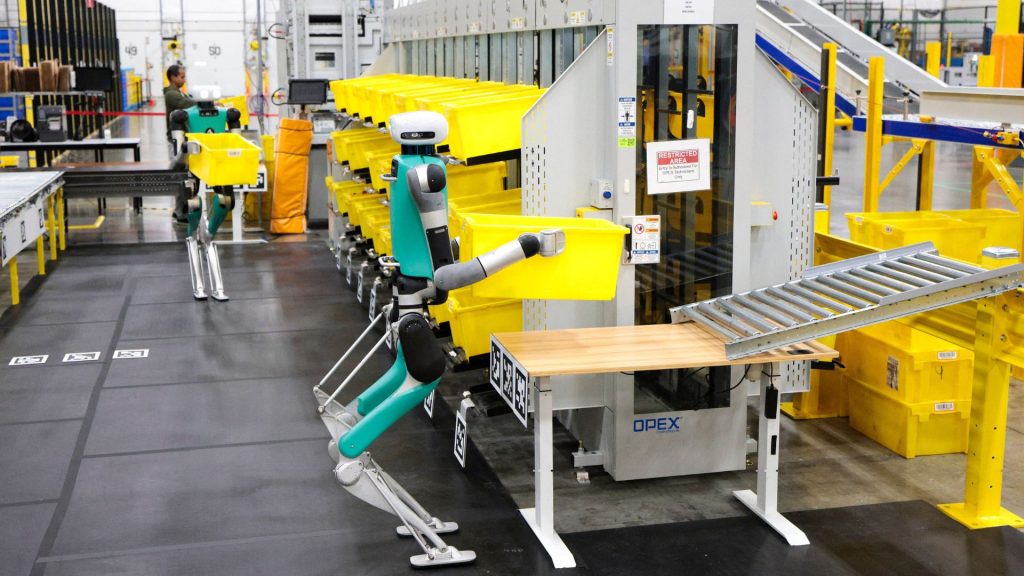
Since 2022, Amazon has cut about 30,000 corporate jobs, citing AI-driven efficiency. That includes white-collar positions inside its robotics division, even as Amazon’s robot fleet approaches a 1-to-1 ratio with its human workforce.
“Nobody else has the same incentive as Amazon to find the way to automate,” MIT’s Daron Acemoglu told The Times. “Once they work out how to do this profitably, it will spread to others, too.”
Whose jobs are at risk?
The clearest victims of the automation disruption, so far, aren’t those already laid off but the people who haven’t been hired at all.
Entry-level job postings are down more than a third since 2023, according to the software company Metaintro. Recent graduate unemployment is also running higher than the national rate — 5.6% compared to the national average of 4.3%, CNBC reports.
But how much of that is actually AI, rather than companies using AI as a convenient scapegoat for cuts they’ve already made, is contested. As Straight Arrow previously reported, researchers say companies’ unwillingness to let inexperienced employees work remotely is a greater cause of unemployment among recent college graduates than AI.
J.P. Gownder, the vice president and principal analyst at the consulting firm Forrester, calls the trend “AI washing,” arguing many companies announcing AI-driven layoffs don’t have the AI systems doing the work.
“AI washing is pervasive right now,” Gownder said. “Some of the organizations and leaders who are claiming layoffs due to AI have very self-interested points of view.”
The picture is further complicated by research from the left-leaning Economic Policy Institute, which found that young workers without college educations are experiencing similar increases in unemployment over the same period. This makes it difficult to pin the slump on AI alone.
What are the pilot programs?
Many of the programs Raise Us plans to test had already been running before Thursday’s launch.
Arkansas’s AI-powered job-matching program debuted in February 2025. The platform is funded by Walmart, with engineering support from Google.
It’s a similar situation in Utah, with its $10 million “pro-human AI” workforce push, introduced in December. The state also introduced free AI credentials for 50,000 new graduates, designed to complement students’ existing technical skills as they enter the workforce.
Connecticut Gov. Ned Lamont credited his state’s AI worker protection law, passed earlier this year, as the foundation for the Raise Us platform.
“I want the workforce of Connecticut to look at the years ahead and see opportunity, not uncertainty,” Lamont said.
In Maryland, Raise Us is building off a program started in 2023. The collaboration involves expanding “service year” pathways into industries like healthcare and education by launching a competitive fund to support career transitions. It also provides support for displaced workers to pursue entrepreneurship, according to the announcement.
The harder questions
Questions remain about the effects of AI-driven workforce disruption, including on corporate transparency. Connecticut, one of the group’s partner states, has passed legislation to enhance it.
Starting this October, the state will require companies filing mass-layoff notices to disclose whether AI was the reason. Two bills now before Congress would impose similar requirements. One would mandate that companies identify the specific AI system they’re using and estimate the share of job losses it caused.
But neither bill has passed, and the Trump administration’s own AI framework aims to preempt state laws like Connecticut’s, not expand them.
On the other end of the spectrum sits a proposal by Sen. Bernie Sanders, I-Vt., to tax half the stock of major AI companies to create a $7 trillion public fund that would pay each American $1,000 annually.
Raise Us plan is more moderate, asking companies to volunteer cooperation and capital rather than demanding it.
Raimondo acknowledges the country’s track record on AI is poor and has called past retraining efforts “ineffective,” according to The Times. The big question isn’t whether AI will create new jobs alongside the ones it eliminates; most economists think it will. It’s whether the people who lose their jobs are the same people who get the new ones.
“Listen, I hear the skepticism, and I understand where it’s coming from,” Raimondo told NPR. ”But I also know we can’t solve this problem without employers. They’re the ones who hire people. They’re at the table, they are committed, and now it’s on us to produce.”
Round out your reading
- Not red or blue: America’s politically homeless middle.
- Peter Thiel’s ‘Dialog’ network was super-secret. A data leak changed that.
- The novel legal strategy that Taylor Swift and Matthew McConaughey are using to fight AI.
- Illinois balances budget with new $200 million social media tax that tracks in-state users.
- When Trump serves up ‘Just the News,’ it comes with a side of bias.
Ella Rae Greene, Editor In Chief