Inside America’s political polling problem
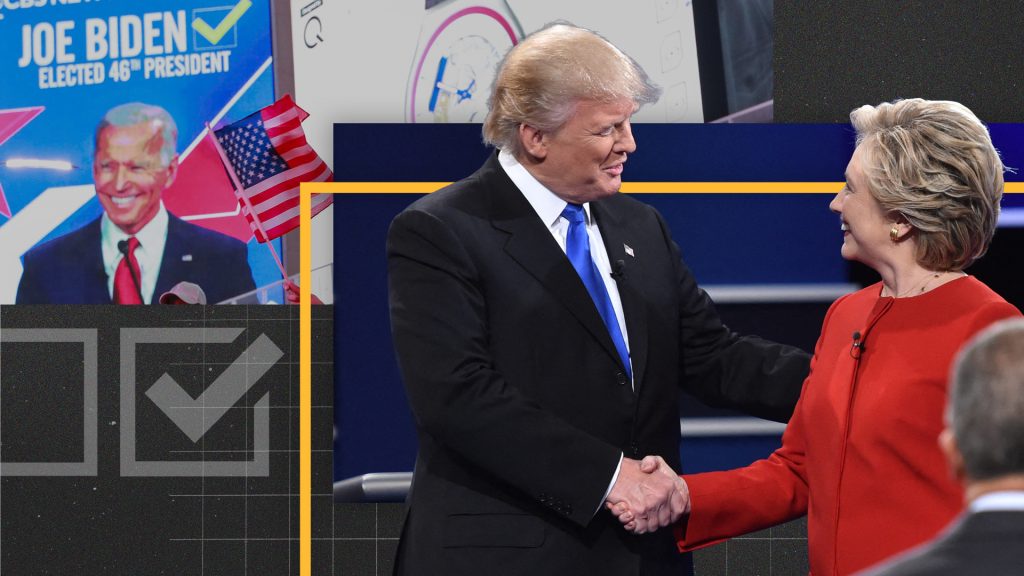
In the early morning hours of Nov. 9, 2016, news networks called Wisconsin for Donald Trump, cementing his victory over Hillary Clinton. Most voters were surprised, both candidates were shocked and pollsters were left looking up and down at their final polls, showing that Clinton would almost certainly win.
It wasn’t an anomaly: Since 2016, when FiveThirtyEight gave Clinton a 75% chance of winning, pre-election polls have shown incorrect trends among voters in 2020, 2022 and 2024. Now, with the 2026 midterm elections just a few months away, worry this will happen again.
While theories that voters may be lying to pollsters or that people are just too shy to share their actual beliefs have proliferated, the data says otherwise. And several researchers who’ve dedicated their careers to ensuring polling is conducted and used correctly, told Straight Arrow they believe something else is going on.
The science behind polling
The idea of voters hiding their true intentions is not new — it even has a name, “The Bradley Effect,” which comes from the 1982 California gubernatorial election.
During the campaign, pollsters asked voters if they were voting for Tom Bradley, the Black mayor of Los Angeles, or state Attorney General George Deukmejian, a white man. Polls showed Bradley with a comfortable lead. Yet on election night, Deukmejian won.
Some believed the polls were wrong because white voters didn’t want to appear discriminatory. But Jon Krosnick, a social psychologist and a political science professor at Stanford University, didn’t see that in his research.
“Researchers who want to claim that social desirability is a big problem can point to those studies as long as they don’t point to how big the effects are,” Krosnick told Straight Arrow. “The minute they start paying attention to the fact that the effects are pretty small, then it becomes less of a problem.”
Krosnick also determined the accuracy of self-report questionnaires is comparable to other survey methods.
“What we discovered is that about 85% of people’s self-reports in surveys are accurate,” said Krosnick, who conducted a review of research comparing survey responses with verified objective data to assess whether people were telling the truth.
But Krosnick wanted to go deeper. So he brought people into a lab, put a bowl of M&M’s in front of them and let them fill out a questionnaire for half an hour. When 30 minutes had passed, Krosnick asked participants how many M&M’s they had eaten while they waited. The half of respondents who did not have to write their names next to their estimates were less accurate about the actual count.
“Complete anonymity is not a good thing because it allows people to become superficial and sloppy in their answering process,” he said.
Krosnick also investigated the idea that self-reported polling fails to capture racial prejudice. His findings: People consistently express racial bias, regardless of whether their survey responses are anonymous.
What the real problem in polling actually is
Mike Noble, the founder of Noble Predictive Insights, has been polling in Arizona for more than a decade. In that time, he has seen a dramatic shift in who answers surveys at all.
About 30 years ago, roughly one in three Americans answered pollsters’ calls, according to Pew Research. Now, The New York Times says fewer than one in 50 people they call for their polls actually respond. And the people who stopped picking up the phone didn’t stop at random.
“People that have, let’s say, a college education or white-collar workers, they’re taking surveys like it’s a hobby,” Noble told Straight Arrow. “They have more flexibility in their schedule, they can sit there and do a five, ten minute interview. However, what you’re missing is that people with more blue-collar jobs or high school or less education.”
This has altered how random samples can truly be.
In a true random probability sample, everyone has an equal chance of being selected. In the increasingly popular opt-in method, people volunteer themselves with no random selection.
The 2016 election exposed what that distinction means in practice. The night before the vote, aggregated polls gave Clinton a 75% to 80% chance of winning. Most of these polls were opt-in surveys. In the battleground states that decided the election, roughly 70 polls were conducted in the final week. Just one used a true random sample, in Florida.
“The random probability samples had an average error in predicting the Trump and Clinton share of the vote of less than 1 percentage point, really accurate, whereas the average error of those opt-in sample surveys was much higher, and sometimes a great deal higher,” Krosnick said. “We just didn’t have good quality telescopes to be able to see the outcome of the election clearly in those places where it mattered.”
One good telescope, in an ocean of blurry ones. But the blurry ones were driving headlines.
What happens when the polls hit the newsroom?
Ben Bogardus spent years producing newscasts in Washington, D.C., Houston and Jacksonville, Florida, before becoming chair of the journalism department at Quinnipiac University, which hosts one of the country’s most cited polling centers. He keeps a checklist of a dozen questions for journalists to ask before running with a poll. Among those key questions: Who paid for it?; What’s the sample size?; What’s the margin of error?

As the news ecosystem changes, finding journalists with extensive experience in this field is becoming harder by the election cycle.
“A lot of the people who do have experience, the lifers, are retiring or leaving the profession,” Bogardus told Straight Arrow.
The journalists replacing them are being asked to produce more content, faster, with fewer resources. That can make an attention-grabbing poll result hard to resist.
“If a press release comes in with a great headline that looks like a shocking news story based on the poll results, you’re going to be sort of interested in putting that in your newscast as something new, something different, something exciting,” Bogardus said.
On social media, where a growing number of people find their news, the problem compounds further. A poll that arrives with a full methodology disclosure is often reduced to two sentences for its wider audience.
“If someone doesn’t click through the article to read the actual specifics of the poll, they could get a lopsided view of what the poll actually says because you only have two sentences on your social media post,” Bogardus told Straight Arrow.
The result is a system that consistently strips context from numbers that were never meant to stand without it. Underneath it all, Bogardus said, is a deeper issue that political journalism has struggled with for decades.
“Since the beginning of time, there’s been this sort of problem in journalism where, when you’re covering political campaigns, it becomes more about the horse race,” he said. “It becomes about who’s ahead, who’s going down. It’s not really about the issues that are out there.”
The audience wants a simple answer. The algorithm rewards a simple answer. And a number on a poll, stripped of its methodology and margin of error, is perhaps the simplest answer journalism can give.
Where does that leave polling?
Polling isn’t going away, and despite its limitations, the people who understand it still believe in its value.
Krosnick’s research shows that when they are constructed with true random sampling, rigorous weighting and careful question design, surveys are still among the most accurate tools available for measuring public opinion. Noble has built a career on honing those methods in one of the nation’s hardest states to poll. Bogardus spent years in newsrooms using polling data responsibly, and he believes most journalists want to do the same.
The problem isn’t the tool. It’s how misunderstood it can be.
“A lot of people think polling, they get a little exact on the numbers and they forget about that margin of error,” Noble said.
“Think of it as the fuzziness of the number,” he said. “That 51 could be as high as 54 for that person or as low as 48.”
Fuzziness, not certainty. That’s what a poll number actually is.
The 2026 midterm cycle will be packed with polls. The question isn’t whether to pay attention to them, it’s how to examine them through the proper telescope.
Round out your reading
- Not red or blue: America’s politically homeless middle.
- Peter Thiel’s ‘Dialog’ network was super-secret. A data leak changed that.
- The novel legal strategy that Taylor Swift and Matthew McConaughey are using to fight AI.
- Illinois balances budget with new $200 million social media tax that tracks in-state users.
- When Trump serves up ‘Just the News,’ it comes with a side of bias.
Ella Rae Greene, Editor In Chief