Iran fires missiles at Bahrain, Kuwait after US forces shoot down 4 Iranian drones
Iran fired seven ballistic missiles toward Bahrain and Kuwait, Bahrain’s Foreign Ministry said Saturday. Initial assessments in Bahrain and Kuwait indicate six of the missiles were intercepted, and a seventh did not reach its intended target, U.S. Central Command said.
Kuwait’s Ministry of Defense, Brigadier General Saud Abdulaziz Al-Otaibi, said there were no human casualties, but there was some material damage.
Bahrain’s Ministry of the Interior said alarm sirens were activated, and it urged residents to remain calm and head to the “nearest safe location.”
Bahrain and Kuwait’s Foreign Ministries both condemned the Iranian attack in statements, with Kuwait calling it a “dangerous escalation.”
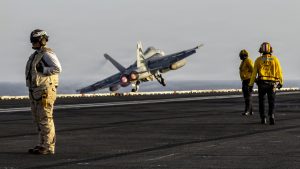
U.S. Central Command said the Iranian attacks happened hours after U.S. forces shot down “four Iranian one-way attack drones that were launched toward the Strait of Hormuz.” These drones posed an “immediate threat to regional maritime traffic,” CENTCOM said.
No U.S. personnel were injured.
Iran’s Revolutionary Guard said, according to state-run media outlet IRNA, that it targeted the Ali Al Salem air base in Kuwait, as it hosts U.S. forces, and the U.S. Navy’s 5th Fleet in Bahrain, in retaliation for the U.S. shooting down the drones.
Iran, meanwhile, said the U.S. attacked surveillance facilities on Qeshm Island and near Sirik. The Foreign Ministry said these facilities were used to protect borders and “ensure the security of navigation in international waters,” The Associated Press reported. This U.S. attack, Iran said, is a violation of the ceasefire currently in place.
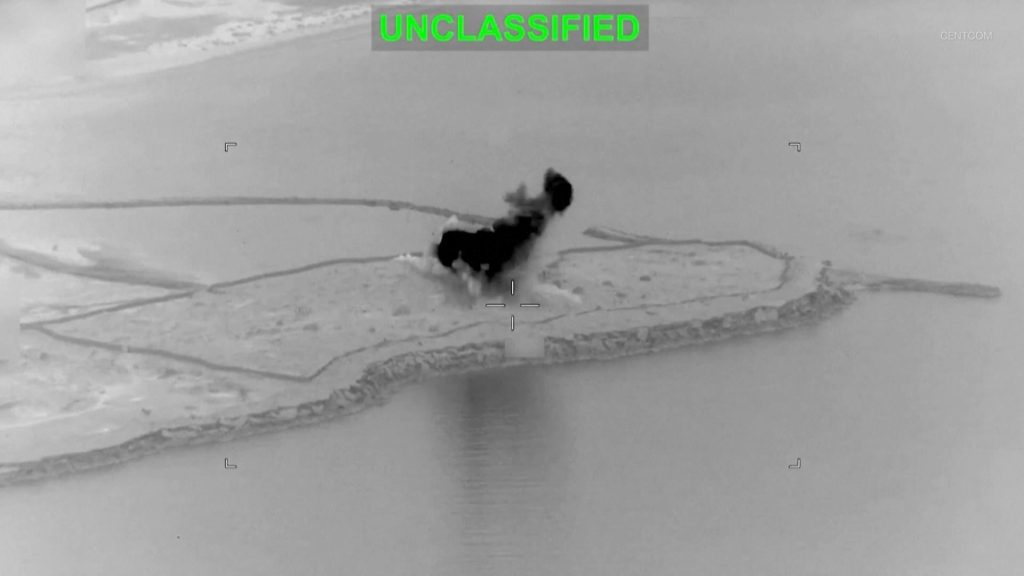
CENTCOM maintained that it struck “Iranian coastal surveillance radar sites” in order to “defend against further maritime attacks.”
The U.S. and Iran have been negotiating a deal to end the war that has killed thousands, and had repercussions on the global economy, especially the world’s most vulnerable countries. On Friday, the United Nations World Food Programme said in a report that an estimated 45 million people could fall into acute food insecurity if the conflict continues and oil prices are kept at $100 per barrel due to the closure of the Strait of Hormuz.
Jean-Martin Bauer, Director of the WFP’s Food Security and Nutrition Analysis Service, said in a statement that “one of the biggest concerns is that the full impact of this crisis has yet to be felt.”
“Even if the conflict were to end today, irreversible damage has been done and the impact on prices, livelihoods and humanitarian operations will continue to be felt for a long time,” Bauer said.
In an interview Friday with NBC News, President Donald Trump said Iranian leaders have “no choice” except to reach an agreement with the U.S.
“They’re strong, they’re proud, there are things they never thought they’d be doing that they’re going to have to do. They’ve got no choice, and it takes a little while,” Trump said.
During the interview, the president asked: “Do we sign a deal or we do it the other way?” adding that “the other way is not nice.”
Earlier this week, Congress voted to push back on Trump’s military authority when the House of Representatives passed a war powers resolution calling for an end to U.S. hostilities with Iran unless Congress authorizes them.
Round out your reading
- Plea bargains keep America’s courts running. Guilt or innocence barely matters.
- Trump says the media isn’t covering one of his biggest accomplishments. We checked.
- Mike Lindell denied MyPillow was hacked. Its private data is now online.
- Red meat allergy rises with ticks as HHS targets Lyme disease, alpha-gal syndrome.
- We’re building a new Straight Arrow. Help us shape our future by taking our survey.
Ella Rae Greene, Editor In Chief