When aggregation goes bad: How a false report that Joe Rogan would join ‘60 Minutes’ went viral
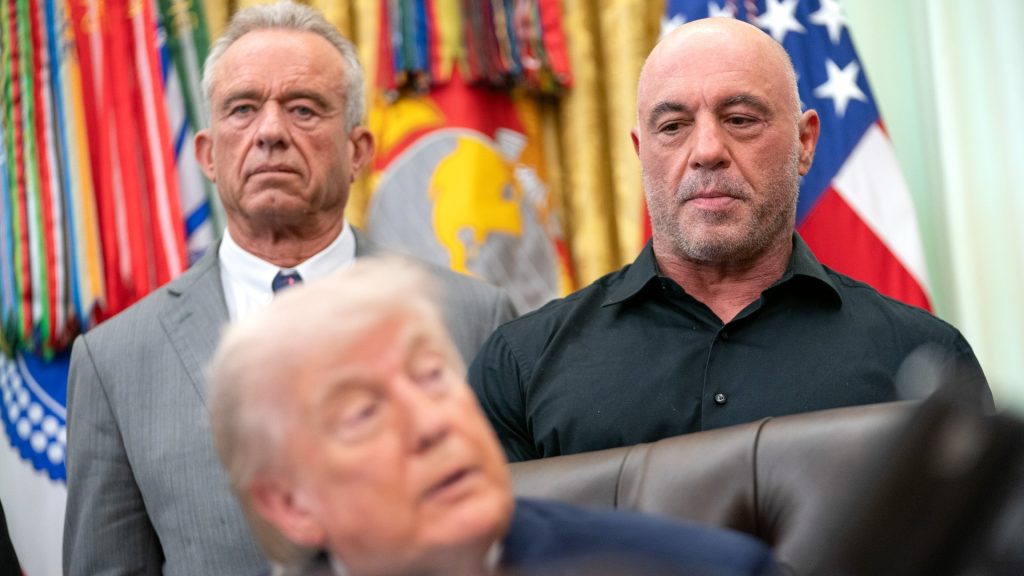
It was a bombshell news story that spread on the internet like wildfire: Popular comedian and podcaster Joe Rogan was replacing longtime “60 Minutes” correspondent Anderson Cooper, who parted ways with CBS News last month.
If only it were true.
Network executives “may have their sights” on the Austin-based podcaster, the Austin American-Statesman reported Wednesday, citing a months-old story from a “celebrity and entertainment” website based on “an unnamed media executive.”
The claim fits into broader discourse about the direction of CBS News under Editor-in-Chief Bari Weiss, who has been accused of forcing a rightward turn at the network to appease President Donald Trump and the network’s new owner, media mogul David Ellison. The original American-Statesman article, which the outlet edited after publication, noted that CBS had “not confirmed” the report.
The episode brings into focus the reliability of news aggregation, a practice by which reporters reproduce existing reports without conducting original research, and how misinformation can spread quickly online even after the record has been corrected.
In fact, CBS says the story is flat “false” and, in a statement to Straight Arrow, questioned the paper’s reporting process. The story was based on a single source — an article posted in gossip site RadarOnline nearly three months ago.
“You’d have to ask them,” the CBS spokesperson said, “why they published this without seeking comment from us.”
Is Joe Rogan joining CBS?
By the time the American-Statesman updated the story, its claims had already spread far and wide online. It wasn’t until 8:53 p.m. ET Thursday — after Straight Arrow sought comment from the paper — that the news outlet posted on X that the story had “been updated to include CBS News’ response.”
Already, prediction market platform Polymarket had highlighted to its 1.6 million followers on X that Rogan was “reportedly being considered as a possible “60 Minutes” replacement.” Users placed bets in a prediction market about whether Rogan would join CBS by the end of June.
Unconfirmed: CBS wants Joe Rogan on 60 Minutes after Anderson Cooper left in February.
The network that spent 60 years doing serious investigative journalism is reportedly pitching Rogan internally as “strategy, not stunt casting.”
Those two things can both be true at the… pic.twitter.com/UMgiIEMG7h
— Mario Nawfal (@MarioNawfal) June 4, 2026
The story’s primary claim began to unravel when other outlets reported that CBS News denied the speculation. But that update appeared to further fuel a conspiracy theory.
Former CNN journalist Don Lemon gave credence to the story on Substack, posting to the platform, in all-caps: “JOE ROGAN TO REPLACE ANDERSON COOPER ON 60 MINUTES??”
“A CBS News spokesperson was quick to hit the brakes, telling Forbes that these claims are completely false,” Lemon wrote. “But just because a network executive denies the reporting publicly, doesn’t mean they aren’t quietly trying to court him. Would you watch?”
When the American-Statesman updated its article, it changed the headline to note that Rogan is “not in consideration” for Cooper’s old gig. As of Friday morning, the story’s lead sentence says CBS “has denied” the reports, while noting lower in the story that the network “and ‘60 Minutes’ have not confirmed” them. An editor’s note at the bottom of the article says the story “has been updated to include comment from CBS News.”

The story was written by Faith Bugenhagen, a breaking and trending reporter. Reached by phone Thursday afternoon, Bugenhagen said she would need to get her editor’s approval before discussing the story.
“I like the story concept, let me tell you that,” she added, referring to this article by Straight Arrow.
Reached again by phone Friday, Bugenhagen declined to comment.
American-Statesman Editor-in-Chief Courtney Sebesta didn’t respond to requests for comment. Neither did representatives for Rogan.
Even after the article was updated, speculation continued to circulate unabated Friday — including claims that CBS News was being dishonest by saying the story was false.
How misinformation spreads online
The story highlights an uncomfortably common reality about America’s modern news ecosystem: False, misleading or poorly sourced information can spread quickly as a result of news aggregation. The American-Statesman story never disclosed that its report was based on an article from March that relied entirely on an anonymous source with unknown motives or insight into CBS hiring decisions.
Social media can serve to amplify misinformation. People don’t even need to believe misinformation is true to amplify it online, according to the American Psychological Association.

“People may share information they know is false to signal their political affiliation, disparage perceived opponents, or accrue social rewards,” the association noted in a 2023 report. “Psychological factors contribute significantly to this process: People are more likely to share misinformation when it aligns with personal identity or social norms, when it is novel and when it elicits strong emotions.”
While mainstream news outlets — like the American-Statesman — tend to have robust safeguards to present and correct false claims, social media platforms lower the barrier for misinformation to spread quickly.
This spread can continue even after the record has been corrected.
“‘Echo chambers’ bind and isolate online communities with similar views, which aids the spread of falsehoods and impedes the spread of factual corrections,” the APA report notes.
On X, Austin-based independent journalist Olivia Messer said the story is the result of media conglomeration and heavy investment “in aggregation-based trend news coverage” by early-career journalists “because it’s less expensive than original reporting.”
“Someone who’s essentially an entry level reporter shouldn’t be taking complete public responsibility for something an editor should have caught,” Messer wrote.
Messer told Straight Arrow she sees value in “well-vetted aggregated trending news stories — and that any investment in local news is a good one.”
“Those things may feel like they’re in conflict,” said Messer, who was editor-in-chief of Austin-based digital news outlet The Barbed Wire until its closure last week. “But if I learned anything running a newsroom, it’s that we have to hold a lot of complicated truths about the industry at the same time.”
Round out your reading
- Plea bargains keep America’s courts running. Guilt or innocence barely matters.
- Trump says the media isn’t covering one of his biggest accomplishments. We checked.
- Mike Lindell denied MyPillow was hacked. Its private data is now online.
- Red meat allergy rises with ticks as HHS targets Lyme disease, alpha-gal syndrome.
- We’re building a new Straight Arrow. Help us shape our future by taking our survey.
Ella Rae Greene, Editor In Chief