Why Chicago is pouring millions into neighborhoods the banks forgot
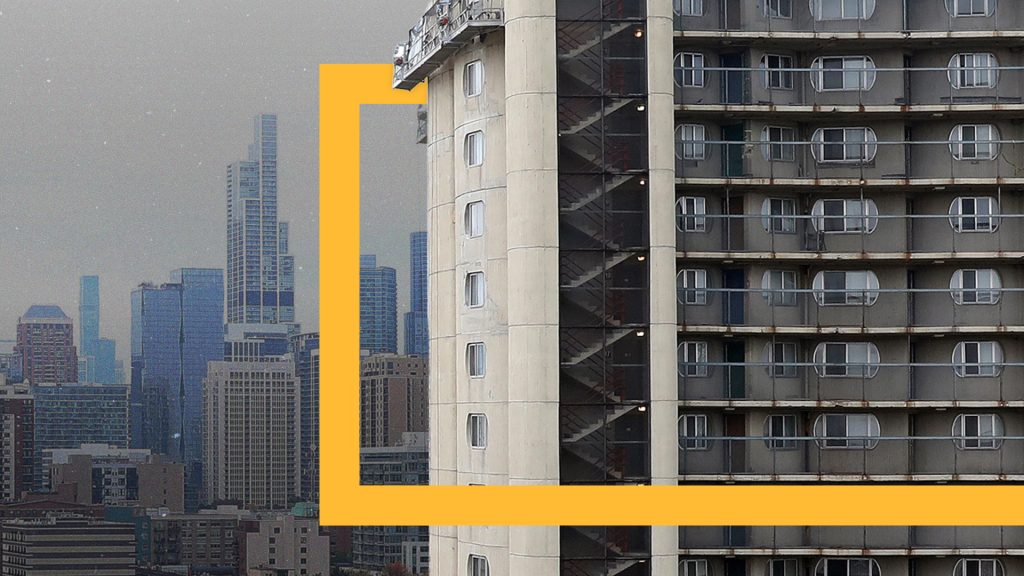
As rent and cost of living mounts nationwide, cities like Chicago are doing everything they can to invest in new affordable housing.
Last month, Chicago Mayor Brandon Johnson announced the city would invest roughly $300 million in 15 affordable housing developments. Combined with private funding and other financing, the projects will cost $711 million, and are expected to create or preserve 1,223 housing units —1,164 of which will be affordable to those who earn roughly 60% or less of the area’s median income. According to data from the city, 60% AMI is $72,900 for a four-person household.
Some developments are reserved for residents with even lower incomes. The city designated 130 units for households earning closer to 30% of the area median income.
“As we continue to make the critical investments we need to increase housing accessibility and equity, we are redoubling our efforts to ensure Chicagoans have access to not just stable housing, but enjoy security and dignity throughout their lives,” Johnson said in a statement.
The announcement arrives at a critical moment for Chicago, which is growing for the first time in years, according to new U.S. Census data.

Once a major magnet during the Great Migration, Chicago has battled a long-term loss of Black residents since the 1990s. Many of the folks moving out have left neighborhoods on the South and West sides amid school closures, gentrification, rising costs and deteriorating housing.
Where is Chicago building new affordable housing developments?
The new developments include the WestGate complex, which will include roughly 55 affordable residential units above commercial space, including a full-service grocery. There is also Ogden Commons, a larger multi-phase development in North Lawndale that first broke ground in 2023. It combines affordable and mixed-income housing with healthcare facilities, commercial space and proximity to public transit, intended for residents earning between roughly 30% and 60% of the area median income.
That public investment is essential to ensuring longtime residents are not left behind, developers told Straight Arrow.
Jim Webb, one of the figures behind the WestGate project, who was born and raised in Garfield Park, said WestGate will function as a holistic community investment that both beautifies and helps set the tone to revitalize a neglected community by providing more amenities than typical housing projects.
“When you put affordable housing, food access and new retail on a corridor that’s been disinvested in for decades, the dynamic changes,” Webb said. “Not because of the unit count, but because of what it signals to the next developer, the next lender and to residents: that the West Side is worth believing in, building in and thriving in.”

Developers like Webb say projects like these are meant to address more than housing shortages: The lack of infrastructure can make it harder for residents to remain in their communities, build wealth, or pursue homeownership. Grocery stores are pivotal in neighborhoods like Garfield Park, which has been considered a food desert for years.
While Webb knows no single development can reverse Chicago’s broader affordability crisis or decades of population decline among Black residents, he said projects like WestGate can help restore confidence in communities.
READ MORE: Chicago’s parking saga: What other cities can learn from ‘the worst deal of the century’
“People generally do not leave Chicago because they don’t love the city,” Webb told Straight Arrow. “They leave because too many neighborhoods have experienced a steady erosion of the conditions that make long-term life possible: quality housing, safe streets, functioning schools, grocery access, economic opportunity and pathways to ownership and stability.”
Why are housing subsidies not enough to fix Chicago neighborhoods?
But housing advocates and researchers say the city’s affordability crisis extends far beyond the number of subsidized units currently being built.
Geoff Smith, executive director of the Institute for Housing Studies at DePaul University, noted that affordability pressures play out differently between neighborhoods. Areas like Logan Square, a formerly working class Latino neighborhood, have seen rapid demand and gentrification from higher-income residents and transit-oriented development along the Blue Line corridor, shrinking available housing supply.
“It’s always important to contextualize what housing is being created or preserved,” Smith said. “The state has a large need for affordable housing, but subsidies can only address a portion of that need.”
Predominantly Black neighborhoods like North Lawndale and West Garfield Park face decades of disinvestment that make it difficult to attract new housing development.
“You need subsidies there to build anything,” Smith said. “You’d be hard pressed to find a traditional bank willing to finance a single-family home in some of those neighborhoods.”
Banking institutions have long been scarce throughout the West Side from systemic redlining, and worsened since the Great Recession, which makes it even harder for residents to build wealth or buy homes. In the Austin neighborhood, one in five adults lack a checking or savings account, according to data from the Chicago Health Atlas.

Chicago is the nation’s third largest city. And while it remains cheaper than the two larger cities – New York and Los Angeles – the city’s housing costs have been steadily rising for years. According to Apartments.com data, the median rent for a Chicago apartment now hovers around $2,406 per month – or nearly $29,000 a year. For residents who earn $78,000 per year – the city’s median household income – this represents 36% of their incomes.
And that’s a problem. The housing industry has long cited the 30% threshold as the line for housing affordability.
Who qualifies for affordable housing in Chicago as rents rise?
Annette Shelton, a West Side real estate agent who has worked in Chicago housing for more than two decades, said even moderate-income buyers are struggling to break into the market.
“The average home price in the Chicagoland area was around $340,000,” Shelton said. “With interest rates and taxes where they are, affordable housing really isn’t affordable anymore.”
Shelton said many lower-income buyers she works with have paused plans to purchase homes entirely while waiting for interest rates to fall. Others remain trapped in a growing “missing middle” — residents who make too much to qualify for affordable housing assistance but cannot comfortably afford market-rate housing.
The affordability crisis has become especially acute on the West Side, where longtime residents increasingly fear displacement and gentrification as investment slowly returns to historically disinvested neighborhoods.
“One of the key challenges in this housing environment is how to create affordability in these neighborhoods without changing it,” Smith told Straight Arrow. “The city has tested out different approaches, and I think it’s a challenge because the market is the driver of these lost affordability pressures. I think the challenge is how to do that in a resource-strained environment.”
Chicago is not alone in its effort to address affordability pressures. New York City recently accelerated large-scale affordable housing initiatives through rezonings and public-private partnerships, while Houston has also invested heavily in affordable housing developments despite ongoing debates around displacement and environmental concerns.
“What’s happening nationally is that there’s pressure on the entire housing spectrum,” Smith said. “Affordable housing is a diverse spectrum, but the subsidy component tends to dominate the conversation.”

That broader pressure increasingly affects middle-income residents. According to Shelton, many residents earning stable salaries struggle to afford homes due to high property taxes, mortgage rates, insurance costs and limited inventory.
READ MORE: Why the $124 trillion great wealth transfer may not reach most families
Despite the challenges, she said many millennials still aspire to own homes. That’s particularly true among Black families seeking generational wealth and long-term stability.
The long-term consequences of unaffordable housing may reshape Chicago’s future if younger residents continue delaying homeownership or leaving the city altogether, said Shelton. And that delay is well underway: The average age of a first-time American homebuyer reached 40 years old last year, according to the National Association of Realtors.
“We have to educate people about preserving wealth and keeping homes in families,” Shelton said. “Seniors are holding down the wealth of homes since they have the largest percentage of ownership. When grandma dies, the home gets run down or sold off, and I see it more than I want to.”
How does the affordable housing crisis impact public health?
Sacharitha Bowers, a physician who studies healthcare inequality, told Straight Arrow that unaffordable housing is a growing public health issue.
“Housing instability impacts every aspect of a person’s life,” Bowers said. “Where someone is born and where they live should not affect how healthy they are. It should be a fundamental right to have access to the same healthcare no matter where you’re from.”

Chicago has one of the widest neighborhood life expectancy gaps in America. According to the Chicago Sun-Times, in predominantly Black communities like West Garfield Park, residents live an average of 67 years, while residents in wealthier, predominantly white neighborhoods like the Loop and Gold Coast live to around 88.
Bowers, who moved from Springfield to Chicago’s LaGrange Park neighborhood with her immediate family and her aging parents, said many families increasingly feel trapped between expensive housing markets and the desire to remain in neighborhoods with strong schools and economic opportunity.
“We didn’t want to become slaves to a mortgage,” Bowers said of her family’s housing search. “I have physician colleagues who are living in bigger homes that are working 80 hours a week to be able to afford bigger homes.”
For now, city officials hope projects like WestGate can help slow those pressures. But researchers and advocates alike say solving Chicago’s housing crisis will require a far larger and longer-term effort.
“I don’t think this is a quick fix,” Shelton said. “The programs need to be restructured heavily. But at least the city is trying to move the conversation forward.”
Round out your reading
- Plea bargains keep America’s courts running. Guilt or innocence barely matters.
- Trump says the media isn’t covering one of his biggest accomplishments. We checked.
- Mike Lindell denied MyPillow was hacked. Its private data is now online.
- Red meat allergy rises with ticks as HHS targets Lyme disease, alpha-gal syndrome.
- We’re building a new Straight Arrow. Help us shape our future by taking our survey.
Ella Rae Greene, Editor In Chief