Why Europe worries about its newfound dependence on American energy
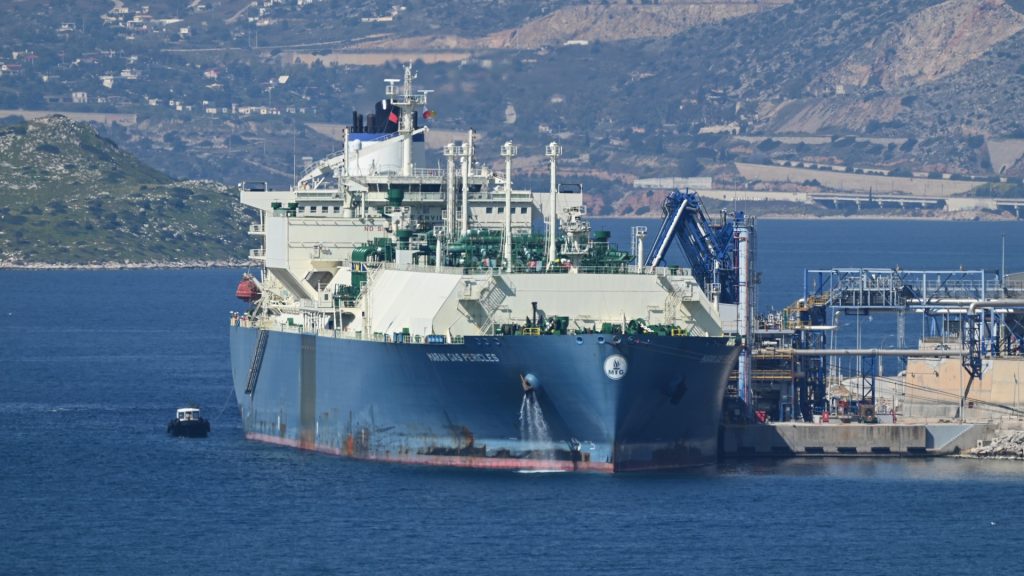
The European Union is worried about its dependence on energy imports from the United States. A new report from the EU’s Agency for the Cooperation of Energy Regulators (ACER) outlines the continent’s “growing exposure to global market risks,” as the crisis over the Strait of Hormuz shuts off some gas supply sources.
“The EU’s reliance on U.S. LNG may raise questions of dependency on a single supplying country,” states the Wednesday report. In 2025, the U.S. supplied 58% of Europe’s liquefied natural gas (LNG) — a share that has grown significantly since European nations began weaning off Russian gas in 2021 and 2022.
This year, Europe has relied on the U.S. for two thirds of its LNG imports, according to the Institute for Energy Economics and Financial Analysis.
LNG is a version of natural gas that has been transformed into a liquid in order to send it on tankers. That creates a global gas market where previously gas was more geographically constrained. Qatar, which is typically among the world’s three largest LNG exporters, has been effectively cut off by Iran’s de facto blockade of the Strait of Hormuz.
Global LNG prices have soared by 80%, and that’s a problem for Europe. For U.S. companies exporting fuel, it’s a major windfall. However, the ACER report and other export analysis suggests Europe is uncomfortable with the new reality, which has renewed calls for diversifying power sources.
What’s the status of Russian imports?
To safeguard Europe’s economy, the ACER report recommends “diversifying supply sources and routes to ensure that no single supplier country, transit corridor or conflict has an immediate impact to destabilise Europe’s energy system.”
Europeans have experienced severe energy disruptions in the recent past. In 2019, Russia provided 47% of Europe’s gas supply via pipelines — most of which cross through Ukraine. By 2025, the share of Russian gas had fallen to only 7%.
But as the U.S. and Israel’s war with Iran disrupted markets, some European countries turned back to Russia. Imports of Russian LNG were up 16% in the first quarter of 2026, the Institute for Energy Economics and Financial Analysis found.
However, Europe is phasing out Russian fuel, with a ban on any imports past 2027 when existing long-term contracts expire. Europe does not want to fund Russia’s war against Ukraine or allow the Kremlin to weaponize energy supplies. The end of imports from Russia could further increase how much gas is imported from the United States, but officials at the European Union also see that as a potential risk.
Why does Europe worry about depending on the US?
The ACER report identifies that most of the LNG imported from the U.S. comes from Gulf Coast export terminals, “a region historically exposed to hurricanes.”
European leaders have also previously voiced concerns about reliance on U.S. energy when President Donald Trump pitched taking over Greenland, a semi-autonomous territory of the Kingdom of Denmark, Reuters reported. The Trump administration’s tariffs have also increased tension.
“It’s pretty clear that the European Union remains concerned with the trade policy of the Trump administration,” said Benjamin Schmitt, a senior fellow at the Kleinman Center for Energy Policy at the University of Pennsylvania.
But Schmitt, who was the State Department’s European energy security adviser from 2015 to 2019, told Straight Arrow that the U.S. would not leverage Europe’s energy supply for other geopolitical aims. Unlike Russia’s energy industry, which is owned by the Russian government, Schmitt said the companies currently supplying LNG to Europe make decisions independently of the U.S. president.
“Any anxiety that the U.S. will suddenly cut off gas to Europe is overblown,” Schmitt said. He added that in the current energy crisis, policies to reduce imports from the U.S. would be “short sighted.”
Ana Maria Jaller-Makarewicz, lead analyst for Europe at the Institute for Energy Economics and Financial Analysis pointed to a potential solution in conservation and investing in renewable energy.
“Europe may have no control over LNG supply disruptions, but it can boost energy efficiency and accelerate renewables and heat pump installations to reduce its import dependency,” Jaller-Makarewicz said.
Round out your reading
- Are aliens real? Pentagon’s newly released UFO files suggest the truth is out there.
- A million Americans get this knee surgery every year. But does it work?
- Is the apocalypse now? One man is tracking flights by the rich to find out.
- ‘No Mow May’: A boon for the bees or a well-intended mistake?
- We’re building a new Straight Arrow. Help us shape our future by taking our survey.
Ella Rae Greene, Editor In Chief