Florida, DHS could close ‘Alligator Alcatraz.’ DeSantis says it ‘served its purpose’
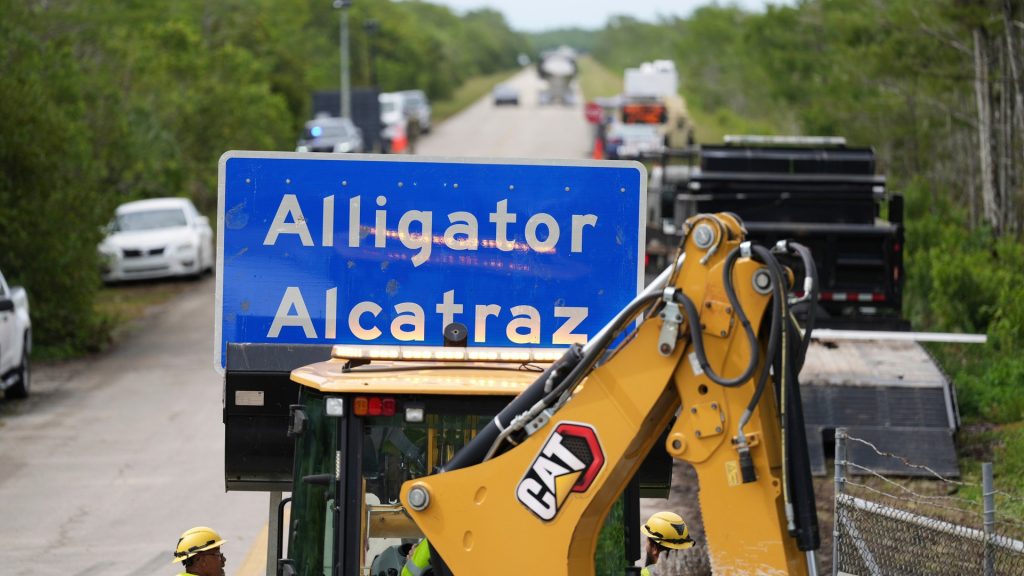
The high-profile U.S. Immigration and Customs Enforcement detention center located in the Florida Everglades could be closing soon, The New York Times reported. “Alligator Alcatraz” became a source of controversy after civil and environmental rights groups sued last year, alleging constitutional violations against detainees.
The report cited anonymous officials from the U.S. Department of Homeland Security and Gov. Ron DeSantis’s office, who said the facility is ineffective and too expensive to operate. One official said the Florida Soft-Sided Facility, also known as “Alligator Alcatraz,” is costing the state at least $1 million a day to operate.
The Times reported the two were preliminarily discussing shutting down the facility due to its expensive upkeep. It also noted DHS officials said the Everglades facility was ineffective.
DHS named the facility after the swamp creatures that inhabit the Ochopee area. The center sits on a 10,500-foot runway at the Dade-Collier Airport, which the Miami International Airport says is a training site for pilots. DeSantis ushered the facility into reality through a state of emergency declaration he ordered in January 2023. In it, he said the state was facing an influx of unauthorized immigrants.
DeSantis told reporters at a Thursday press conference on data centers that the Everglades facility wasn’t intended to be permanent.

“I said on Day 1 it was going to be temporary,” he said. “We didn’t know how long because we didn’t know what funding was going to be passed.”
He told reporters that it “served its purpose” since it aided in detaining 2,200 unauthorized immigrants. He doesn’t know when the wind-down could happen, as Markwayne Mullin now leads the department.
Unbiased. Straight Facts.TM
According to the Deportation Data Project, the Florida Soft-Sided Facility — also known as “Alligator Alcatraz” — has 1,357 detainees as of March 10.

He noted that DHS has since changed its deportation model, and the Ochopee facility could become redundant.
“We’ll change the approach to make sure we’re getting the people in DHS’s hands, and then let them put them in the facilities that they have,” DeSantis said. “So, that may be the case.”
A spokesperson with DHS told Straight Arrow over email that reports that it is pressuring Florida to cease operations are false.
“Florida continues to be a valuable partner in advancing President [Donald] Trump’s immigration agenda, and DHS appreciates their support,” the spokesperson wrote. “DHS continuously evaluates detention needs and requirements to ensure they meet the latest operational requirements.”
The Florida Division of Emergency Management didn’t immediately respond to Straight Arrow’s request for comment. The New York Times reported that the facility had nearly 1,400 detainees. However, the Deportation Data Project website said the count is instead at 1,357 people as of March 10.
The Trump administration has used the Ochopee facility as a blueprint for future facilities across the nation, some of which were constructed in Florida, Indiana and Texas.

Detention center costing millions
The New York Times’ reporting on the center’s cost isn’t exactly new. Several immigrant rights groups have raised concerns about the Ochopee facility costing taxpayers millions of dollars.
The Florida Policy Institute, a left-leaning think tank, said in a Sept. 9 report that the Everglades facility had an estimated $450 million annual operating cost. The institute criticized DeSantis’ administration for fast-tracking construction, which could ultimately cost taxpayers in the future.
That price tag hasn’t always been the same. Florida Phoenix, a States Newsroom publication, reported in March that the Florida emergency management division has revised operating costs at least five times between June and November of 2025.
Numbers fluctuated from $807 million, down to $390.2 million, with projections of $1.065 billion by this June. Emergency Management Executive Director Kevin Guthrie applied on Aug. 7 for a $608.4 million reimbursement from the federal government. FEMA denied the request because of the application size and lack of an environmental review.
A DHS spokesperson told Straight Arrow that it’s working on reimbursement requests.
“DHS reviews reimbursement requests for grant funding to ensure costs are allowable and validated expenses that are eligible for reimbursement prior to releasing funding,” the spokesperson wrote.

Constitution, environmental law allegations
The southern Florida detention center has been embroiled in litigation since before it opened.
In one lawsuit, the American Civil Liberties Union claimed that Florida and DHS officials have been denying detainees access to lawyers. The class action lawsuit came after immigration lawyers learned about conditions at the facility, which they described as abysmal. They claimed that lawyers requested to meet detainees at the facility’s checkpoint, but were told by Florida National Guard or state police officials that in-person visits weren’t allowed.
Since then, DHS and Florida’s Division of Emergency Management have created webpages instructing lawyers on how to contact detainees held at the facility.
The Friends of the Everglades, Center for Biological Diversity and the Miccosukee Tribe of Indians sued DHS on June 27, alleging that federal officials failed to conduct a required environmental survey of the site. A U.S. District Court judge briefly sided with the groups in dismantling parts of the facility, but an appellate court kept it in operation.
Groups believed that because federal officials were assisting with the facility’s operations, a site study was required under the National Environmental Policy Act. According to the Environmental Protection Agency, the law mandates all federal agencies to consider the impacts of their actions on surrounding habitats.
That same appellate court — the 11th Circuit Court of Appeals — later ruled this past April that since Florida hasn’t yet received reimbursement for the Ochopee detention center, an environmental review wasn’t needed.
Ella Rae Greene, Editor In Chief