Tulsi Gabbard, other intelligence officials testify before Senate committee
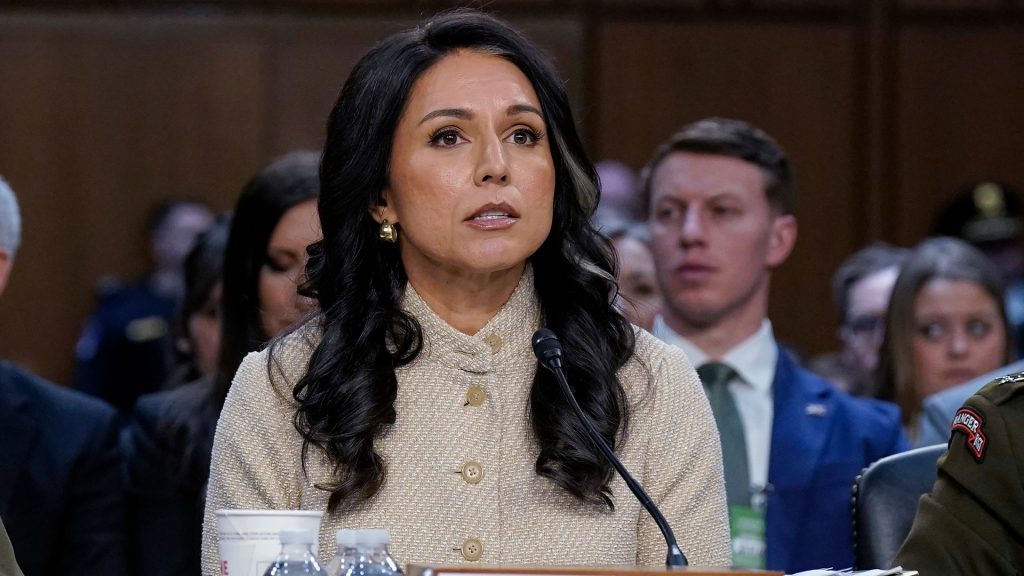
Director of National Intelligence Tulsi Gabbard testified Wednesday on current threats to the U.S. in her first public appearance since the war in Iran began. Senators on the Intelligence Committee panel questioned her on Iran, homeland security concerns, election integrity and broader global threats.
Gabbard is not the only intelligence official testifying before the committee on Tuesday. She will be joined by CIA Director John Ratcliffe, FBI Director Kash Patel, National Security Agency chief Lt. Gen. William Hartman and Defense Intelligence Agency Director Lt. Gen. James Adams.
Comments on Iran
Gabbard addressed numerous threats during her opening remarks, including protecting the U.S.-Mexico border, efforts against drug cartels and, of course, the war in Iran. But before getting into anything, she noted her testimony will not convey her personal thoughts; rather, it “conveys the intelligence community’s assessment of the threats facing U.S. citizens, our homeland and interests, not my personal views or opinions.”
But as expected, much of the hearing surrounded the war in Iran. Gabbard said the Iranian regime is “intact but largely degraded,” noting it has limited options due to leadership deaths and the destruction of military assets.
Sen. Ron Wyden, D-Ore., asked Gabbard asked about what he called “foreseeable” and “predicted” consequences of striking Iran. To those questions, Gabbard said everything coming out of Iran “was not only foreseeable but predicted by the intelligence agencies.”
She said the agency always took the threat against American troops seriously, saying, “The IC assessment has always taken very seriously the threat of the Iranian regime’s missile capabilities and how our American troops in the region may be put at risk.”
Senate committee members also questioned the other officials in the room regarding Iran. Specifically, Sen. Michael Bennet asked Ratcliffe about the Trump administration’s priorities overseas.
He said the “war is not ending, it is escalating,” and said the goals of the administration have “become less clear.
Ratcliffe replied, saying the defined goals are clear: to eliminate Iran’s nuclear and military power.
The other major sticking point during the hearing was the Strait of Hormuz, which remains mostly closed amid the ongoing operations in Iran.
Both Ratcliffe and Gabbard confirmed intelligence suggested the closure was possible prior to the U.S. launching an attack.
“This has long been an assessment of the IC that Iran would likely hold the Strait of Hormuz as leverage,” Gabbard said.
Did Iran pose a threat?
Wednesday’s testimony comes amid renewed scrutiny over the Trump administration’s decision to attack Iran. Both President Donald Trump and Defense Secretary Pete Hegseth have said Iran posed an imminent threat to the U.S., so the president decided to take action.
However, on Tuesday, the Trump administration’s top counterterrorism official, Joe Kent, announced his immediate resignation. Kent reported directly to Gabbard.
In a resignation letter, Kent said he couldn’t support the war in Iran, saying there was no imminent threat to the U.S.
His opinion aligns with previous intelligence reports that suggested Iran was “not building a nuclear weapon.”
However, Trump, Hegseth and other officials continue to emphasize that there was a threat.
Following Kent’s resignation announcement on Tuesday, Gabbard said on X that the decision to attack Iran was up to the discretion of the president.
She noted her office is “responsible for helping coordinate and integrate all intelligence to provide the President and Commander in Chief with the best information available to inform his decisions.”
She went on to say that after Trump reviewed the intelligence the office provided, he “concluded that the terrorist Islamist regime in Iran posed an imminent threat and he took action based on that conclusion.”
During Wednesday’s hearing, Ratcliffe also noted he disagreed with Kent’s opinion. He said he had numerous meetings with Trump prior to the decision to attack, and emphasized Iran did pose a threat to the U.S.
“What I can tell you is that Iran had specific plans to hit U.S. interests in energy sites across the region, and that’s why the Department of War and the Department of State took measures for force protection and personnel protection in advance of Operation Epic Fury,” Ratcliffe said. “I think that’s what’s most important.”
Ella Rae Greene, Editor In Chief