Supreme Court strikes down Trump’s tariffs, dealing blow to economic agenda
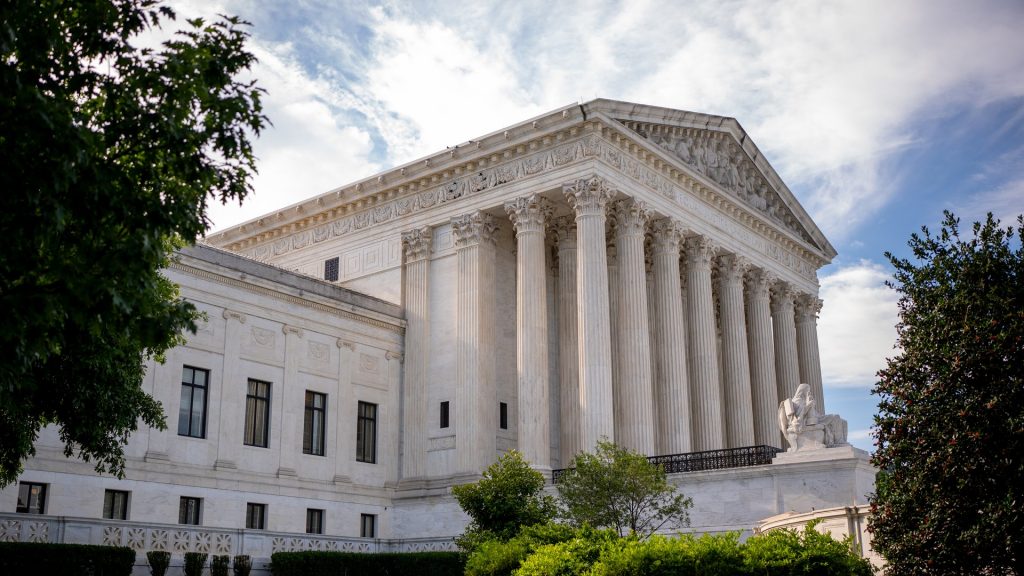
The Supreme Court struck down President Donald Trump’s sweeping global tariffs on Friday, undermining his signature economic policy in a ruling that said he had exceeded his authority as chief executive.
In a 6-3 decision, the court said it was illegal for Trump to impose the tariffs under a 1977 law, the International Emergency Economic Powers Act, or IEEPA.
The word “tariff” does not appear in the act, a fact that weighed heavily in the court’s opinion.
“The president asserts the extraordinary power to unilaterally impose tariffs of unlimited amount, duration and scope,” Chief Justice John Roberts wrote for the majority. “In light of the breadth, history, and constitutional context of that asserted authority, he must identify clear congressional authorization to exercise it.”
“Based on two words separated by 16 others in … IEEPA, ‘regulate’ and ‘importation,’ the President asserts the independent power to impose tariffs on imports from any country, at any rate, for any amount of time,” Roberts added. “Those words cannot bear such weight.”
The federal government may now have to refund as much as $175 billion in tariffs paid by importers of foreign goods, based on an analysis by the University of Pennsylvania.
But in a dissenting opinion, Justice Brett Kavanaugh wrote the refund process “is likely to be a ‘mess,’ as was acknowledged at oral argument.”
“The Court says nothing today about whether, and if so how, the Government should go about returning the billions of dollars that it has collected from importers,” Kavanaugh said.
Kavanaugh was joined in dissenting from the majority by Justices Samuel Alito and Clarence Thomas. Justices Amy Coney Barrett, Neil Gorsuch, Ketanji Brown Jackson, Elena Kagan and Sonia Sotomayor joined Roberts in the majority.
Trump complained of waiting for decision
Trump did not immediately respond to the court’s decision, although the White House has previously suggested he could find other avenues to bring back the tariffs if he lost the Supreme Court case.
On Thursday, he complained about having to wait months for a ruling.
“I have to wait for this decision,” Trump said during a speech at a Georgia steel mill. “I’ve been waiting forever. Forever. And the language is clear that I have the right to do it as president. I have the right to put tariffs on for national security purposes.”
“We’re taking in hundreds of billions of dollars,” he added. “We’re going to be taking in next year $900 billion in tariffs, unless the Supreme Court says you can’t do that. Can you believe it? That I have to be up here, trying to justify that?”
Democrats and a few Republicans praised the court’s opinion.
“The Supreme Court decision striking down the harmful Trump Tariffs is a big victory for the American people,” House Minority Leader Hakeem Jeffries, D-N.Y., wrote on X. “And another crushing defeat for the wannabe King.”
Sen. Rand Paul, R-Ky., said the ruling would prevent presidents “from using emergency powers to enact socialism.” But Sen. Bernie Moreno, R-Ohio, called the court’s decision a “betrayal.” He said congressional Republicans should enact Trump’s tariffs into law.
Background
The court ruled in a case brought by a dozen states and a group of small businesses that said only Congress has the authority to approve the high tariffs on imports from virtually every nation that Trump announced in April 2025.
Trump has described the case as one of the most important in the nation’s history.
“If a President is not allowed to use Tariffs, we will be at a major disadvantage against all other Countries throughout the World,” Trump wrote on Truth Social on Nov. 2, shortly before oral arguments at the Supreme Court.
Three lower courts — including the Court of International Trade and two U.S. Courts of Appeals — found the tariffs to be illegal.
Friday’s ruling was the first time the Supreme Court has interpreted the 1977 law. Any decision has major implications, Hans von Spakovsky, a senior legal fellow at The Heritage Foundation, a conservative think tank, told Straight Arrow News last year, “because it will define not only what President Trump can do, but what future presidents can do.”
What is the International Emergency Economic Powers Act?
The 1977 economic powers law, known as the IEEPA, grants presidents broad authority to declare a state of emergency in cases of “unusual or extraordinary” threats to the U.S. and to regulate economic transactions and international trade.
The law derives from a World War I-era statute called the Trading with the Enemy Act. It was amended during the Great Depression to apply it to any national emergency, and again during World War II to regulate imports. The Trump administration suggested that amendment applied to his tariffs.
In the decades that followed, Congress wanted to curtail powers the president was granted through the Trading with the Enemy Act.
“In 1977, Congress passed IEEPA, which uses much of the same language of the Enemy Act,” legal fellow Brent Skorup at the Cato Institute, a libertarian think tank, told SAN last year. “It gives the president broad powers during the emergency, but it also gives Congress the power to cancel the declared emergency. IEEPA says the president can regulate importation. The fight about the tariffs today is: when Congress allows the president to regulate importation during an emergency, does that include the president being able to set whatever tariff rates he wants?”
Over time, presidents have called upon this federal law in times of crisis. During the 1979 Iran hostage crisis, President Jimmy Carter blocked Iranian assets. President George W. Bush took a similar action against funders of terrorist groups after the Sept. 11, 2001, attacks.
“The statute that’s at issue here has very specific language,” von Spakovsy said. “It has to be an ‘unusual and extraordinary’ threat. The president has said fentanyl is a threat, and that the trade deficit has gotten so large, that it’s an extraordinary event. Did the president under the Constitution and, specifically, under this statute, have the power to impose these kinds of tariffs?”
What comes next?
The White House has suggested that Trump could re-impose tariffs using authority granted by other laws. However, they wouldn’t work as quickly and have more procedural restrictions.
First is the Trade Expansion Act of 1962, which gives presidents the power to impose tariffs on imports when there’s a threat to national security. However, a president can only act after the Commerce Department investigates and determines that importing the products threatens to impair national security.
Section 201 of the Trade Act of 1974 allows a president to impose tariffs when imports are causing or threatening serious injury to American manufacturers. This route requires an investigation and approval from the International Trade Commission.
As part of its investigation, the ITC also has to conduct public hearings and solicit public responses.
Another section of the Trade Act of 1974, section 301, also grants the president the power to impose tariffs. In this case, they must be in response to other nations’ trade measures deemed discriminatory or a violation of U.S. rights under international trade agreements.
Section 301 requires the US Trade Representative’s office to conduct an investigation.
Finally, there are two options that do not require additional investigations or oversight.
Section 122 of the 1974 Trade Act allows a president to impose tariffs when he finds there have been “fundamental international payment problems.” It can only be used to remedy “large and serious” payment deficits from import countries.
Trump’s last option would be Section 338 of the Smoot-Hawley Tariff Act of 1930. This provision grants the president the power to introduce tariffs on nations that impose unreasonable charges or limitations or engage in discriminatory behavior against U.S. commerce.
The post Supreme Court strikes down Trump’s tariffs, dealing blow to economic agenda appeared first on Straight Arrow News.
Ella Rae Greene, Editor In Chief