Columbus statue toppled in 2020 protest finds a new home: the White House
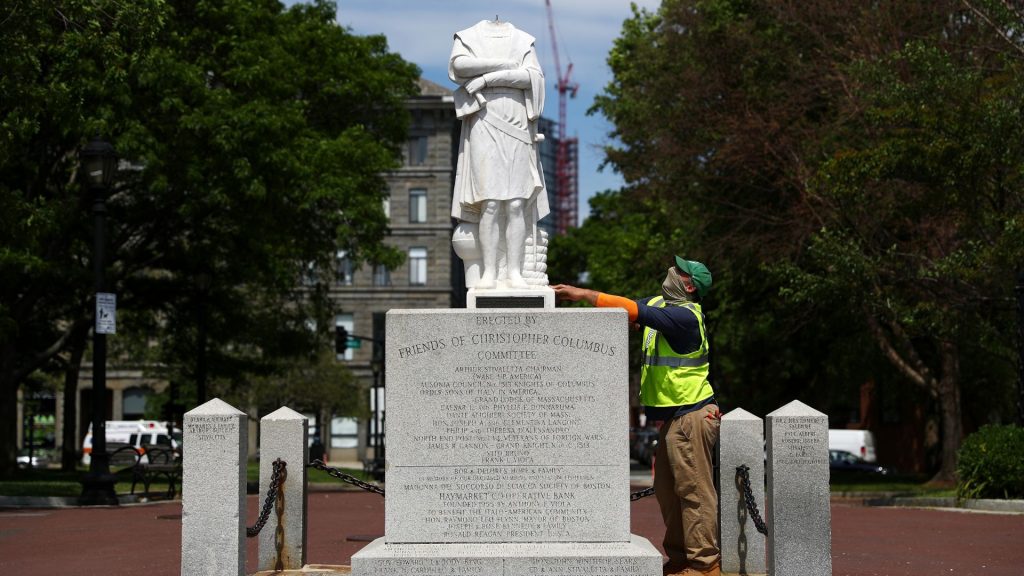
Almost six years ago, amid a racial reckoning brought on by the killing of George Floyd, protesters in Baltimore toppled a statue of Christopher Columbus and dumped it into the city’s harbor.
Now the statue — or, more precisely, a reconstructed version of it — is back, in a far more prominent location.
The Trump administration plans to place the Columbus statue on the White House grounds, The Washington Post reported. Originally unveiled by President Ronald Reagan, it has been rebuilt by Washington-area sculptors with the support of a group of Italian businessmen and politicians. Local charities and federal grants funded the project.
“The Italian people are very happy about it,” President Donald Trump said at the White House last month. “Remember when you go to the voting booths, I reinstated Columbus Day.”

During the final days of his first term, Trump signed an executive order authorizing the creation of the National Garden of American Heroes. He said the garden would showcase people who embody “the American spirit of daring and defiance, excellence and adventure, courage and confidence, loyalty and love.” Trump included Columbus among those to be honored in the garden.
The proposal was short-lived. Less than five months after Trump announced the plans, former President Joe Biden formally revoked them.
But in October, nine months after returning to office, Trump signed a proclamation recognizing Columbus Day and lauding Columbus himself as “the original American hero.”
Columbus controversy
Columbus Day has become a controversial holiday in recent years. Critics say it’s untrue to claim that Columbus discovered America, since Native peoples lived in the country long before he landed in 1492. They also say his voyages led to slavery and genocide of native peoples.
Before 2020, some states had begun discussing and officially replacing Columbus Day with Indigenous Peoples’ Day. However, a major tipping point for the Columbus Day controversy was in 2020, during the Floyd protests.
Protesters and cities removed dozens of Columbus statues, and more states and local municipalities began replacing Columbus Day with Indigenous Peoples’ Day. In 2021, Biden was the first president to formally celebrate Indigenous Peoples’ Day alongside Columbus Day.
While most Americans have a favorable opinion of Columbus, Democrats are more likely to hold an unfavorable one, according to a YouGov poll. Forty-eight percent of Democrats said they have an unfavorable opinion of him, compared to 41% who said the opposite.
Among Republicans, however, 68% said they hold a favorable opinion. Only 19% of Republicans said they had a negative opinion of Columbus.
Other ‘divisive concepts’
Columbus Day isn’t the only topic that has caused controversy in American culture. One of the longest and deepest divisions in the U.S. is the Civil War.
Following the 2020 protests, Congress passed legislation requiring the Department of Defense to remove the names of Confederates from military bases. In 2023, the Pentagon changed the names of nine military facilities named after Confederate officers.
However, much like Biden’s reversal of Trump’s garden of heroes, Trump ditched this policy. In June, the Defense Department reinstated the bases’ former names, but with a twist. Fort Bragg in North Carolina, for instance, is now named for Army PFC Roland L. Bragg, a World War II paratrooper, rather than Braxton Bragg, a Confederate general.
The post Columbus statue toppled in 2020 protest finds a new home: the White House appeared first on Straight Arrow News.
Ella Rae Greene, Editor In Chief