Trump unveils ‘warrior dividend’ checks; Venezuela escalates oil standoff
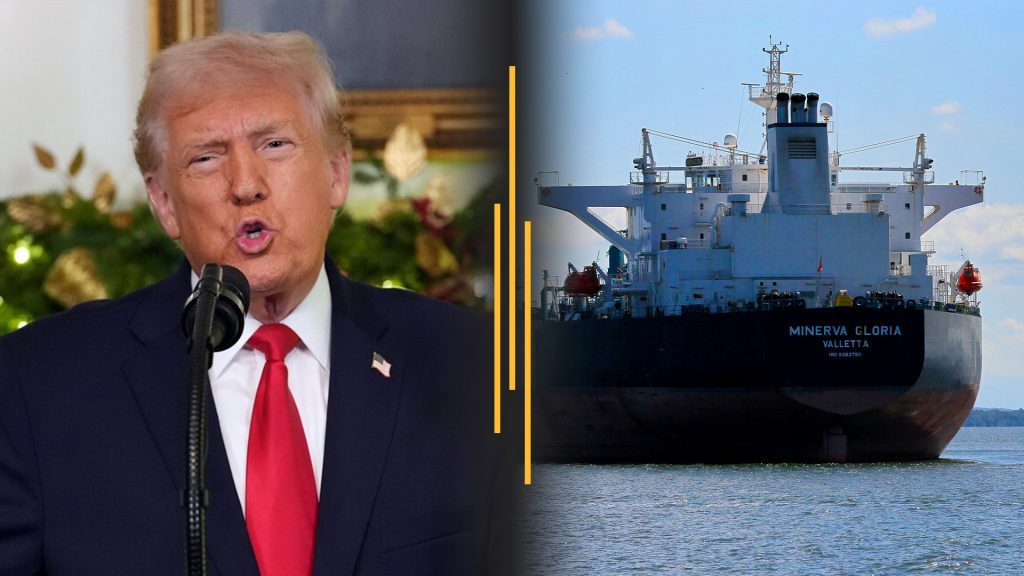
President Donald Trump delivered a holiday-season address framing the economy as a success story, even as polls show voters growing more anxious about costs. He leaned on tariffs, inflation claims and what he called a “warrior dividend.”
Plus, Venezuela responded to Trump’s oil tanker blockade with action, not rhetoric. The country has begun using military escorts to move oil shipments, raising the stakes in an already tense standoff.
And new plaques lining the White House colonnade were billed as tributes to past presidents. Instead, some read more like roasts.
These stories and more highlight your Unbiased Updates for Thursday, December 18, 2025.
Trump promotes economy in address, claims administration has ended inflation
President Donald Trump’s prime-time address to the nation was a full-throated defense of his economic record, and a blunt warning about what he says Democrats left behind.
In a roughly 20-minute speech, the president argued the economy is back on track under his leadership. He blamed high prices on the Biden administration while promising relief for everyday costs such as groceries, prescription drugs, and energy.
Trump also said he plans to take on what he called the “gigantic health insurance companies,” though he didn’t offer specifics on how those costs would be reduced.
The president also doubled down on his sweeping global tariffs, claiming they’re paying off. He announced what he called “warrior dividend” checks of $1,776 for more than a million active-duty service members.
The White House says those payments are already being distributed.
That announcement comes as economists have estimated that Trump’s tariffs cost the average household roughly $1,700 a year due to higher prices.
Looking ahead, Trump said he’ll soon name a replacement for Federal Reserve Chair Jerome Powell, a longtime critic, promising his pick will push interest rates lower.
He also teased what he called “some of the most aggressive housing reform plans in American history” in 20026, predicting a major economic surge in the year ahead.
“Inflation has stopped. Wages are up. Prices are down. Our nation is strong. America is respected, and our country is back, stronger than ever before,” Trump said. “We’re poised for an economic boom the likes of which the world has never seen.”
But public sentiment tells a different story.
A new poll conducted this month found 61% of Americans say the economy is not working well for them personally, and seven in ten say the cost of living is still unaffordable.
Bongino to step down as FBI director as Trump signals his return to broadcasting
Deputy FBI director Dan Bongino is stepping down, ending a short, turbulent run at the bureau and signaling his return to the media world he came from.
Trump confirmed the move on Wednesday, suggesting Bongino is ready to go back to broadcasting.

“Dan did a great job. I think he wants to go back to his show,” Trump said.
Not long after, Bongino made it official, posting on X that he’ll leave the FBI in January. He thanked Trump, Attorney General Pam Bondi, and FBI Director Kash Patel, saying it was a privilege to serve.
Bongino spent less than a year as the FBI’s number two official. He was a political appointee in a role typically held by a career agent.
The former Secret Service agent and pro-Trump podcaster faced internal clashes, public scrutiny, and ongoing tension over the bureau’s direction.
Sources tell CNN that Bongino struggled with the demands of the job and the shift from an opinionated media figure to an evidence-based law enforcement leader, especially as he worked to distance himself from conspiracy theories he once promoted.
Venezuela escorts tankers amid blockade, Trump escalates standoff as military pressure builds
The standoff with Venezuela has taken a sharper turn.
After Trump declared what he’s calling a blockade of sanctioned oil tankers, Venezuela has ordered its navy to escort ships carrying petroleum products out of port.
The move is a direct show of force as those vessels head toward Asian markets.
The New York Times reports several tankers left Venezuela’s coast under military protection, just hours after Trump said the U.S. would stop oil shipments tied to sanctions violations.
The White House is now watching closely, weighing its next steps as the risk of a confrontation rises.
Trump doubled down on Wednesday on patrolling the waters and accusing Venezuela of stealing American oil assets.
“It’s a blockade. I’m not going to let anybody going through that shouldn’t be going through,” Trump said. “You remember they took all of our energy rights. They took all of our oil from not that long ago, and we want it back. But they took it. They illegally took it.”
Venezuela’s government fired back, calling the move “war-mongering,” filing a complaint with the United Nations, and insisting its ships have a right to free navigation as oil exports remain the backbone of its economy.
And in the background, the U.S. is quietly building muscle.
Late Wednesday, the Pentagon confirmed another U.S. strike on an alleged drug-running boat in the Eastern Pacific, killing four people.
The military said the vessel was operating along a known narco-trafficking route and released video of the strike.
American military assets are surging through Puerto Rico and across the region as part of the largest U.S. Naval presence in Latin America in decades.
The big question now is how far this goes and whether this blockade stays economic or turns into something bigger.
Government admits fault in midair crash in Washington, DC
The federal government has acknowledged its role in a deadly midair collision that killed 67 people near Washington, D.C., in late January.
In court filings responding to a lawsuit from victims’ families, the U.S. government admitted that the crew of an Army Black Hawk helicopter failed to maintain safe visual separation from an American Eagle passenger jet as it approached Reagan National Airport. According to the Justice Department filing, the helicopter crew was on a nighttime training mission using night-vision goggles and “failed to maintain vigilance so as to see and avoid other aircraft,” resulting in the collision.

The filing also assigns partial blame to the air traffic controller on duty that night, alleging the controller “negligently violated” FAA procedures by failing to properly manage visual separation between the helicopter and the passenger plane inbound from Wichita, Kansas.
At the time of the crash, multiple reports indicated that only one air traffic controller was staffing the tower.
Families of the victims have called the collision a “wholly avoidable tragedy” as the lawsuit continues.
HHS cuts pediatric grants following vaccine dispute
The Department of Health and Human Services has terminated seven grants to the American Academy of Pediatrics, citing that the programs “no longer align with the department’s mission or priorities.”
Critics suggest the move might be retaliation following the group’s lawsuit against HHS Secretary Robert F. Kennedy Jr. over his vaccine policies.
The grants funded research and programs to reduce sudden infant death syndrome, prevent birth defects and identify autism in young children.
The academy’s CEO, Mark Del Monte, warned that the cuts could have real-world consequences, saying, “The sudden withdrawal of these funds will directly impact and potentially harm infants, children, youth, and their families in communities across the United States.”
The decision could also expose HHS to legal challenges, with opponents arguing that the federal government cannot use funding cuts to punish protected speech.
The American Academy of Pediatrics has already sued Kennedy, accusing him of undermining confidence in vaccines, including by firing all members of the advisory committee on immunization practices and replacing them with critics of vaccination.
Under Kennedy’s leadership, HHS has also removed CDC recommendations that pregnant women and children receive COVID-19 vaccines, and recently rolled back guidance encouraging newborns to receive the hepatitis B vaccine.
History, according to Trump: White House plaques turn portraits into verdicts
Trump has put his stamp on presidential history by installing new, sharply partisan plaques beneath the portraits of every former commander in chief along the White House colonnade.
The exhibit is called the Presidential Walk of Fame, and the plaques — many of which were written by Trump himself — don’t just describe history; they judge it.
Trump labeled former President Joe Biden “Sleepy Joe” and called him “by far the worst president in American history,” while plaques repeated Trump’s false claim that the 2020 election was stolen.
Former President Barack Obama is described as “one of the most divisive political figures in history,” and his health care law is dismissed as “unaffordable.”
-

New plaques have been placed underneath presidential portraits on the Colonnade at the White House, Wednesday, Dec. 17, 2025, in Washington. (AP Photo/Alex Brandon) -

Portraits of former Presidents Richard Nixon, Lyndon Johnson, John F. Kennedy, Dwight Eisenhower, and Harry Truman with plaques of text below are seen on the Presidential Walk of Fame on the Colonnade of the White House, Wednesday, Dec. 17, 2025, in Washington. (AP Photo/Mark Schiefelbein) -

Portraits of former Presidents George W. Bush, Bill Clinton, and George H.W. Bush with plaques of text below are seen on the Presidential Walk of Fame on the Colonnade of the White House, Wednesday, Dec. 17, 2025, in Washington. (AP Photo/Mark Schiefelbein) -

Plaques of explanatory text are seen beneath a framed portrait of former President Barack Obama on the Presidential Walk of Fame on the Colonnade of the White House, Wednesday, Dec. 17, 2025, in Washington. (AP Photo/Mark Schiefelbein) -

New plaques of explanatory text are seen beneath a framed portrait in the space for former President Joe Biden on the Presidential Walk of Fame on the Colonnade of the White House, Wednesday, Dec. 17, 2025, in Washington. (AP Photo/Mark Schiefelbein) -

Alex Brandon / The Associated Press
Bill Clinton receives credit — yet only with a reminder of his scandals and a final note that Trump defeated his wife in the 2016 presidential race.
The tone softens the further back in history, although even George W. Bush faces criticism for initiating wars in Iraq and Afghanistan.
And Ronald Reagan? The plaque highlights his admiration for a young Trump.
Trump, meanwhile, receives two favorable mentions — one celebrating what he describes as the “greatest economy in the history of the world” and his popular-vote victory in 2024. His plaque concludes with the line, “The best is yet to come.”
The White House said the plaques are a tribute, while critics argue they’re something else entirely.
More from Straight Arrow News:

From Schedule I to III: What marijuana reclassification would really mean
President Donald Trump is expected to sign an executive order no later than Thursday to reschedule marijuana to a lower drug category, according to multiple reports. Although federal restrictions would be significantly eased, the drug still would not be legalized nationally.
The plan, the reports say, is to reclassify marijuana from a Schedule I drug to a Schedule III drug.
The Drug Enforcement Administration classifies Schedule I drugs as having “no currently accepted medical use and a high potential for abuse.” Right now, marijuana is on that list alongside drugs like heroin and MDMA (ecstasy).
Schedule III drugs carry a “moderate to low potential for physical and psychological dependence,” according to the DEA. They include substances like Tylenol with codeine, ketamine and anabolic steroids.
In the Oval Office on Monday, Trump indicated that an executive order would be issued soon. Read the full story now>
The post Trump unveils ‘warrior dividend’ checks; Venezuela escalates oil standoff appeared first on Straight Arrow News.
Ella Rae Greene, Editor In Chief