How a Minnesota church is tapping a ‘land use’ law to combat homelessness
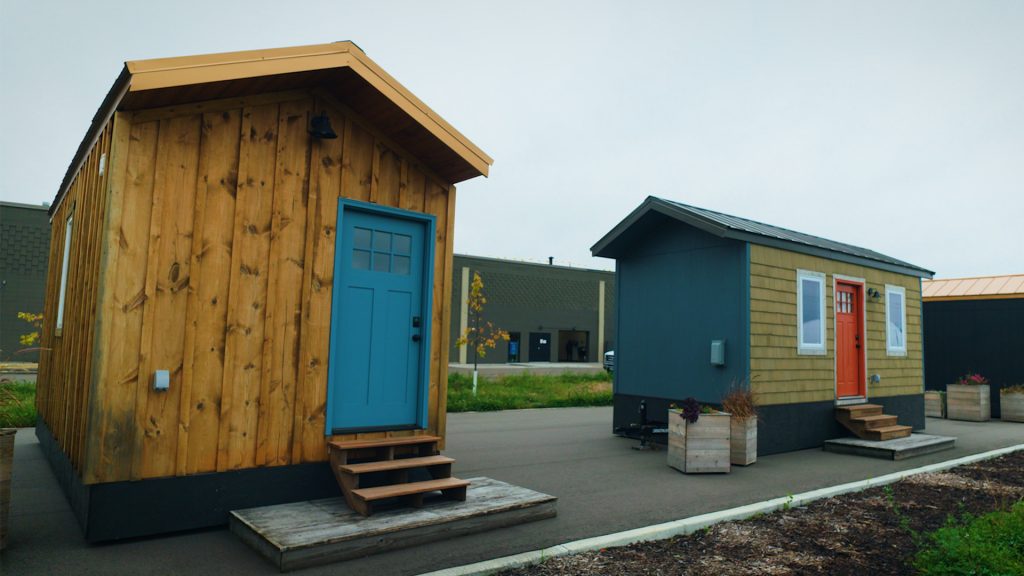
ST. PAUL, Minn. — After moving out of her home in New Jersey, Valerie Roy lived a transient lifestyle. “In my misspent youth, I traveled and waitressed the country,” said Roy, 56. “I lived in a 1959 Chevy school bus made into an RV. It was quite the life. I kept a house, an antique and a car on the road all at one time.”
But being homeless is more expensive than Roy lets on. She owned the bus outright, but parking was a constant issue. If she showed up somewhere, someone inevitably reported her. She needed to ensure she moved the bus once a day.
The cheapest RV parks cost upward of $1,000 a month to park. Some would not allow conversions like her bus at all.
She camped near Langon Park in Roseville, a suburb north of St. Paul, Minn. Another couple had been there for a while, using drugs. When the police came to throw them out, they found they had trashed the place, Roy said.
An officer recognized Roy and put her in touch with a police liaison, who then connected her with Prince of Peace Lutheran Church. The church allowed her to park her bus in the parking lot over that summer, in 2022.
That’s where she met Gabrielle Clowdus, a former University of Minnesota researcher and founder of Settled, an organization that coordinates tiny home communities on church land.
Roy never moved back into the bus. Instead, just before Christmas that year, she became Prince of Peace’s first tiny home resident.

How many Americans are homeless?
Chronic homelessness, defined as being unhoused for a continuous period of at least 12 months or four separate episodes in the last three years, is rising in the U.S.
The Department of Housing and Urban Development’s 2024 annual homeless assessment report found 770,000 people experienced homelessness on an average single night, the highest since annual reporting began in 2007.
Of that figure, more than 150,000 experienced chronic homelessness, with nearly 100,000 people in unsheltered locations.
Helping those who need it most
Clowdus and her organization, Settled, are building creative solutions using federal law and calling on the churches to help via “Sacred Settlements” — tiny home communities on church property that house people who have been chronically homeless.
“Our work is really calling the American church into that lifestyle of radical hospitality,” Clowdus told Straight Arrow News (SAN). “It means using our land and buildings 24 hours a day, seven days a week, living life together intentionally, and a Sacred Settlement is an opportunity to do that.”
The idea stems from Clowdus’ research at the University of Minnesota on how places of worship can alleviate homelessness.
“If the church were to put their focus on that 20% that are the hardest to house, most expensive to the public, with the least amount of options available, then we would free up 80% of public resources to help people that do just sort of need a hand up,” Clowdus said. “But often we look away from the hardest to house because of things like mental illness and substance abuse. We believe the church is so equipped and well-positioned to help the people struggling the most.”
This requires more than a roof over someone’s head. While many organizations push a “housing first” model, Clowdus said Settled practices the “full community” model.
“Housing first made significant strides in research,” Clowdus said. “The area where it remained silent is a profound and catastrophic loss in people’s lives. The rebuilding of family has to be part of the solution.”

What causes chronic homelessness?
Often, the root cause of chronic homelessness is not solely housing, according to Clowdus’ research. Rather, factors like social isolation, scattershot services and lack of fulfilling work opportunities can play a key role. In short, she found, chronic homelessness was often about a loss of community rather than just shelter.
In 2017, a hospital CEO told Clowdus’ team about a loophole often used by unhoused folks in his community when shelters were full: The emergency room would not turn them away.
Clowdus examined how hospitals might provide for homeless people who frequently showed up in the ER — at a cost of $1,500 a day. That led her to looking at more intentional communities, especially tiny home developments, which can be cost-effective with limited footprint. In particular, she studied Community First! Village in Austin, Texas. That community is home to more than 470 formerly homeless people and is expanding to include 1,900 homes across 127 acres.
Building a community
The community is laid out like many other neighborhoods. There is a market, a clinic, community space and even an outdoor cinema. But Clowdus was especially intrigued by how a portion of its homes are set aside for people who had never experienced chronic homelessness.
She also found a preemptive solution to any potential zoning problems: the Religious Land Use and Institutionalized Persons Act of 2000, which prohibits discriminating against religious institutions in zoning laws.
“Synagogues, mosques, churches, if they can show their mission is to care for the poor and the way they want to care for the poor is by creating a permanent and intentional tiny home community, then the local zoning is superseded by the federal land use law,” Clowdus said.
From this research, Clowdus developed the full community model that relies on elements such as permanent homes, cultivated space, purposeful work, supportive friends and intentional neighbors.

‘Won’t you be my neighbor?’
At Settled, formerly unhoused tenants pay rent — usually around $300 a month — based on the square footage of the house. Community space allows for all types of activities, from bonfires to backyard chickens.
The homes come equipped with heat, air conditioning and power. There is no plumbing, but residents at both Prince of Peace and Mosaic Christian Community in St. Paul have keys to the church building to access bathrooms and showers, a larger kitchen and other facilities.
That might seem like a lot of faith to put into someone, but that’s the point, said Alyssa Herrig, Prince of Peace’s settlement coordinator and minister of faith formation and community engagement.
“This church building is an extension of their home,” Herrig said. “We have full trust they will treat this building with respect. And honestly, since it is their home, they are very concerned with the things that happen here. If anything is out of the ordinary — which is rare — but if there’s anything, they’re in touch with us because they want to be safe where they live.”
Tenants are provided opportunities to earn credit toward rent by performing work on the church grounds such as landscaping or other odd jobs.
The model also requires different congregations to work together. One congregation offers the land for use while another sponsors the placement of a tiny home. Clowdus said this helps to break down philosophical barriers amongst differing congregations.
“We actually see this as a strength of the movement of the church really coming together in an ecumenical way and saying, ‘Hey maybe we can’t get along on these theological differences or these political differences, but we can connect on this one thing. We can love our neighbor as ourselves.’”
How long do they take to build?
The homes take about 12 weeks to construct. There are six tiny homes ready to go at any moment.
Settled currently has three tiny home communities in the Twin Cities metro, with more on the way. While Settled currently operates solely in Minnesota, Clowdus said she is working with churches in Washington, Missouri, Michigan and Kansas.
The process has been mostly smooth, though with some stumbles. In early 2023, the city of Roseville sent Prince of Peace a cease and desist, alleging the tiny home community was not up to code. What could have been a divisive battle reached a simple solution: The city granted Prince of Peace an interim-use permit and the state added Sacred Settlements as a form of housing, aligning with federal law.

How can neighbors help solve a city’s homelessness issues?
Perhaps the most radical aspect of Clowdus’ model is the “intentional neighbors” — people who live in the tiny home communities who have not experienced homelessness themselves. The idea is to break down the isolation chronically homeless people experience.
For Karen Baumgartner, 32, choosing to become an intentional neighbor at Mosaic, a Nazarene congregation in St. Paul, has become one of the most rewarding experiences of her life.
“The safety has been the biggest concern, but I immediately tell them if anything, I feel safer because I have neighbors here looking out for me. I feel like there’s people watching out for me,” said Baumgartner, a flutist and music instructor.
Where she might have previously spent her time alone scrolling her phone, now she partakes in active community engagement through cookouts and movie nights. She has also grown closer to her faith since moving in this June.
“Jesus’ ministry, he wasn’t just interacting with the people around him in his social circle,” Baumgartner told SAN. “He was reaching out to people. There wasn’t really any reason he needed to be connecting with them. He cared about the poor and the needy and was intentional about putting himself in spaces where he was interacting with them.”
Mosaic resident David Doren told SAN that having neighbors like Baumgartner has been paramount to the community’s success.
“Anyone can hand you a place to live, but without the support of people around you to help you maintain and keep that place or maintain yourself, basically in order to keep that place, you’re just going to end up in the same spot,” said Doren, 55.
A former truck driver and bartender, Doren spent several years unhoused after his brother lost the home they shared. Doren tried to avoid the encampments and kept to himself, setting up a tent in a wooded area by the river. He slept during the day and stayed awake at night to ensure nobody took his limited belongings.
Applying for jobs, bank accounts or just about anything else was extremely difficult with no fixed address.
“Shelters are first come, first serve,” said Doren, who moved into Mosaic’s settlement in October, 2022. “Some of them you can get mail, but they’ll only hold it for a week. Not knowing when the mail actually arrives, I didn’t want to go back to the shelter every day just to get the mail.”
Mosaic’s community aspect has helped plant him in place — it has kept him from regressing back onto the street, he said.
“You’ve got people around you you can trust and rely on,” he said. “It’s nice having a locked door. All the way around, it’s made everything so much better and easier to deal with the rest of my life.”
The community model has also been a boon to Roy, who has found added stability in her life. She already had a degree in sustainability, but is back in school to become a licensed alcohol and drug counselor.
The post How a Minnesota church is tapping a ‘land use’ law to combat homelessness appeared first on Straight Arrow News.
Ella Rae Greene, Editor In Chief