Food for thought: ‘Sandwich Guy’s’ acquittal stirs debate about slinging meat
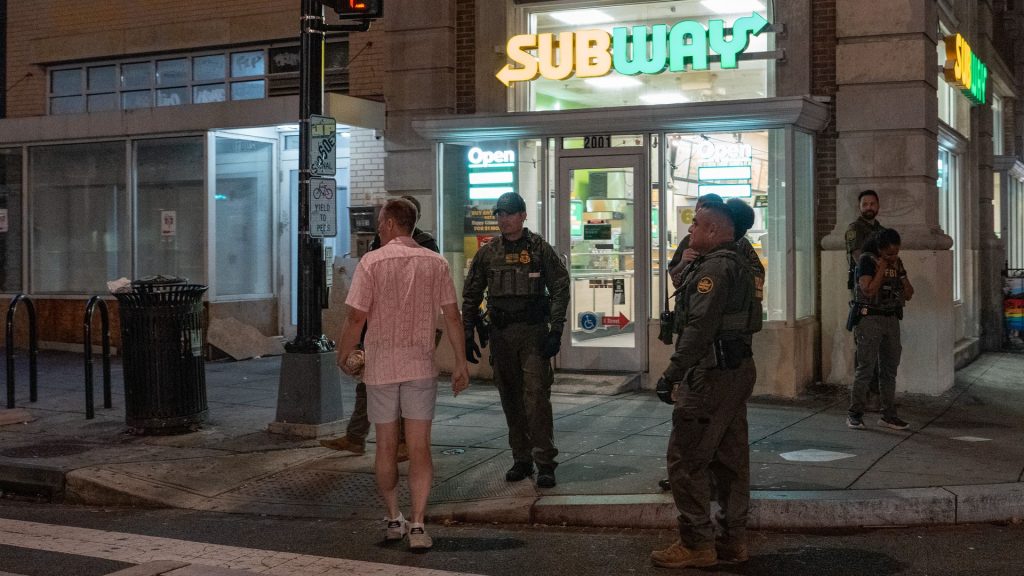
The man who launched a foot-long sandwich at a federal Customs and Border Protection agent last summer was found not guilty of misdemeanor assault on Thursday. So does that mean it’s now legally OK to hurl deli meat and toppings stuffed into a hoagie roll at federal agents? Maybe, maybe not.
Sean Dunn — now widely known as Sandwich Guy — threw the salami sub at an agent outside a Washington nightclub. The alleged assault took place during a massive law enforcement crackdown that President Donald Trump ordered for the nation’s capital.
Some hail Dunn — who, at the time, worked for the Department of Justice — as a martyr. Others see him as a an agent of the Deep State. His acquittal sparked outrage and excitement in chatrooms across the internet, where the deeper meaning of Dunn’s meat-slinging has stimulated endless debate.
What does the decision mean?
“A jury decision does not mean ‘this guy did nothing,’” a Reddit user identified as parsonsrazersupport wrote. “It means ‘we, the jury, have not been convinced by the prosecution that they have met their burden to prove that the defendant did this specific charged thing.’ They aren’t saying ‘you can throw things’ they are saying ‘it was not proven that this man committed assault under these circumstances.’”
Writing on Lawfare, a website that normally covers weighty national security issues, Molly Roberts described the case as “a strange sort of performance art — highly amusing and highly menacing at the same time.”
In the end, Roberts wrote, the federal judge told the jury “that they must find Sandwich Guy acted forcibly, regardless of the verb — assault, impede, and interfere turn out to be the most relevant three — they do or don’t conclude he performed. He defines forcibly as ‘by use of force,’ elaborating that a person can act forcibly by ‘threatening or attempting to inflict bodily harm upon someone, with the present ability’ to do so.”
Throughout the trial, which began Monday, both sides had much to say and frequently interrupted each other. While the prosecution wanted to depict Dunn’s jettison of the foot-long object as a nefarious act, the defense hoped to make it seem frivolous.
As Roberts put it, the defense treated “l’affaire de sandwich more as farce.”
“Both sides want to make an example of Sandwich Guy,” Roberts wrote. “The government, as a menace to society against whom that society must, for the sake of law and order, impose punishment, and the defense, as a dissident unfairly targeted for his deeply held ideological convictions.”
After Dunn was acquitted, his attorney, Sabrina Shroff, told journalists that the case was about the right to dissent from Trump’s agenda.
“In some dissent we’re together, and in some dissent we stand alone,” she said. “But we really want to thank the jury for having sent back an affirmation that dissent is what is not just tolerated. It is legal, it is welcome.”
The stakes were more than just a sandwich
While the case has been the subject of jokes and pun-filled headlines, the stakes were high for Dunn, who was fired by Attorney General Pam Bondi after his arrest.
The government originally sought felony charges against Dunn, but a grand jury refused to indict him. While the misdemeanor of which he was ultimately charged would have carried a lighter punishment, a guilty verdict could have barred Dunn from returning to government service or even for working for nongovernmental organizations that receive federal funding.
Still, Dunn’s acquittal doesn’t mean people should start throwing late-night munchies at federal agents. If anything, it should serve as a warning. Even if found not guilty, you still run the risk of becoming a folklore hero or a menace to society, depending on who you ask.
The post Food for thought: ‘Sandwich Guy’s’ acquittal stirs debate about slinging meat appeared first on Straight Arrow News.
Ella Rae Greene, Editor In Chief