25,000-acre wildfire burns uncontained near ‘Alligator Alcatraz’
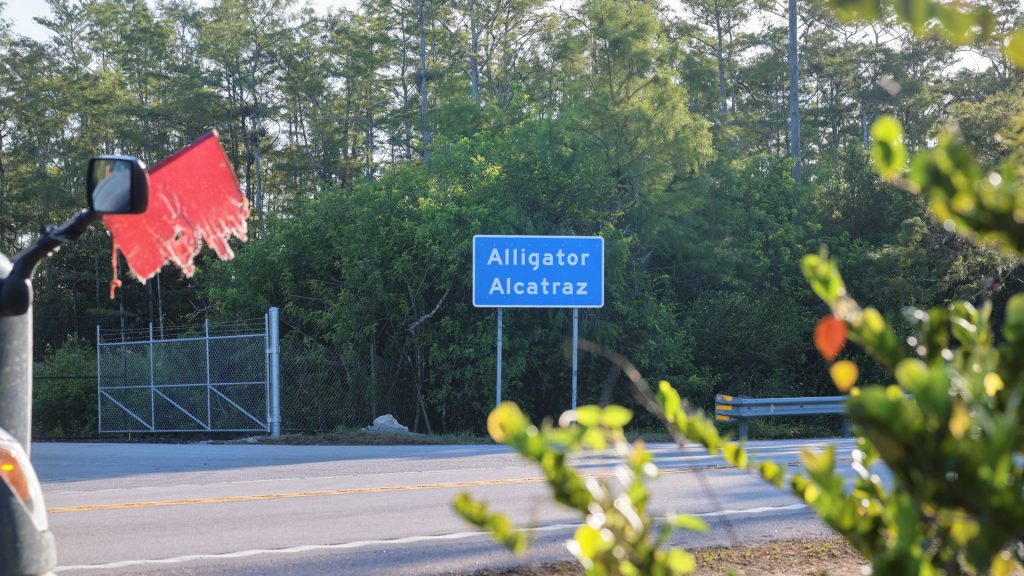
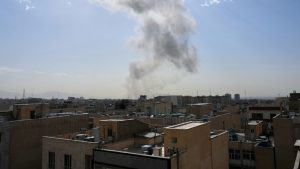
A 25,000-acre wildfire continues to burn in south Florida, just 20 miles from the immigrant detention facility known as “Alligator Alcatraz.” Florida officials say there’s no danger to the facility due to favorable winds, but others remain concerned.
Wildfire burning
The fire is burning in Big Cypress National Preserve as crews continue to try to contain it. As of now, it remains entirely uncontained.
The acreage burned is now equivalent to nearly 47 square miles, larger than Disney World.
Crews are fighting the fire with helicopters and trucks and are concerned the fire line won’t hold because of weather conditions.
The fire has at times closed I-75, better known as Alligator Alley, which connects the east and west coasts of the state.
Alligator Alcatraz concerns
“I would certainly hope that if a wildfire got closer to be a problem, that they would act on it,” Deigen Villalobos, associate immigration attorney at Smith and Eulo Law Firm, told Straight Arrow News.
Villalobos has three clients in the facility. He’s had trouble speaking to those clients, which is an issue that’s been happening since the facility opened last year, but said they’re mostly unaware of the fire burning 20 miles away.
“I can only speak to the one individual who was recently detained, recently transferred there, so I’m not sure just the word hadn’t gotten around to him about the wildfire, or if there is, in fact, some kind of information cut off,” Villalobos said. “I can’t speak to that. I’m sure folks are concerned.”
According to experts SAN spoke with, there are about 1,500 migrants detained in the facility right now.
“Given the volume of folks in the facility, I’m sure they worry about their conditions and what would happen if the wildfire got closer, but to my knowledge, they haven’t expressed any concern, not to me at least, but my information is limited,” Villalobos added.
Meanwhile, immigration advocates have some concerns about the conditions.
“I’m in several chats with family members of detainees,” Thomas Kennedy, policy analyst with the Florida Immigration Coalition. “The conditions seem to be the same in terms of access to phones that are monitored, lackluster food, not being able to access immigration officers or regular immigration court proceedings.”
Kennedy said, as of now, those are the major concerns of family members, as opposed to the fires.
Part of that is because the Florida Department of Emergency Management continues to say the fires won’t impact the facility.
“That being said, you can’t really take much of what the Department of Emergency Management says at face,” Kennedy said. “You have to take whatever they say with a huge grain of salt.”
One reason Florida officials have not shown concern is because of the direction of the wind.
“The fire is situated 20 miles to the west of the facility and is burning in the opposite direction,” Stephanie Hartman, director of communications for the department, told ABC News.
However, wind can change direction, which is where concerns lie with family members and advocates.
Fires can spread as quickly as 14 miles-per-hour, so the 20-mile distance doesn’t provide a lot of time in the worst-case scenario of a necessary evacuation of hundreds of detainees.
When asked if he believes officials are ready to quickly evacuate everyone in the facility, Kennedy simply replied, “No.”
“We’re talking about a rather extensive operation to move well over 1,000 people, all of whom have to be moved unless the government is going to release them into the public,” César García Hernández, a law professor at Ohio State University, told SAN.
Major evacuations like that involve significant logistics.
“It’s the government that has to be responsible for 100% of the relocation process,” Hernández said. “That’s everything from finding the buses to figuring out whether some people are going to be flown out of Florida, or at least out of the region. Ensuring that transportation is safe and efficient. Safe for the detainees, safe for the staff, who’s going to be moving them.”
There’s also concern over the way Alligator Alcatraz is built.
“It is what the DHS would call a soft-sided detention facility, meaning it’s a tent detention camp,” Kennedy said. “So, it’s obviously a greater risk, not just of actual burning, but I think of exposure to the elements, to smoke, to chemicals, etc.”
Another concern is that there’s only one way in and out of the facility. That’s through U.S. Highway 41, also known as the Tamiami Trail.
It’s a two-lane highway that cuts through the reserve moving east and west. Kennedy said he’s concerned the wildfire could also obstruct the road.
“Logistically, it could actually get very difficult to evacuate that facility in the case of an emergency, or in the case of waiting to the last minute,” he said.
Government responsibility
“Anytime that an individual is locked up, whether that is in a local, state or federal facility, the agency that is confining the person is responsible for the well-being of that individual,” Hernández said.
This facility is federally funded. However, there’s been a lot of debate over who’s actually running the facility.
The state has said it’s operating the facility under agreements between state and local agencies, as well as ICE.
That means it’s on the state if an evacuation becomes necessary.
“Because this is a facility that is operated by the state on behalf of the federal government, or under contract with the federal government, it’s really going to be a question of whether or not the state has put that kind of contingency plan,” Hernández said.
Hernández said those plans would need to have been made well in advance.
“They’re unlikely to just get put up in a Holiday Inn in Miami, right?” he said. “The Department of Homeland Security is going to look for space in other secured facilities. But of course, not every secured facility is in the position to take on dozens or hundreds of individuals, especially given that there’s a wildfire raging.”
The most recent example of this came just three years ago, when 4,000 inmates had to be moved from 35 facilities due to Hurricane Idalia.
In July 2025, following a Miami Herald report that there was no hurricane plan for Alligator Alcatraz, the State Emergency Response Team put out a plan.
“This thing was more redacted than the Epstein files,” Kennedy said. “It was literally, like, a black page. So, we don’t know exactly what that entails and what those procedures are.”
There are only three pages of that 33-page report that are not mostly, if not fully, redacted.
Ella Rae Greene, Editor In Chief