Why Iranian Kurdish groups are drawing new attention in Iran
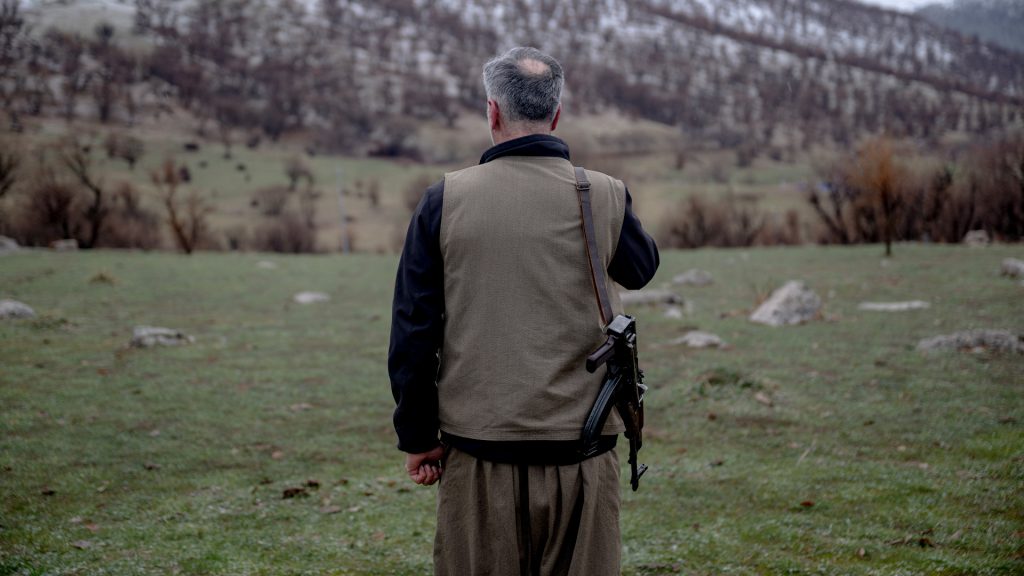
Five major Iranian Kurdish groups have united, raising new questions about whether they could open another front against Tehran from bases in northern Iraq. For now, the White House denies U.S. involvement in any insurgency plan, and Kurdish leaders say they are not launching a ground offensive.
Still, Stefano Ritondale, chief intelligence officer at Artorias, told Straight Arrow News that Kurdish groups could play “an important role” in a broader anti-regime strategy if they draw Iranian forces toward the northwest and create openings for U.S. and Israeli strikes. Artorias aggregates intelligence data for governments and businesses worldwide.
The White House has pushed back on reports of any approved Kurdish insurgency plan. Press secretary Karoline Leavitt called such reports “completely false,” according to The New York Times.
Why Kurdish groups matter in this conflict
Iranian Kurdish groups are drawing new attention because they operate along Iran’s western border with Iraq and could, in theory, complicate Tehran’s security response. But their possible role depends on more than geography, including their military capacity, their political aims, whether outside support materializes and whether unrest spreads more broadly inside Iran.

Estimates of Iran’s Kurdish population vary, with Henri Barkey of the Council on Foreign Relations putting it at 10 million to 15 million and Chatham House’s Winthrop M. Rodgers estimating 7 million to 15 million. Both described a long history of repression in Kurdish areas.
What Kurdish groups, officials and analysts are saying
Unbiased. Straight Facts.TM
Kurdish forces are largely light infantry equipped with small arms, mortars and RPGs, operating from bases in the Kurdistan Region of Iraq.
The renewed focus stems in part from recent Kurdish political coordination. Barkey wrote that five Kurdish groups agreed on Feb. 22 to form a united front. Atlantic Council expert Yerevan Saeed said the coalition initially brought together KDPI, PJAK, PAK, Khabat and one Komala faction, with the Komala Party of Iranian Kurdistan joining on March 4.
The Times reported that the CIA had previously provided small weapons to Iranian Kurdish forces as part of a covert effort to destabilize Iran. CNN also reported that the CIA had been working to arm Kurdish forces. The agency did not comment on the reports.
Secretary of Defense Pete Hegseth, however, downplayed U.S. reliance on the Kurds.
“None of our objectives are premised on the support of the arming of any particular force,” he said.
Ritondale told SAN that Iranian Kurdish groups are capable in the near term of “limited localized offensive operations” and insurgent-style attacks against isolated facilities operated by the Islamic Revolutionary Guard Ground Forces and the Islamic Republic of Iran Army, known as Artesh. He said more significant operations would likely depend on logistical, intelligence and air support from the U.S. or Israel.

Khalid Azizi, a spokesperson for the Democratic Party of Iranian Kurdistan, told Fox News that Kurdish groups are prepared and organized but “do not have any intention” at this stage of entering Iranian Kurdistan.
“It’s very easy to start a war,” Aziizi said, “but it will be more complicated how to end this war.”
That caution has also appeared in official regional statements. A March 4 press release from the Kurdistan Region Presidency said President Nechirvan Barzani and Iranian Foreign Minister Abbas Araghchi discussed border security and regional stability, and said the Kurdistan Region “will not be part of the conflicts.”
Why analysts disagree on what Kurdish involvement would mean
The central debate is whether Iranian Kurdish groups could become a meaningful pressure point without triggering political blowback or a broader regional backlash.
Ritondale argued that some news coverage has underestimated both Kurdish military pressure and cross-sectarian cooperation during anti-regime protests. He said Kurdish groups could become a more serious pressure point by drawing Iranian forces into the northwest, degrading internal stability and opening space for protests.

Other experts were more skeptical. Barkey said reports that thousands of fighters had gathered in northern Iraq appeared unrealistic and argued that the time needed to train Kurdish rebels makes near-term action unlikely. Rodgers wrote that the groups’ real battlefield strength remains unclear, and he quoted Komala leader Abdullah Mohtadi: “We will not send our forces to the slaughterhouse.”
The Atlantic also highlighted deep uncertainty within the Kurdish camp. The magazine reported that some fighters near the Iraq-Iran border appeared eager to join the conflict, while others warned that an armed push could lead to reprisals, wider regional disorder or abandonment by outside powers. The article also described voices in Kurdish politics arguing that any durable alternative to the regime would have to emerge from inside Iran, not from an externally backed ground campaign.
Why Kurdish involvement could cut both ways
There is also disagreement over how any Kurdish move would be received inside Iran. Ritondale told SAN that Tehran would likely use a Kurdish offensive to argue that the opposition was trying to fragment the country. The Foundation for Defense of Democracies made a similar argument, writing that backing Kurdish armed groups could strengthen that narrative and help the regime portray the conflict as foreign-backed dismemberment.
At the same time, other sources framed Kurdish goals more narrowly than outright secession. Rodgers wrote that Kurdish parties say they want rights and local self-rule within a future democratic Iran. Saeed similarly wrote that the coalition’s formal goal is self-determination within Iran, even as that remains a fault line within the wider anti-regime movement.
What would signal a real shift on the ground
The clearest signs to watch are whether Kurdish groups remain in a holding pattern, whether insurgent attacks in northwestern Iran increase, whether there are reports of force buildups in Iraqi Kurdistan and whether broader protests emerge inside Iran.
Ritondale told SAN that increased insurgent-level attacks in northwest Iran and signs of a larger Kurdish force buildup would suggest the groups are moving from a theoretical option to a real operational factor.
Azizi told Fox that the Iranian regime remains in power because “people are not on the streets and there is no alternative right now to replace this regime.”
Ella Rae Greene, Editor In Chief