Why did Bad Bunny climb a utility pole? A deep dive into Puerto Rico’s power grid
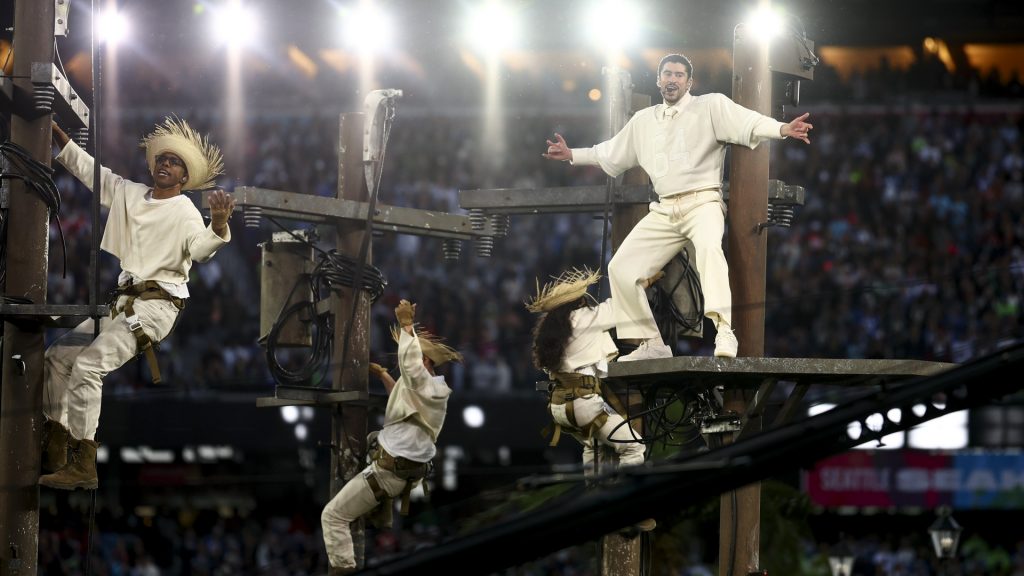
When Bad Bunny climbed a utility pole during the Super Bowl LX Halftime Show, the performance brought attention to the fact that nearly a decade after a devastating hurricane, Puerto Rico’s power grid still isn’t fixed. Today, the island remains afflicted with intermittent outages, and as locals turn to rooftop solar and batteries, the federal government has also cut funding to the island’s electric grid projects.
While performing the song “El Apagón,” which translates to “the blackout,” Bad Bunny — known offstage as Benito Antonio Martínez Ocasio — stood atop an electric distribution pole with other performers dressed as utility linesmen, eventually sending sparks into the air as the halftime show reached its climax.
“For the public that might have forgotten, Bad Bunny climbing the poles gave voice and visibility to an unforgettable instance of being powerless in Puerto Rico in a very literal sense,” said Diana Hernández, a professor and co-director of the Energy Opportunity Lab at the Columbia Center for Global Energy Policy.
With a population of 3.2 million people — more than five times that of Wyoming — the U.S. territory of Puerto Rico is isolated geographically and politically because it lacks voting power for the president or in congress.
The grid reflects a major disparity: The average utility customer in Puerto Rico spent an average of more than two extra days without power in 2024 compared with those on the mainland. In Puerto Rico, customers lost power more than 13 times and spent 30 hours without electricity on blue-sky days, according to the U.S. Energy Information Administration. Storms added five more service interruptions and 43 hours without power in 2024. By contrast, customers on the mainland lose power for an average of two hours per year and experience 1.3 service interruptions, including major storms.
Puerto Rico also pays more for electricity. Residents of the island pay 49 cents per kilowatt hour of electricity — more than triple the national average of 14 cents.
What impact did hurricane Maria have on Puerto Rico’s grid?
Unbiased. Straight Facts.TM
The average resident of Puerto Rico spends more than two days a year without electricity.

In 2017, two category five hurricanes swept through Puerto Rico: Irma and a couple weeks later, Maria. When Maria hit, 80,000 people were still without power from Irma. In Maria’s wake, 2,975 people lost their lives, and it took 11 months to restore electricity to all of the homes and businesses that lost power.
Over 2,400 miles of high-voltage transmission lines were damaged, along with 33,000 miles of distribution lines and nearly 300 substations that link the transmission and distribution grids.
Hernández, a “Nuyorican” who grew up in the Puerto Rican diaspora in New York City with family who were born on the island, spent time interviewing locals in Puerto Rico in 2018 and 2019 for her research on access to electricity.
Because people went months without refrigeration, “a cold glass of water was like gold,” Hernández told Straight Arrow News.
For people who depend on electronic medical devices, losing power is a life or death matter. Most of the deaths associated with Hurricane Maria were due to the loss of power in its aftermath.
Did Puerto Rico’s grid have underlying issues before Maria?
When the hurricanes hit, the grid already had problems, experts told SAN.
“The grid that Maria found was already on its knees,” said Cecilio Ortiz Garcia, who lived for decades in Puerto Rico where he studied the electric grid, and is now a professor at the University of Texas Rio Grande Valley.
Built initially with hydroelectricity, Garcia said corporations built coal and oil power plants on Puerto Rico’s grid to fuel a growing industrial sector that manufactured goods to export to the mainland, taking advantage of cheap labor and lucrative tax policy.
“The grid evolved as the political powers evolved in seeing Puerto Rico more and more as a colony to extract as much as they could from it,” Garcia told SAN.
The power plants are largely concentrated on the island’s south side, while the population is concentrated in the north. During high-wind storms, the transmission lines carrying electricity across the island become a major vulnerability.
What’s the status of energy projects to improve Puerto Rico’s grid?
The U.S. Department of Energy (DOE) estimated total repairs to Puerto Rico’s grid after the hurricanes would cost $100 billion.
In 2022, Congress allocated $1 billion in a program designed to make the grid more resilient to storms that can knock out power lines by investing in residential solar power and battery systems. However, the Trump administration has either rescinded or re-allocated $815 million of that funding.
Last September, the DOE announced that $365 million of the initial $1 billion would go toward “commonsense repairs and emergency measures that strengthen grid stability and harden critical infrastructure.” At the start of 2025, $450 million was clawed back without any announcement from DOE, according to a report from Latitude Media.
Marla Pérez Lugo, who testified before Congress in the aftermath of Hurricane Maria and is currently a professor at the University of Texas Rio Grande Valley, said solar and battery systems help families maintain critical medical equipment and refrigeration during power outages, which still occur daily on the island.
“If the refrigerator doesn’t work, the food gets spoiled and there’s more expenses to this family, and we are talking about very poor families,” Lugo told SAN.
Still, she said, she has hope. She pointed to local, island-based organizations, such as Barrio Electrico, which provides solar and batteries to low-income families across Puerto Rico.
What were the reactions to Bad Bunny’s performance?
Inside energy policy circles, Bad Bunny’s halftime show performance became a viral moment that highlighted not only the problems in Puerto Rico, but also the importance of the power grid in general.
For Puerto Rican experts on the power grid, the moment was even more amplified.
Garcia interpreted a direct message to Puerto Ricans to take more control of the island’s energy systems, which he views as inextricably linked to politics.
“Puerto Ricans not only need to go vote now, they also need to get on the roofs and install solar panels,” Garcia said.
“There was something really powerful,” Hernández said, about watching Bad Bunny sing about blackouts while “proclaiming Puerto Rican excellence in its multiple varieties” and ascending a utility pole.
“I saw it as kind of like an ascension to power, despite all the challenges, and really in many ways, against all odds,” Hernández said.
The post Why did Bad Bunny climb a utility pole? A deep dive into Puerto Rico’s power grid appeared first on Straight Arrow News.
Ella Rae Greene, Editor In Chief