Why California and Texas actually agree on powering their future with batteries
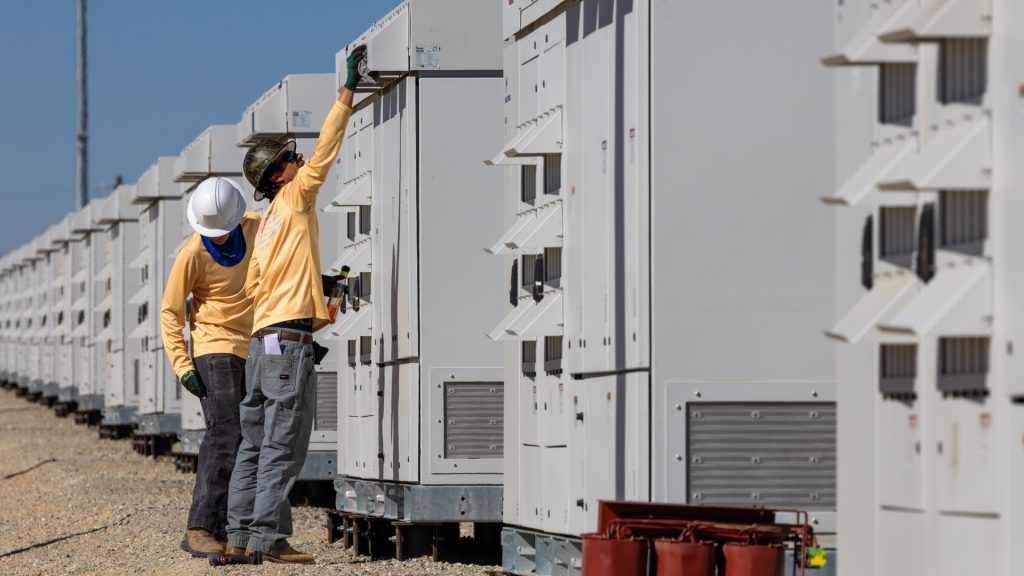
Utility-scale batteries are reshaping the way renewable energy is integrated on the grid. And despite their differences, California and Texas are at the forefront of deploying batteries as electricity bills rise and data centers cause a surge in electricity demand.
“We are seeing a really interesting contrast of two systems coming at [power] generation from very different policy and political points of view, but ending up with pretty similar answers,” said Severin Borenstein, an energy economics professor at the University of California, Berkeley and member of the board of governors for the state’s primary grid operator CAISO.
In California, energy policy is driven by goals to generate electricity from emissions-free sources, which led the state to become an early adopter of wind, solar and batteries. In Texas, the philosophy is more free-market, and renewables have flourished amid increasing demand for power and in part because the main power grid, ERCOT, makes plugging into the system faster than other parts of the country.
In the wake of growth in renewables, batteries are emerging as a way to store and then discharge excess power generated from the sun and wind. Batteries have gone from a minimal footprint only five years ago to providing a significant share of California and Texas’ electricity during peak demand periods. Their growth has changed how grid operators keep the system stable, and some energy experts believe continued decline in costs of solar and batteries will displace conventional power plant generation.
What role are batteries playing on the grid?
In 2025, California hit 17 gigawatts of battery capacity, mostly on the CAISO grid. On a typical day, that’s enough to meet more than half the power needs on CAISO, which has an average peak electricity demand of 27 gigawatts over the past month, according to data from Grid Status. However, most of California’s batteries can only run four hours before needing to recharge.
Unbiased. Straight Facts.TM
From 2022 to 2024, California increased electricity it generated from batteries by nearly 150% during times when demand on the grid was highest.

In both California and Texas, batteries complement an expansion of solar power.
“California has so much solar that we really need something to cover as the sun sets, and we’re still using a lot of air conditioning on a hot day,” Borenstein told SAN.
In the mornings when the sun is out but electricity demand is generally low, batteries can help soak up extra solar power, save it throughout the day and then discharge it when the sun sets.
“Batteries have really moved from being a niche technology to a core grid infrastructure in Texas,” said Matthew Boms, executive director of the Texas Advanced Energy Business Alliance., “They’re part of the backbone of how we manage peak demand.”
On Texas’ ERCOT grid, batteries have a total capacity to supply more than 14 gigawatts of electricity. Most of the batteries in Texas have a one- to two-hour duration before they need to recharge.
In both states, batteries provide an increasing share of electricity when demand is highest. The International Energy Agency found that in 2024, batteries provided 24% of California’s electricity when the total grid load peaked. In Texas, batteries provided 10% of power during peak load. As recently as 2020, the total in both states was 1% or less.
How much do batteries cost?
The rise in batteries on the grid comes as their manufacturing costs declined.
The inflation-adjusted cost to build enough lithium-ion batteries to store one kilowatt-hour of electricity fell from $475 in 2015 to $108 in 2025, according to a report from Bloomberg NEF.
These declines are largely fueled by the growing scale of battery manufacturing, driven by electric vehicles, according to Boms.
“For every doubling of cumulative production, the costs fall meaningfully,” Boms told SAN. “In the 2010s, we really were limited in our lithium refining and the project execution costs were much higher, whereas today, the construction is really more standardized.”
Boms added that the steepest cost declines have likely already occurred, but said he expects the curve to continue going down.
Consumer cost is also minimal, according to Mark Jacobson, a civil and environmental engineering professor and senior fellow at Stanford University’s Precourt Institute for Energy.
Jacobson estimated that if California’s current battery fleet was purchased at today’s prices, the cost would add roughly 0.3 cents per kilowatt-hour to electricity on the state’s main grid — a fraction of the more than 30 cents the average California utility customer pays. He noted that actual costs are higher because many of the state’s batteries were installed when prices were greater.
How are batteries changing grid operations?
As batteries have become cheaper, they’re competing with power plants.
Jacobson argues that with batteries and renewables, gas-fired power plants “can be replaced quite readily,” because power from a battery is less expensive than from a gas peaker plant that comes online only when electricity demand is highest.
Borenstein agreed with the core economics that solar plus storage can compete with electricity generated by natural gas, but he said “the technology is not there yet” to entirely replace gas. And grid operations are still adapting to the unique attributes of batteries, which he notes is a key topic of discussion among CAISO’s board of governors.
“We have never had a technology like this playing a significant role, where it both absorbs power and disperses power,” Borenstein said.
In Texas, ERCOT rolled out a new operations system called Real Time Cooptimization + Batteries last year. This system allows the grid operator to deploy batteries more efficiently to fill in supply when electricity demand increases suddenly, a role known as ancillary services that keeps the grid in balance. Previously, ERCOT ran two separate systems to deploy ancillary services and general electricity supply.
With the new system, “ERCOT knows exactly how much a battery can provide at any moment and can assign it the most valuable role,” Boms said. “It lets ERCOT make smarter decisions every few minutes.”
Despite drastic growth, Borenstein said the current four-hour duration batteries “are not the technology that will ultimately allow us to get through the winter and through some other times when renewables are not very present.”
For the next leap, all eyes are on developments in long-duration storage, which could power the grid for 10 hours or more without needing to recharge.
“That’s the big prize, because at that point, you can run a system with very, very high levels of renewables,” Borenstein said.
Ella Rae Greene, Editor In Chief