What would it take to secure ships in the Strait of Hormuz? More than naval escorts
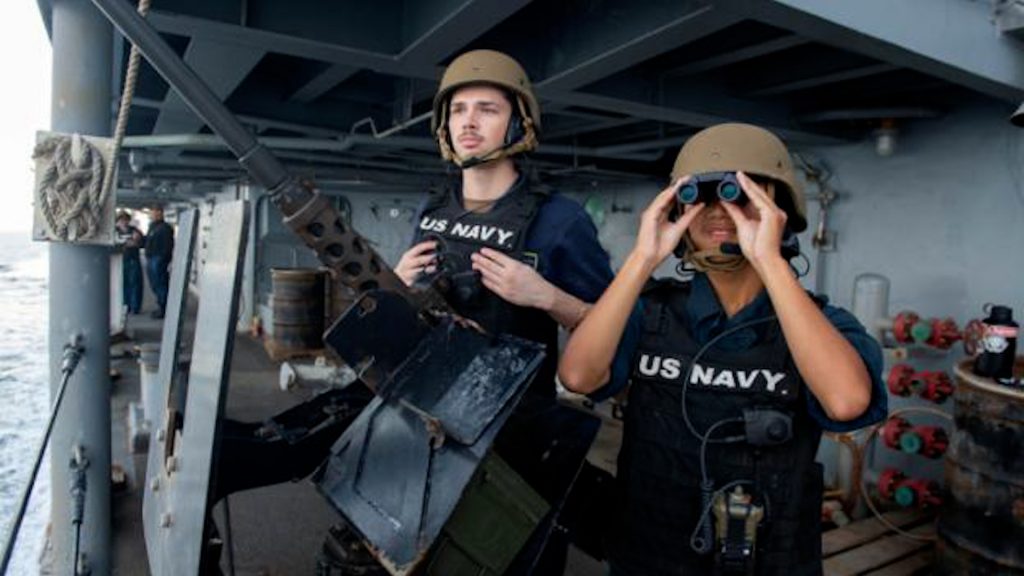
President Donald Trump is demanding that global allies step up and “police” the Strait of Hormuz, a key shipping channel for one-fifth of world oil supplies.
Inside the U.S. Navy’s daily briefings, however, the message is much more cautious.
The Navy has told shipping industry counterparts in near-daily briefings since the war began that it cannot provide military escorts through the Strait of Hormuz “for the time being” because the risk of attack remains too high, Reuters reported. The warning draws a contrast between Trump’s public promises of protection and the operational constraints naval and maritime analysts describe.
Why escorts may not restart normal traffic
Connecting the Persian Gulf and the Gulf of Oman, the Strait of Hormuz is a narrow chokepoint not only for oil tankers but also for ships carrying much of the global supply of liquefied natural gas and fertilizer products.
Even if the U.S. or other countries begin escorting those ships, analysts said it would not erase the core risks that have driven most commercial traffic off the route. Shipping companies, insurers and naval planners would still have to contend with Iranian mines, drones, missiles and small-boat attacks in a confined waterway that is just 21 miles wide at its narrowest point.
What Trump is saying
Trump has framed Hormuz security as a burden that should be shared by countries that depend more heavily on the route. Speaking Sunday aboard Air Force One, he said the U.S. was talking with other countries about “policing the straits,” arguing the U.S. gets “very little” oil through the route while others rely on it far more.
“I’m demanding that these countries come in and protect their own territory because it is their territory,” Trump said. “It’s the place from which they get their energy, and they should come and they should help us protect it.”
U.S. allies are rejecting Trump’s call for help, however.
“This is not our war; we did not start it,” Boris Pistorius, Germany’s defense minister, said, according to The New York Times. British Prime Minister Keir Starmer said the U.K. “will not be drawn into the wider war.” Other leaders have made similar statements, including the European Union’s top diplomat, who said there is no appetite for now to put personnel in harm’s way in the strait.
On Tuesday, Trump criticized European leaders who he said supported the war but refused to help the U.S.
“NATO’s making a very foolish mistake,” Trump said. “We don’t need them, but they should be there.”
One shipping industry source told Reuters that escorts would only become possible once the risk of attack was reduced.
Gen. Dan Caine, chairman of the Joint Chiefs of Staff, said the military is reviewing “a range of options,” while a U.S. official told Reuters the U.S. had not escorted any commercial ships through the strait.
Why escorts are difficult, even if ordered
Even if escorts begin, analysts said the strait’s tight geography, mine and drone threats, and insurers’ risk tolerance could keep traffic far below normal.
The Wall Street Journal emphasized how little room ships and escorts would have to maneuver and how little time crews would have to respond to attacks.
Jennifer Parker, an adjunct fellow in naval studies at the University of New South Wales, Canberra, told CNN that effective escorts would require more than destroyers accompanying tankers. Carl Schuster, a former U.S. Navy captain, said the mission would also need aircraft or helicopters, early warning and reconnaissance capabilities, and missile countermeasures.
The Journal reported that U.S. Navy officers have warned that Iranian drones and anti-ship missiles could turn the strait into a “kill box.” It said escort missions could require large numbers of ships — potentially two ships per tanker or roughly a dozen ships to protect convoys of five to 10 tankers — along with persistent air surveillance and strikes on Iranian launchers.
The paper also cited Lloyd’s List Intelligence as estimating that escorts and limited warship availability could restore traffic to only about 10% of normal levels, leaving a backlog of more than 600 ships that could take months to clear.
Commercial operators would still have to decide whether the route was safe enough to use.
“You would have to convince the insurance and shipping companies it is safe enough to transit,” said Mick Mulroy, a former deputy assistant secretary of defense for the Middle East, according to The Journal.
Analysts told the Journal that normal traffic — described as more than 100 ships a day — would likely require not just escorts, but also an end to the fighting and assurances that attacks will stop.
Ella Rae Greene, Editor In Chief